
Verwandte Artikel zu Provocations for Development
Inhaltsangabe
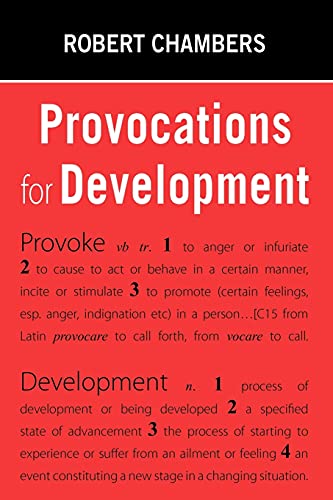
Do we use obscure or fashionable words to impress our colleagues or win research proposals? Are many of our actions against poverty simple, direct and wrong? Provocations for Development is an entertaining and unsettling collection of writings that questions concepts, conventions and practices in development. It is made up of short and accessible writings by Robert Chambers reflecting on the evolution of concepts like participation and of organizations like the World Bank. Besides provocations, there is mischief, verse and serious fun. The book irreverently examines vocabularies of development and how words are instruments of power; challenges concepts of poverty, presents empowering breakthroughs in the current explosion of participatory methodologies; is critical of past and present procedures and practices in aid; points to feasible changes for doing better; touches on values, ethics, gender and participation, immersions, hypocrisy, and paradigms; and finally invites readers to ponder the question 'what would it take to eliminate poverty in the world?'
Die Inhaltsangabe kann sich auf eine andere Ausgabe dieses Titels beziehen.
Über die Autorin bzw. den Autor
Professor Robert Chambers is a research associate of the Institute of Development Studies, Sussex, UK, which has been his base since 1969 with periods in other countries. He is widely recognized as one of the main driving forces behind the great surge of interest in the use of Participatory Rural Appraisal around the world.
Auszug. © Genehmigter Nachdruck. Alle Rechte vorbehalten.
Provocations for Development
By Robert ChambersPractical Action Publishing
Copyright © 2012 Robert Chambers
All rights reserved.
ISBN: 978-1-85339-733-2All rights reserved.
Contents
Cover,
About the author,
Preface,
Acknowledgements,
Part One: Word Play,
Part Two: Poverty and Participation,
Part Three: Aid,
Part Four: To provoke: For our future,
Acronyms,
For starters: assertions to tempt you or turn you off,
Endnote,
PART I,
Introduction: words and concepts,
Words, bingo and reflexivity,
Simple is sophisticated,
The power of words in development,
Words of power,
Participatory GIS,
What's in a name?,
Academic games,
What words count? The Paris Declaration on Aid Effectiveness,
What words and aspirations now?,
PART II,
To provoke: poverty and participation,
What is poverty? Who asks? Who answers?,
Professionals and the powerless: whose reality counts?,
Whose voice? Participatory research and policy change: Foreword, Afterword and Postscript,
Blind spots: hidden, unseen and sensitive dimensions of deprivation,
Poverty in diagrams,
Integrated: seasonal poverty, season blindness,
Two syndromes of seasonality,
For professionals, a time to provoke,
Participation: tyrannical or transformative?,
Negotiated learning: collaborative monitoring in resource management,
Measuring empowerment? Ask them? A win-win in Bangladesh,
Participatory numbers and statistics,
PRA: start, stumble, self-correct, share,
PRA behaviours: 21 do's,
PART III,
Provoking aid,
How development organizations see each other and relate,
Rugby International: UNHCR vs NGOs,
My visit to a rural settlement,
Imposing aid,
ZOPP marries PRA: whose realities, needs and priorities count?,
Reversals, realities and rewards,
On lenders, donors, debt, and development,
On the World Bank,
The World Bank: what next?,
Participation and PRA for donors,
The effectiveness of World Bank support for community-based and -driven development,
What DFID should do,
Aid and the New Bottom Billion: need for a radical rethink?,
The big push back, and the big push forward,
Endnotes,
PART IV,
Introduction,
Whose priorities?,
Objectives for outsiders,
The Myth of Community: gender issues in participatory development,
Transforming power: from zero sum to win-win,
A pedagogy for the powerful,
21 ways to move an organization towards participation,
Livelihoods: sustainable in what sense, and for whom?,
Oh poverty experts! Time to stand on our heads,
Immersions: something is happening,
The World Development Report: concepts, content and a chapter 12,
Development paradigms: neo-Newtonian and adaptive pluralism,
Paradigms, lock-ins and liberations,
Stepping Forward: children's and young people's participation in development,
What would it take to eliminate poverty in the world?,
What would it take to eliminate poverty in the world?,
References,
A few useful websites,
Search terms,
CHAPTER 1
PART I Word Play
Introduction: words and concepts
'When I use a word' Humpty Dumpty said, 'in a rather scornful tone, it means just what I choose it to mean, neither more nor less'
'The question is,' said Alice, 'whether you can make words mean so many different things.'
'The question is,' said Humpty Dumpty, 'which is to be master – that's all.'
Lewis Carroll, Through the Looking Glass and What Alice Found There, 1871 Winnie-the-Pooh sat down at the foot of the tree, put his head between his paws, and began to think. First of all he said to himself: 'That buzzing noise means something. You don't get a buzzing noise like that, just buzzing and buzzing, without its meaning something.'
A.A. Milne, Winnie-the-Pooh, 19261
The words used in development continuously change. Some do become hardy perennials – poverty, gender, sustainability, livelihood – long-term survivors, year on year. Others influence policy, thinking and practice and then are used less and less, perhaps in part because their job is done – basic needs, for instance, and feminism (somewhat surprisingly). Others like coordination and integration have their day, fade away and then revive. Yet others gestate for years and then their moment comes and they are almost everywhere – sustainable livelihoods, social capital, civil society, good governance.
Words can feed cynicism and at the same time be a source of fun. To mock fashions in the lexicon of development we use expressions like buzz words, development-speak, flavours of the month, and PC (politically correct); and we describe acronyms as alphabet soup. Current development-speak words can be used for Development Bingo (aka tombola or houseyhousey), a diverting game that can be played by students during lectures on development and more generally by members of the audience in political fora.
Words, bingo and reflexivity introduces the Development Bingo game in which the columns can list the latest and most used fashionable words, including nowadays acronyms such as MDGs (Millennium Development Goals) and RBM (results-based management) and words like harmonization, capacity development, deliverables, social protection, evidence-based, empowerment, accountability and fragile states. These are ticked as they are mentioned. Development bingo brings triple benefits: it mitigates the ordeal of the listener; it enhances critical awareness; and it startles speakers with suppressed laughter or cries of 'development' when a column is complete. This includes an invitation to list and reflect on your own favourite words.
The Cornwall and Eade book Deconstructing Development Discourse is at once entertaining, enlightening and erudite on the subject of words in development and says almost all that needs to be said. For our purposes here let me underline two points. First, the vagueness of the meanings attributed to the same words by different actors – empowerment and participation are notorious cases – can lead to misunderstanding but is not all bad: for it can also sometimes allow action to go ahead, with the word as a Trojan horse. Second, in contrast, defining what you are going to mean by words, in a talk, lecture, or writing, sharpens thinking and helps communication. These two points are in tension, and it is a matter of tactics and judgement, which should be master when and for whom.
For all the cynicism, critiques, whimsy and fun to which development-speak gives rise, words do matter. In my view they matter hugely. They express concepts. They raise issues. Their choice and meanings reveal and express mindsets. Reflexivity, meaning critical reflection on one's own mindset, and warning readers about this, is fundamental. Then the usages and meanings of words evolve. Identifying new ones that have come into use can show us how thinking and practice have changed and are changing. Development Bingo is in the spirit of serious fun, a source of learning as the listener or reader lists words and checks them off as they are used. Such words and their combinations frame and form our perceptions and thought, structure our mindsets, and influence our actions. As Fritjof Capra (1996: 47) put it:
As humans, we exist in language and we continually weave the linguistic web in...
„Über diesen Titel“ kann sich auf eine andere Ausgabe dieses Titels beziehen.
Suchergebnisse für Provocations for Development

Beispielbild für diese ISBN
Provocations for Development
Anbieter: PBShop.store US, Wood Dale, IL, USA
Verkäuferbewertung 5 von 5 Sternen

PAP. Zustand: New. New Book. Shipped from UK. Established seller since 2000. Artikel-Nr. CX-9781853397332
Beispielbild für diese ISBN
Provocations for Development
Anbieter: PBShop.store UK, Fairford, GLOS, Vereinigtes Königreich
Verkäuferbewertung 5 von 5 Sternen
PAP. Zustand: New. New Book. Shipped from UK. Established seller since 2000. Artikel-Nr. CX-9781853397332
Neu kaufen
EUR 23,83
EUR 4,91 Versand
Versand von Vereinigtes Königreich nach USA
Versand von Vereinigtes Königreich nach USA
Anzahl: 15 verfügbar
Foto des Verkäufers
Provocations for Development
Verlag:
Rugby: Practical Action Publishing, 2012
ISBN 10: 1853397334
ISBN 13: 9781853397332
Gebraucht
Paperback (No Dust Wrapper.)
Signiert
Anbieter: BookLovers of Bath, Peasedown St. John, BATH, Vereinigtes Königreich
Verkäuferbewertung 5 von 5 Sternen
Paperback (No Dust Wrapper.). Zustand: Near Fine. Signed copy. Paperback; Measures Trade Paperback (9¼" x 6") (0.7 kg); pp (xvi) 224; Index; Signed by the author, with dedication, on the half-title page without provenance. Includes: Diagrams; Tables; References; Glossary; || The book is on the shelf, ready to be appropriately packed, and posted from the pastoral paradise of Peasedown St. John, Bath, by a real bookseller in a real book shop - with my personal guarantee and beady eye on the Consumer Contracts Regulations. REMEMBER! Buying my copy means the book shop Jack Russells get their supper! My Book #185627 ||. Artikel-Nr. 185627
Gebraucht kaufen
EUR 15,79
EUR 17,70 Versand
Versand von Vereinigtes Königreich nach USA
Versand von Vereinigtes Königreich nach USA
Anzahl: 1 verfügbar
Beispielbild für diese ISBN
Provocations for Development
Anbieter: Ria Christie Collections, Uxbridge, Vereinigtes Königreich
Verkäuferbewertung 5 von 5 Sternen
Zustand: New. In English. Artikel-Nr. ria9781853397332_new
Neu kaufen
EUR 27,85
EUR 11,05 Versand
Versand von Vereinigtes Königreich nach USA
Versand von Vereinigtes Königreich nach USA
Anzahl: Mehr als 20 verfügbar
Beispielbild für diese ISBN
Provocations for Development
Anbieter: Revaluation Books, Exeter, Vereinigtes Königreich
Verkäuferbewertung 5 von 5 Sternen
Paperback. Zustand: Brand New. 248 pages. 9.13x6.14x0.71 inches. In Stock. Artikel-Nr. x-1853397334
Neu kaufen
EUR 32,46
EUR 11,80 Versand
Versand von Vereinigtes Königreich nach USA
Versand von Vereinigtes Königreich nach USA
Anzahl: 2 verfügbar