
Verwandte Artikel zu Small-Scale Food Processing: A directory of equipment...
Inhaltsangabe
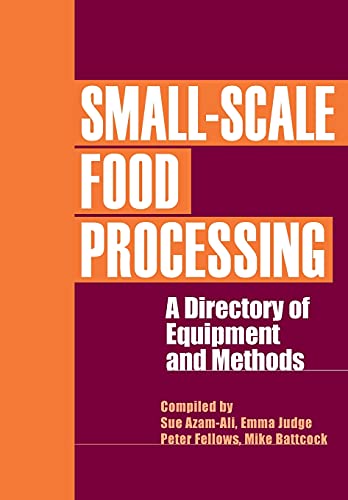
This completely revised and expanded second edition is the essential reference guide for all those involved in food processing on a small- or medium-scale. Extensively illustrated, clearly laid out and easy to use. A vital reference tool for business advisers and trainers, development workers and food processing.
Die Inhaltsangabe kann sich auf eine andere Ausgabe dieses Titels beziehen.
Über die Autorinnen und Autoren
Dr Peter Fellows is a consultant food technologist specializing in small-scale food processing. Previously he taught food technology at Oxford Brookes University, worked for Practical Action, and has held the UNESCO Chair in Post-Harvest Technology at Makerere University, Uganda. He has practical experience of assisting small-scale food processors in 20 countries and has published 33 books and 40 articles on food processing.
Susan Azam-Ali is Assistant Professor, Faculty of Science at the University of Notthingham.
Auszug. © Genehmigter Nachdruck. Alle Rechte vorbehalten.
Small-Scale Food Processing
A Directory of Equipment and Methods
By Sue Azam-Ali, Emma Judge, Peter Fellows, Mike BattcockPractical Action Publishing Ltd
Copyright © 2003 ITDG Publishing
All rights reserved.
ISBN: 978-1-85339-504-8All rights reserved.
Contents
Acknowledgements, vi,
Preface, vii,
Introduction, 1,
How to use this book, 7,
I PRINCIPLES OF FOOD PRESERVATION, 9,
Food spoilage, 11,
Methods of food preservation, 14,
Food safety, hygiene and quality assurance, 22,
Packaging, 27,
II PROCESSING OF FOOD GROUPS, 35,
Fruits and vegetables, 37,
Root crops, 62,
Cereals and pulses, 71,
Oil-seeds and nuts, 86,
Honey, syrups and sugar confectionery, 94,
Meat and fish products, 103,
Dairy products, 115,
III DIRECTORY, 127,
Equipment directory, 129,
Manufacturers directory, 209,
IV REFERENCE SECTION,
Glossary, 231,
References and further reading, 239,
Index, 242,
Improvements to this book, 247,
Questionnaire, 248,
CHAPTER 1
PRINCIPLES OF FOOD PRESERVATION
Food spoilage
From the moment foods are harvested or slaughtered they deteriorate and eventually become unfit or unsafe for consumption. One of the main purposes of food processing is to prevent or slow down this deterioration. Food spoilage is brought about by a combination of physical damage (e.g. bruising or cuts to the surface of fruits and vegetables), chemical and biochemical reactions (e.g. development of rancidity in fats or colour changes in fruits and vegetables due to enzyme activity), and changes caused by micro-organisms, such as the growth of mould or slime on the food surface and changes in texture and taste of foods.
Physical damage
Raw foods, especially fruit and vegetables, are very susceptible to physical damage. Poor handling at harvest or during transport leads to damage to the tissues, which are then more susceptible to biochemical changes and invasion and spoilage by microorganisms. Physical damage can be reduced by careful post-harvest handling and storage, and the use of containers instead of dumping foods in piles or in the backs of vehicles.
Enzyme activity
Enzymes are present in all living tissues and control the growth and development of the plant or animal. They continue to act after harvest or slaughter, causing undesirable changes in the appearance, taste and texture of foods. The ripening of fruits after harvest is also due to enzyme activity. When most plant materials are cut and exposed to air, enzymes present in the cells cause colourless chemicals to be converted into brown coloured compounds (known as enzymic browning). Enzymes that are produced by micro-organisms cause similar biochemical changes to foods to produce unpleasant and sometimes toxic products.
Damage caused by enzyme activity can be controlled by heating the food to denature the enzymes. Boiling, frying, pasteurization and canning are all heating methods that reduce enzyme activity. Blanching of vegetables is used before other forms of processing such as drying or freezing which do not heat the food sufficiently to destroy the enzymes. Alternatively, enzyme activity can be inhibited by changing the level of acidity, excluding air, or reducing the moisture content in some foods.
Chemical changes
Non-enzymic browning is a chemical reaction that takes place in foods, leading to browning of the material. In some instances, such as in the browning of bread crust and toasting of cereals, this produces desirable flavours and colours. However, in other foods such as dried milk it leads to the production of undesirable brown colours. It can be reduced by a number of methods: lowering the temperature of storage, optimizing the moisture content (the reaction rate is lowest at very high and very low moisture contents), increasing the acidity or using chemicals such as sulphur dioxide.
When foods are exposed to air, fats and oils are prone to oxidation which results in the development of off flavours and a reduction in nutritional value. This is a particular problem in oily fish and cooking oils. Oxidation is promoted by sunlight and some metals (e.g. copper and brass) which should not be used as containers for fatty foods. Oxidative changes can be prevented by excluding air with airtight packaging and keeping foods cool and away from light. At a more sophisticated level of technology, flushing foods with nitrogen or carbon dioxide gases before packaging in an airtight light-proof container can prevent oxidation.
Microbial spoilage and food poisoning
Micro-organisms live in abundance all around us in the soil, in water and air, and in the digestive tracts of animals. The three main types that are important in food processing are yeasts, moulds and bacteria, although viruses may also be important in particular foods (e.g. milk). Given the correct conditions for growth, micro-organisms multiply rapidly, causing undesirable changes to foods including changes to the taste, texture and appearance. Sometimes there is visible damage such as slime formation or the growth of moulds; often there is an offensive odour, particularly if proteins are broken down, and some foods may develop a bitter or acidic off flavour.
Microbial contamination of foods is wasteful but it can also be harmful, and in some cases life-threatening if food-poisoning bacteria (or 'pathogens') are present. They can be transmitted to foods by a number of routes: by animals, insects or birds that come into contact with foods, packaging materials or equipment; by poor personal hygiene of food handlers; or by cross-contamination from raw materials to a processed food via surfaces, utensils, equipment or human hands. Methods to control and prevent food poisoning by good hygiene and quality assurance are described in the chapter on Food safety, hygiene and quality assurance.
Food poisoning can be caused by eating the bacteria themselves, or by poisons (or 'toxins') that the micro-organisms release into the food. If this occurs and the microorganisms are then killed by processing, the poisons can remain in the food unseen (for example, aflatoxin, which is produced by a mould in poorly dried cereals and nuts – see Part II). Some types of micro-organisms also produce dormant spores which can regrow when conditions become favourable. This can be a source of contamination and potential food poisoning in dried foods which are subsequently rehydrated. The symptoms of an attack of food poisoning can include stomach pains, diarrhoea, vomiting, headache, fever and aching limbs. Sometimes the illness lasts for days, weeks or months, and in some cases it can kill.
However, not all microbial activity in foods is undesirable. Yeasts are used to leaven bread and produce alcohol by fermentation of fruits and grains. A number of foods are preserved by the action of micro-organisms, especially lactic acid bacteria which are used in vegetable, meat and dairy fermentations (see Part II). Moulds are used for the production of tempeh from soybeans, in some types of cheese and for development of flavours in a number of other fermented foods.
The factors that control microbial growth, and hence the risk of spoilage or food poisoning, are temperature, acidity, moisture content, presence of air and the concentration of salts or sugar. Control of these factors is the basis of most methods of food preservation.
Temperature
Micro-organisms have an optimum...
„Über diesen Titel“ kann sich auf eine andere Ausgabe dieses Titels beziehen.
Suchergebnisse für Small-Scale Food Processing: A directory of equipment...

Beispielbild für diese ISBN
Small-Scale Food Processing
Anbieter: PBShop.store UK, Fairford, GLOS, Vereinigtes Königreich
Verkäuferbewertung 5 von 5 Sternen

PAP. Zustand: New. New Book. Shipped from UK. Established seller since 2000. Artikel-Nr. CX-9781853395048
Neu kaufen
EUR 28,58
EUR 5,84 Versand
Versand von Vereinigtes Königreich nach USA
Versand von Vereinigtes Königreich nach USA
Anzahl: 15 verfügbar
Beispielbild für diese ISBN
Small-Scale Food Processing
Anbieter: PBShop.store US, Wood Dale, IL, USA
Verkäuferbewertung 5 von 5 Sternen
PAP. Zustand: New. New Book. Shipped from UK. Established seller since 2000. Artikel-Nr. CX-9781853395048
Beispielbild für diese ISBN
Small-Scale Food Processing: A directory of equipment and methods.
Anbieter: Ria Christie Collections, Uxbridge, Vereinigtes Königreich
Verkäuferbewertung 5 von 5 Sternen
Zustand: New. In English. Artikel-Nr. ria9781853395048_new
Neu kaufen
EUR 33,37
EUR 13,13 Versand
Versand von Vereinigtes Königreich nach USA
Versand von Vereinigtes Königreich nach USA
Anzahl: Mehr als 20 verfügbar
Foto des Verkäufers
Small-Scale Food Processing : A Directory of Equipment and Methods.
Verlag:
Practical Action Publishing Dez 2003, 2003
ISBN 10: 1853395048
ISBN 13: 9781853395048
Neu
Taschenbuch
Anbieter: AHA-BUCH GmbH, Einbeck, Deutschland
Verkäuferbewertung 5 von 5 Sternen
Taschenbuch. Zustand: Neu. Neuware - This completely revised and expanded second edition is the essential reference guide for all those involved in food processing on a small- or medium-scale. Extensively illustrated, clearly laid out and easy to use. A vital reference tool for business advisers and trainers, development workers and food processing. Artikel-Nr. 9781853395048
Neu kaufen
EUR 43,80
EUR 35,00 Versand
Versand von Deutschland nach USA
Versand von Deutschland nach USA
Anzahl: 2 verfügbar
Beispielbild für diese ISBN
Small-Scale Food Processing: A Directory of Equipment and Methods
Anbieter: Revaluation Books, Exeter, Vereinigtes Königreich
Verkäuferbewertung 5 von 5 Sternen
Paperback. Zustand: Brand New. 2nd sub edition. 248 pages. 9.75x7.25x0.75 inches. In Stock. Artikel-Nr. x-1853395048
Neu kaufen
EUR 64,97
EUR 14,53 Versand
Versand von Vereinigtes Königreich nach USA
Versand von Vereinigtes Königreich nach USA
Anzahl: 2 verfügbar
Foto des Verkäufers
Small-Scale Food Processing
Anbieter: moluna, Greven, Deutschland
Verkäuferbewertung 5 von 5 Sternen
Zustand: New. Über den AutorDr Peter Fellows is a food technologist with over 20 years experience in small-scale food processing in Africa and Asia. He has been Senior Technical Manager with ITDG and Senior Lecturer at Oxford Polytechnic. Susan . Artikel-Nr. 597114112
Neu kaufen
EUR 34,09
EUR 48,99 Versand
Versand von Deutschland nach USA
Versand von Deutschland nach USA
Anzahl: Mehr als 20 verfügbar