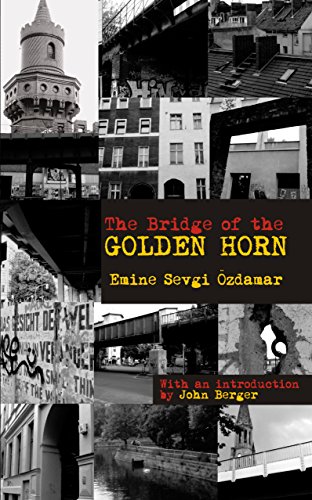
Inhaltsangabe
“There is something about the way she tells a story that would make her words sparkle under any circumstances, and in any tongue.”—Financial Times
“Ermine Sevgi Ozdamar writes with wisdom and humor…(The Bridge of the Golden Horn) is an appealing tale about a young immigrant who discovers herself through politics, sex and the arts.”—Foreword Magazine
In 1966, a sixteen-year-old girl leaves Istanbul and signs up as a migrant worker in Germany.The Bridge of the Golden Horn is a witty, picaresque account of a precocious teenager refusing to become wise and the story of a young woman who is obsessed with theater, poetry, and left-wing politics.
Emine Sevgi Özdamar was born in Turkey and now lives in Berlin, where she has directed in the theater and written plays. Her other books include the novelLife is a Caravanserei.
Die Inhaltsangabe kann sich auf eine andere Ausgabe dieses Titels beziehen.
Über die Autorinnen und Autoren
Emine Sevgi Özdamar was born in Turkey and now lives in Berlin. She attended drama school in Istanbul and has appeared in major theatrical productions in Germany, Vienna, Avignon and Paris as well as in films. She has also directed in the theatre and written plays. Her other books include the novel Life is a Caravanserei.
Martin Chalmers is a writer, editor and translator. He has translated novels and short story collections by Erich Fried, Ernst Weiss, Herta Muller, Hubert Fichte, and Bertolt Brecht.
Auszug. © Genehmigter Nachdruck. Alle Rechte vorbehalten.
The Bridge of the Golden Horn - John Berger's Introduction
Leadtext: Cultural theorist, writer and art critic John Berger is such an ardent fan of Sevgi's work that he penned this introduction to her novel, The Bridge of the Golden Horn.
About Badness
by John Berger
It's difficult for me to comment on Sevgi's writing because I love it, and analysing something you love is a daft activity. Of course she's a story-teller, an irresistible all-night story-teller, and late in the morning wakes up telling another story. And what makes her stories so rich and necessary? Necessary because when you hear them, you realise the extent of the emptiness they have filled.
What they offer is often lacking today. I'm not sure whether this is an historical remark, what do you think, Sevgi?
Perhaps story-tellers have always been listened to because they fill a lack. Stories never concur with the official version of events which, by definition, is the version of those visibly in power. The story-teller by contrast is invisible except when telling her or his story.
And the magic of a story is always invisible for it finally derives, not from the story being told with all its described incidents and carefully drawn characters, but from the voice telling it. Is her voice feminine? Immensely so, but often not. She can talk about sex like a man. She talks about dreams like a child. She talks about the cruelty of the existent like a grandparent. Her voice changes age from sentence to sentence. And what is between its legs changes too. [I put it like this for a word like gender would never pass her voice's lips.]
The first thing you might think about her voice is that it exaggerates. Yet this is not as simple as it sounds, for the essential difference between information and a story is that the latter always exaggerates! Without exaggeration there would be no stories. Exaggeration begins as soon as feelings are shared.
Stories exaggerate some things and understate others, and it's this which allows the path of a story to go up and down hill. Talking of downhill, Sevgi is, on certain occasions, the fastest story-teller I know. You sit pillion behind her, arm round her waist, and when you corner your knee grazes the ground.
Re-look at the verb exaggerate Exaggeration relates to what is normally said. Exaggeration is to go beyond those norms. When referring directly to reality, is it possible to exaggerate?
In its cruelties, its injustices, its repetitiveness, and its gifts, there is nothing more exaggerated than reality. Governors, ruling class, bureaucrats, moralists, judges ceaselessly pretend that reality is not exaggerated. Slaves, citizens, scammers, know otherwise, and mostly they keep quiet about it - except when they are asleep and dream. They is why stories fill the emptiness created by all the official pretences that reality is not exaggerated
At one moment - towards the very end of the book - Sevgi listens to many mothers crossing the Bridge of the Golden Horn. "They didn't say anything, but I heard their voices." And the voices say: "With these eyes in this blind world we have seen the Day of Judgement."
The great stories she tells her are all about badness, and about those whom the official versions of what's happening in the world continually fix the label bad to.
Her stories are the opposite of what mothers tell their young children. They are, however, what the mothers live with.
They are about poverty, betrayals, disobedience, cruelties, desperation, wild hopes, lies, deceits, vengeance, pain, helplessness, pain again, endurance, cowardice, taking unreasonable risks and fury.
Thanks to her stories the listener learns how the bad suddenly and unexpectedly contains the good. Yet the trick of telling the difference between the two is hidden in each story and cannot be transferred to another.
So there's no golden rule? No, never. If there's a very approximate rule, it's this: As soon as it's big, forget it. Only what is small can grasp what is immense and what matters!
Since their beginning stories have pretended to take place far away. Faraway and once-upon-a-time are code words for Here and Now. Just as information is the opposite of stories, informers are the opposite of story-tellers. When a story is being retold every word becomes a code-word describing a Here and Now.
And saying this makes me suddenly wonder whether Sevgi's voice is not her whole body? Her whole body throughout her entire life. Her whole body entering the listener's ear! It could be that this contortionist act - funny, grotesque, beautiful, incredible (of course you don't believe it) - is the secret of Sevgi's great storytelling!
Yes, she's laughing - and we join her....
„Über diesen Titel“ kann sich auf eine andere Ausgabe dieses Titels beziehen.
Weitere beliebte Ausgaben desselben Titels

Suchergebnisse für The Bridge of the Golden Horn

Beispielbild für diese ISBN
The Bridge of the Golden Horn
Anbieter: Better World Books: West, Reno, NV, USA
Verkäuferbewertung 5 von 5 Sternen

Zustand: Good. Used book that is in clean, average condition without any missing pages. Artikel-Nr. 4030801-6
Foto des Verkäufers
The Bridge of the Golden Horn
Anbieter: WeBuyBooks, Rossendale, LANCS, Vereinigtes Königreich
Verkäuferbewertung 5 von 5 Sternen
Zustand: Like New. Most items will be dispatched the same or the next working day. An apparently unread copy in perfect condition. Dust cover is intact with no nicks or tears. Spine has no signs of creasing. Pages are clean and not marred by notes or folds of any kind. Artikel-Nr. wbs4705463196
Gebraucht kaufen
EUR 6,37
Versand:
EUR 6,43
Von Vereinigtes Königreich nach USA
Anzahl: 1 verfügbar
Beispielbild für diese ISBN
The Bridge of the Golden Horn
Anbieter: Better World Books Ltd, Dunfermline, Vereinigtes Königreich
Verkäuferbewertung 5 von 5 Sternen
Zustand: Good. Ships from the UK. Used book that is in clean, average condition without any missing pages. Artikel-Nr. 4030801-6
Gebraucht kaufen
EUR 5,57
Versand:
EUR 9,10
Von Vereinigtes Königreich nach USA
Anzahl: 1 verfügbar
Beispielbild für diese ISBN
The Bridge of the Golden Horn
Anbieter: medimops, Berlin, Deutschland
Verkäuferbewertung 5 von 5 Sternen
Zustand: good. Befriedigend/Good: Durchschnittlich erhaltenes Buch bzw. Schutzumschlag mit Gebrauchsspuren, aber vollständigen Seiten. / Describes the average WORN book or dust jacket that has all the pages present. Artikel-Nr. M01852429321-G
Gebraucht kaufen
EUR 16,53
Versand:
EUR 105,00
Von Deutschland nach USA
Anzahl: 1 verfügbar