
Verwandte Artikel zu Discrete-time Stochastic Systems: Estimation And Control...
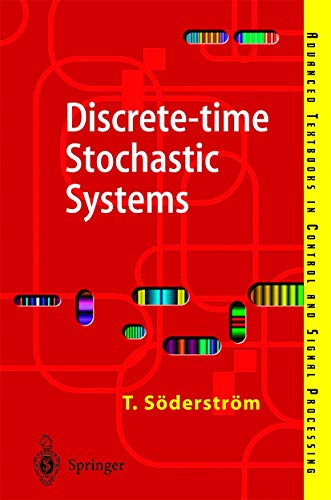
Discrete-time Stochastic Systems: Estimation And Control (Advanced Textbooks in Control and Signal Processing) - Softcover
Inhaltsangabe
Discrete-time Stochastic Systems gives a comprehensive introduction to the estimation and control of dynamic stochastic systems and provides complete derivations of key results such as the basic relations for Wiener filtering. The book covers both state-space methods and those based on the polynomial approach. Similarities and differences between these approaches are highlighted. Some non-linear aspects of stochastic systems (such as the bispectrum and extended Kalman filter) are also introduced and analysed. The books chief features are as follows: * inclusion of the polynomial approach provides alternative and simpler computational methods than simple reliance on state-space methods; * algorithms for analysis and design of stochastic systems allow for ease of implementation and experimentation by the reader; * the highlighting of spectral factorization gives appropriate emphasis to this key concept often overlooked in the literature; * explicit solutions of Wiener problems are handy schemes, well suited for computations compared with more commonly available but abstract formulations; * complex-valued models that are directly applicable to many problems in signal processing and communications. Changes in the second edition include: * additional information covering spectral factorisation and the innovations form; * the chapter on optimal estimation being completely rewritten to focus on a posteriori estimates rather than maximum likelihood; * new material on fixed lag smoothing and algorithms for solving Riccati equations are improved and more up to date; * new presentation of polynomial control and new derivation of linear-quadratic-Gaussian control. Discrete-time Stochastic Systems is primarily of benefit to students taking M.Sc. courses in stochastic estimation and control, electronic engineering and signal processing but may also be of assistance for self study and as a reference.
Die Inhaltsangabe kann sich auf eine andere Ausgabe dieses Titels beziehen.
Über die Autorin bzw. den Autor
Torsten Söderström received a PhD degree in automatic control in 1973, from Lund Institute of Technology, Sweden. He is a Life Fellow of IEEE, and an IFAC Fellow. Since 1974, he has been with the Division of Systems and Control at Uppsala University, where he is now a professor emeritus of automatic control. His main research interests are in the fields of system identification and estimation. In these areas he has published numerous papers, and is the co-author of four books. In 1981 he was given an Automatica Paper Prize Award along with other co-authors. He has been the Automatica editor for the area of system identification since 1992.
Von der hinteren Coverseite
Discrete-time Stochastic Systems gives a comprehensive introduction to the estimation and control of dynamic stochastic systems and provides complete derivations of key results such as the basic relations for Wiener filtering. The book covers both state-space methods and those based on the polynomial approach. Similarities and differences between these approaches are highlighted. Some non-linear aspects of stochastic systems (such as the bispectrum and extended Kalman filter) are also introduced and analysed. The books chief features are as follows:
• inclusion of the polynomial approach provides alternative and simpler computational methods than simple reliance on state-space methods;
• algorithms for analysis and design of stochastic systems allow for ease of implementation and experimentation by the reader;
• the highlighting of spectral factorization gives appropriate emphasis to this key concept often overlooked in the literature;
• explicit solutions of Wiener problems are handy schemes, well suited for computations compared with more commonly available but abstract formulations;
• complex-valued models that are directly applicable to many problems in signal processing and communications.
Changes in the second edition include:
• additional information covering spectral factorisation and the innovations form;
• the chapter on optimal estimation being completely rewritten to focus on a posteriori estimates rather than maximum likelihood;
• new material on fixed lag smoothing and algorithms for solving Riccati equations are improved and more up to date;
• new presentation of polynomial control and new derivation of linear-quadratic-Gaussian control.
Discrete-time Stochastic Systems is primarily of benefit to students taking M.Sc. courses in stochastic estimation and control, electronic engineering and signal processing but mayalso be of assistance for self study and as a reference.
„Über diesen Titel“ kann sich auf eine andere Ausgabe dieses Titels beziehen.
Suchergebnisse für Discrete-time Stochastic Systems: Estimation And Control...

Beispielbild für diese ISBN
Discrete-Time Stochastic Systems: Estimation and Control (Advanced Textbooks in Control and Signal Processing)
Anbieter: Anybook.com, Lincoln, Vereinigtes Königreich
Verkäuferbewertung 5 von 5 Sternen

Zustand: Fair. This is an ex-library book and may have the usual library/used-book markings inside.This book has soft covers. In fair condition, suitable as a study copy. Library sticker on front cover. Please note the Image in this listing is a stock photo and may not match the covers of the actual item,700grams, ISBN:9781852336493. Artikel-Nr. 4324822
Gebraucht kaufen
EUR 69,88
EUR 15,41 Versand
Versand von Vereinigtes Königreich nach USA
Versand von Vereinigtes Königreich nach USA
Anzahl: 1 verfügbar
Beispielbild für diese ISBN
Discrete-time Stochastic Systems
Anbieter: Ria Christie Collections, Uxbridge, Vereinigtes Königreich
Verkäuferbewertung 5 von 5 Sternen
Zustand: New. In English. Artikel-Nr. ria9781852336493_new
Neu kaufen
EUR 95,54
EUR 13,34 Versand
Versand von Vereinigtes Königreich nach USA
Versand von Vereinigtes Königreich nach USA
Anzahl: Mehr als 20 verfügbar
Foto des Verkäufers
DISCRETE-TIME STOCHASTIC SYSTEMS
Anbieter: Stella & Rose's Books, PBFA, Tintern, MON, Vereinigtes Königreich
Verkäuferbewertung 5 von 5 Sternen
Softcover. Zustand: Fine. No Jacket. 2nd 2002. Fine condition. Advanced Textbooks in Control and Signal Processing. Card wraps. 375 pages. Minimal rubbing to corners. Circular blind stamp to first page. Packaged with care and promptly dispatched! Artikel-Nr. 597585
Gebraucht kaufen
EUR 97,10
EUR 20,58 Versand
Versand von Vereinigtes Königreich nach USA
Versand von Vereinigtes Königreich nach USA
Anzahl: 1 verfügbar
Foto des Verkäufers
Discrete-time Stochastic Systems : Estimation and Control
Anbieter: AHA-BUCH GmbH, Einbeck, Deutschland
Verkäuferbewertung 5 von 5 Sternen
Taschenbuch. Zustand: Neu. Druck auf Anfrage Neuware - Printed after ordering - Discrete-time Stochastic Systems gives a comprehensive introduction to the estimation and control of dynamic stochastic systems and provides complete derivations of key results such as the basic relations for Wiener filtering. The book covers both state-space methods and those based on the polynomial approach. Similarities and differences between these approaches are highlighted. Some non-linear aspects of stochastic systems (such as the bispectrum and extended Kalman filter) are also introduced and analysed. The books chief features are as follows: inclusion of the polynomial approach provides alternative and simpler computational methods than simple reliance on state-space methods; algorithms for analysis and design of stochastic systems allow for ease of implementation and experimentation by the reader; the highlighting of spectral factorization gives appropriate emphasis to this key concept often overlooked in the literature; explicit solutions of Wiener problems are handy schemes, well suited for computations compared with more commonly available but abstract formulations; complex-valued models that are directly applicable to many problems in signal processing and communications. Changes in the second edition include: additional information covering spectral factorisation and the innovations form; the chapter on optimal estimation being completely rewritten to focus on a posterior estimates rather than maximum likelihood; new material on fixed lag smoothing and algorithms for solving Riccati equations are improved and more up to date; new presentation of polynomial control and new derivation of linear-quadratic-Gaussian control. Discrete-time Stochastic Systems is primarily of benefit to students taking M.Sc. courses in stochastic estimation and control, electronic engineering and signal processing but may also be of assistance for self study and as a reference. Artikel-Nr. 9781852336493
Neu kaufen
EUR 91,42
EUR 35,00 Versand
Versand von Deutschland nach USA
Versand von Deutschland nach USA
Anzahl: 1 verfügbar