
Verwandte Artikel zu Electron Paramagnetic Resonance: Volume 24 (A Specialist...
Inhaltsangabe
The topics covered in this series describe contrasting types of Electron Paramagnetic Resonance (EPR) application, including EPR studies of free-radical reactions in biology and medically-related systems, experimental developments and applications involving EPR imaging, the use of very high fields, and time-resolved methods. EPR applications remain very significant in modern science and this volume compiles critical coverage of developments in the recent literature by a hand-picked group of researchers at the cutting-edge of the field.
Die Inhaltsangabe kann sich auf eine andere Ausgabe dieses Titels beziehen.
Von der hinteren Coverseite
With contributions from leaders in the field Specialist Periodical Reports provide a unique resource for the active research chemist, presenting critical and in-depth reviews of major developments in recent chemical research. Subject coverage between volumes is similar, with publication on a biennial basis.
As Electron Paramagnetic Resonance continues to find new applications in virtually all areas of modern science, including physics, chemistry, biology and materials science, this series caters not only for experts in the field, but also those wishing to gain a general overview of EPR applications in a given area. Chapters include ‘Dynamic nuclear polarisation’, ‘Site directed spin labelling’, and ‘Homogeneous catalysis’.
Auszug. © Genehmigter Nachdruck. Alle Rechte vorbehalten.
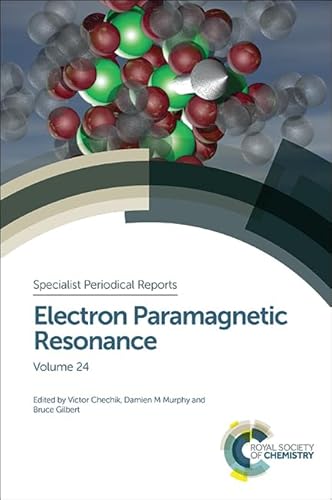
Electron Paramagnetic Resonance Volume 24
By Emma Carter, Yuan Ding, Sergei A. Dzuba, Günter Grampp, Daniel R. Kattnig, Derek Marsh, Boryana Mladenova, Gavin W. Morley, Damien M. Murphy, Phuong Nguyen, Vasily S. Oganesyan, Peter Z. Qin, Kenneth Rasmussen, Carolina Vazquez Reyes, Narin S. Tangprasertchai, Maxim Yulikov, Xiaojun Zhang, Bruce Gilbert, Victor Chechik, Damien M MurphyThe Royal Society of Chemistry
Copyright © 2015 The Royal Society of Chemistry
All rights reserved.
ISBN: 978-1-84973-981-8All rights reserved.
Contents
Preface, v,
Spectroscopically orthogonal spin labels and distance measurements in biomolecules Maxim Yulikov, 1,
1 Introduction, 1,
2 DEER in Gd(III)–nitroxide pairs, 5,
3 Relaxation enhancement in the Dy(III)–nitroxide pairs, 14,
4 General discussion and future perspectives, 24,
5 Conclusion, 28,
Acknowledgements, 28,
References, 28,
Computational approaches for simulating motional EPR spectra Vasily S. Oganesyan, 32,
1 Introduction, 32,
2 Approaches to model motional CW EPR spectra, 35,
3 Applications of the SLE approach and further developments, 37,
4 Trajectory based EPR simulation approach, 38,
5 Bridging MD calculations with the simulation of EPR spectra, 44,
6 Further advances in MD–EPR simulation approaches, 52,
7 Magnetic tensors by DFT calculations, 56,
8 Conclusions and future perspectives, 56,
Acknowledgements, 57,
References, 58,
Towards spintronic quantum technologies with dopants in silicon Gavin W. Morley, 62,
1 Introduction to phosphorus dopants in silicon (Si:P) as a model system for electron paramagnetic resonance (EPR), 62,
2 Requirements and proposals for quantum technologies, 63,
3 Atomic scale fabrication with scanning tunneling microscopy (STM), 68,
4 Bound excitons for dynamic nuclear polarization (DNP) and spin readout, 68,
5 Bismuth dopants in silicon (Si:Bi), 70,
6 Electrically-detected magnetic resonance (EDMR), 72,
7 Conclusions and outlook, 72,
Acknowledgements, 73,
References, 73,
3 EPR spectroscopy in room temperature ionic liquids Günter Grampp, Daniel R. Kattnig, Boryana Mladenova and Kenneth Rasmussen, 77,
1 Introduction, 77,
2 EPR spectroscopy in ionic liquids, 79,
Acknowledgements, 98,
References, 98,
ESEEM of spin labels to study intermolecular interactions, molecular assembly and conformation Sergei A. Dzuba and Derek Marsh, 102,
1 Introduction, 102,
2 Methodology, 103,
3 Applications, 110,
4 Conclusions, 119,
Acknowledgements, 120,
References, 120,
Nucleic acid structure and dynamics: perspectives from site-directed spin labeling Yuan Ding, Phuong Nguyen, Narin S. Tangprasertchai, Carolina Vazquez Reyes, Xiaojun Zhang and Peter Z. Qin, 122,
1 Introduction, 122,
2 Chemical strategies for introducing spin labels at specific sites of nucleic acids, 123,
3 Structural and dynamic information derived from singly-attached nitroxide spin labels, 126,
4 Deriving structural information using distances measured with spin labels, 133,
5 Spin-labeling in NMR and EPR-NMR studies of nucleic acids, 142,
6 Conclusions and perspectives, 142,
References, 143,
Homogeneous catalytic transformations investigated by EPR spectroscopy Emma Carter and Damien M. Murphy, 148,
1 Introduction, 148,
2 Catalytic transformations, 149,
3 Reactive intermediates, 175,
4 Conclusions and perspectives, 188,
References, 188,
CHAPTER 1
Spectroscopically orthogonal spin labels and distance measurements in biomolecules
Maxim Yulikov DOI: 10.1039/9781782620280-00001
Essential details of two techniques for distance measurements between non-identical spin labels are summarized. One technique is based on double electron–electron resonance (DEER) between Gd(III) ions and nitroxide radicals. The other technique is based on indirect measurements of stochastic dipolar interaction between Ln(III) ions and organic radicals via the change of longitudinal relaxation of the latter species. Combination of these techniques with double electron–electron resonance in pairs of identical spin labels (nitroxide–nitroxide or Gd(III)–Gd(III)) allows to suggest a new experimental strategy for multiple distance measurements in orthogonally-labelled samples. General discussion of advantages and disadvantages of the new strategy for studies of biomacromolecules and their complexes is given along with illustrative experimental examples. In particular, performance of Gd(III)–nitroxide DEER is compared to other possible combinations of nonidentical spin label pairs, while relaxation enhancement in pairs Fe(III)–organic radical is compared to the case of Dy(III)–nitroxide pairs.
1 Introduction
EPR-based techniques to measure nanometre range distances are nowadays recognized as a valuable tool in studies of structure and conformational changes of biomacromolecules. A typical approach uses some type of nitroxide-based spin labels, which are selectively attached to specific sites. The distances between pairs of these spin labels are then measured by some appropriate pulse EPR technique, most commonly, by the dead-time-free 4-pulse double electron –electron resonance (DEER) experiment.
As the field of structural and molecular biology proceeds towards more and more demanding objects, such as multi-subunit complexes in solution or in lipid membranes, development of appropriate EPR methodologies becomes necessary. For instance, while being proved to be robust and sensitive, the nitroxide-based approach does not allow distinguishing between specific labelling sites, because two nitroxide labels are typically very difficult to distinguish spectroscopically. Thus, measurement of the properties of the local environment for a spin label at a particular site requires additional singly-labelled samples. Furthermore, in multiple-subunit systems one is restricted to labelling only two sites per biomolecular complex, otherwise interpretation of the distance distribution gets difficult, as all pairwise distance distributions overlap and cannot be separated from each other. Further difficulties may be caused by the appearance of combination frequencies in the DEER experiment on multiply-labelled biomolecules.
The number of labelled sites and, thus, the accessible number of distances can be increased by employing non-identical types of spin labels. In this chapter we will discuss an approach of using distinct types of labels for each labelling site in a biomolecule or biomolecular complex under study. We will mainly concentrate on combining nitroxide radicals with chelate complexes of different lanthanide ions, but other spectroscopic selection options tested so far will be shortly reviewed as well. After providing general introduction in the following part of this section, Sections 2 and 3 will give details of two particular distance measurement approaches for the lanthanide–nitroxide pairs. In Section 4 we will attempt to formulate perspectives of this EPR methodology and discuss its current state of development.
1.1 Brief overview of the spectroscopically-selective spin label pairs for DEER spectroscopy
The idea of having two non-identical spin labels that can be distinguished spectroscopically appeared rather early after DEER (sometimes also called PELDOR) and related techniques have attracted considerable attention....
„Über diesen Titel“ kann sich auf eine andere Ausgabe dieses Titels beziehen.
Suchergebnisse für Electron Paramagnetic Resonance: Volume 24 (A Specialist...

Beispielbild für diese ISBN
ELECTRON PARAMAGNETIC RESONANCE: VOLUME 24 (SPECIALIST PERIODICAL REPORTS)
Anbieter: Romtrade Corp., STERLING HEIGHTS, MI, USA
Verkäuferbewertung 5 von 5 Sternen

Zustand: New. This is a Brand-new US Edition. This Item may be shipped from US or any other country as we have multiple locations worldwide. Artikel-Nr. ABBB-181676
Beispielbild für diese ISBN
Electron Paramagnetic Resonance: Volume 24 (Specialist.
Anbieter: Majestic Books, Hounslow, Vereinigtes Königreich
Verkäuferbewertung 4 von 5 Sternen

Zustand: New. Artikel-Nr. 126403125
Neu kaufen
EUR 283,06
EUR 7,76 Versand
Versand von Vereinigtes Königreich nach USA
Versand von Vereinigtes Königreich nach USA
Anzahl: 1 verfügbar
Foto des Verkäufers
Electron Paramagnetic Resonance
Anbieter: moluna, Greven, Deutschland
Verkäuferbewertung 5 von 5 Sternen
Zustand: New. The topics covered in this series describe contrasting types of Electron Paramagnetic Resonance (EPR) application, with results being set into the context of earlier work and presented as a set of critical, yet coherent, overviews.Inhaltsverzeichnis. Artikel-Nr. 597107025
Neu kaufen
EUR 488,88
EUR 48,99 Versand
Versand von Deutschland nach USA
Versand von Deutschland nach USA
Anzahl: 1 verfügbar
Foto des Verkäufers
Electron Paramagnetic Resonance
Verlag:
Royal Society Of Chemistry Sep 2014, 2014
ISBN 10: 1849739811
ISBN 13: 9781849739818
Neu
Hardcover
Anbieter: AHA-BUCH GmbH, Einbeck, Deutschland
Verkäuferbewertung 5 von 5 Sternen
Buch. Zustand: Neu. Neuware - The topics covered in this series describe contrasting types of Electron Paramagnetic Resonance (EPR) application, with results being set into the context of earlier work and presented as a set of critical, yet coherent, overviews. Artikel-Nr. 9781849739818
Neu kaufen
EUR 649,60
EUR 35,00 Versand
Versand von Deutschland nach USA
Versand von Deutschland nach USA
Anzahl: 1 verfügbar
Beispielbild für diese ISBN
Electron Paramagnetic Resonance
Anbieter: Revaluation Books, Exeter, Vereinigtes Königreich
Verkäuferbewertung 5 von 5 Sternen
Hardcover. Zustand: Brand New. 193 pages. 9.25x6.50x0.75 inches. In Stock. Artikel-Nr. x-1849739811
Neu kaufen
EUR 687,29
EUR 11,94 Versand
Versand von Vereinigtes Königreich nach USA
Versand von Vereinigtes Königreich nach USA
Anzahl: 1 verfügbar