
Verwandte Artikel zu Science and Art: The Painted Surface
Inhaltsangabe
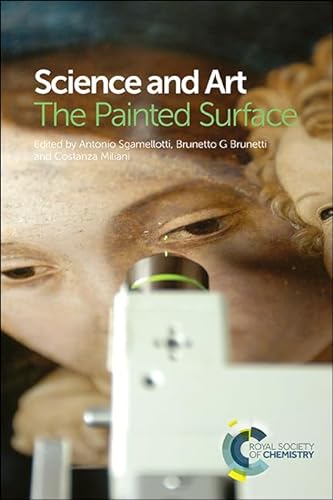
Science and art are increasingly interconnected in the activities of the study and conservation of works of art. Science plays a key role in cultural heritage, from developing new analytical techniques for studying the art, to investigating new ways of preserving the materials for the future. For example, high resolution multispectral examination of paintings allows art historians to view underdrawings barely visible before, while the use of non-invasive and micro-sampling analytical techniques allow scientists to identify pigments and binders that help art conservators in their work. It also allows curators to understand more about how the artwork was originally painted.
Through a series of case studies written by scientists together with art historians, archaeologists and conservators, Science and Art: The Painted Surface demonstrates how the cooperation between science and humanities can lead to an increased understanding of the history of art and to better techniques in conservation. The examples used in the book cover paintings from ancient history, Renaissance, modern, and contemporary art, belonging to the artistic expressions of world regions from the Far East to America and Europe. Topics covered include the study of polychrome surfaces from pre-Columbian and medieval manuscripts, the revelation of hidden images below the surface of Van Gogh paintings and conservation of acrylic paints in contemporary art.
Presented in an easily readable form for a large audience, the book guides readers into new areas uncovered by the link between science and art. The book features contributions from leading institutions across the globe including the Metropolitan Museum of Art, New York; Art Institute of Chicago; Getty Conservation Institute; Opificio delle Pietre Dure, Firenze; National Gallery of London; Tate Britain; Warsaw Academy of Fine Art and the National Gallery of Denmark as well as a chapter covering the Thangka paintings by Nobel Prize winner Richard Ernst.
Die Inhaltsangabe kann sich auf eine andere Ausgabe dieses Titels beziehen.
Über die Autorin bzw. den Autor
Antonio Sgamellotti is an Academician of Lincei and Professor of Inorganic Chemistry at the University of Perugia. He is also Co-founder of the Center of Excellence SMAArt (Scientific Methodologies applied to Archaeology and Art). His research interests include advanced computations on chemistry, electronic and structural properties of molecules and inorganic materials, spectroscopic properties and characterization of archaeological and art-historical artefacts.
Brunetto Giovanni Brunetti is a Full Professor of General and Inorganic Chemistry at the University of Perugia. He is also the coordinator for the European project CHARISMA (Cultural Heritage Advanced Research Infrastructures: Synergy for a Multidisciplinary Approach to Conservation/Restoration) and President of the Center of Excellence SMAArt (Scientific Methodologies applied to Archaeology and Art).
Costanza Miliani is a researcher at the CNR Institute of Molecular Science and Technology (CNR-ISTM) and coordinator of the mobile laboratory MOLAB of the CHARISMA project. His research interests include non-invasive spectroscopic techniques for in-situ investigations on cultural heritage.
Von der hinteren Coverseite
Science and art are increasingly interconnected in the activities of the study and conservation of works of art. Science plays a key role in cultural heritage, from developing new analytical techniques for studying the art, to investigating new ways of preserving the materials for the future. For example, high resolution multispectral examination of paintings allows art historians to view underdrawings barely visible before, while the use of non-invasive and micro-sampling analytical techniques allow scientists to identify pigments and binders that help art conservators in their work. It also allows curators to understand more about how the artwork was originally painted.
Through a series of case studies written by scientists together with art historians, archaeologists and conservators, Science and Art: The Painted Surface demonstrates how the cooperation between science and humanities can lead to an increased understanding of the history of art and to better techniques in conservation. The examples used in the book cover paintings from ancient history, Renaissance, modern, and contemporary art, belonging to the artistic expressions of world regions from the Far East to America and Europe. Topics covered include the study of polychrome surfaces from pre-Columbian and medieval manuscripts, the revelation of hidden images below the surface of Van Gogh paintings and conservation of acrylic paints in contemporary art.
Presented in an easily readable form for a large audience, the book guides readers into new areas uncovered by the link between science and art. The book features contributions from leading institutions across the globe including the Metropolitan Museum of Art, New York; Art Institute of Chicago; Getty Conservation Institute; Opificio delle Pietre Dure, Firenze; National Gallery of London; Tate Britain; Warsaw Academy of Fine Art and the National Gallery of Denmark as well as a chapter covering the Thangka paintings by Nobel Prize winner Richard Ernst.
Aus dem Klappentext
Science and art are increasingly interconnected in the activities of the study and conservation of works of art. Science plays a key role in cultural heritage, from developing new analytical techniques for studying the art, to investigating new ways of preserving the materials for the future. For example, high resolution multispectral examination of paintings allows art historians to view underdrawings barely visible before, while the use of non-invasive and micro-sampling analytical techniques allow scientists to identify pigments and binders that help art conservators in their work. It also allows curators to understand more about how the artwork was originally painted.
Through a series of case studies written by scientists together with art historians, archaeologists and conservators, Science and Art: The Painted Surface demonstrates how the cooperation between science and humanities can lead to an increased understanding of the history of art and to better techniques in conservation. The examples used in the book cover paintings from ancient history, Renaissance, modern, and contemporary art, belonging to the artistic expressions of world regions from the Far East to America and Europe. Topics covered include the study of polychrome surfaces from pre-Columbian and medieval manuscripts, the revelation of hidden images below the surface of Van Gogh paintings and conservation of acrylic paints in contemporary art.
Presented in an easily readable form for a large audience, the book guides readers into new areas uncovered by the link between science and art. The book features contributions from leading institutions across the globe including the Metropolitan Museum of Art, New York; Art Institute of Chicago; Getty Conservation Institute; Opificio delle Pietre Dure, Firenze; National Gallery of London; Tate Britain; Warsaw Academy of Fine Art and the National Gallery of Denmark as well as a chapter covering the Thangka paintings by Nobel Prize winner Richard Ernst.
Auszug. © Genehmigter Nachdruck. Alle Rechte vorbehalten.
Science and Art
The Painted Surface
By Antonio Sgamellotti, Brunetto Giovanni Brunetti, Costanza MilianiThe Royal Society of Chemistry
Copyright © 2014 The Royal Society of Chemistry
All rights reserved.
ISBN: 978-1-84973-818-7All rights reserved.
Contents
Chapter 1 Science and Art — My Two Passions Richard R. Ernst,
Chapter 2 Study and Laser Uncovering of Hypogean Early Christian Wall Painting of Roma's Catacombs of Santa Tecla and Domitilla S. Siano, F. Fratini, M. Mascalchi, G. Patrizi and B. Mazzei,
Chapter 3 Scientific Examination for the Investigation and Conservation of Far East Asian Mural Paintings Rocco Mazzeo, Giorgia Sciutto, Silvia Prati, Irene Bonacini and He Ling,
Chapter 4 Maya Mural Paintings in Calakmul: Pictorial Technique and Conservation P. Baglioni, R. Carrasco Vargas, M. Cordeiro Baqueiro and David Chelazzi,
Chapter 5 The Colours of Indigenous Memory: Non-invasive Analyses of Pre-Hispanic Mesoamerican Codices Davide Domenici, David Buti, Costanza Miliani, Brunetto Giovanni Brunetti and Antonio Sgamellotti,
Chapter 6 Material Study of the Codex Colombino Sandra Zetina, José Luis Ruvalcaba, Tatiana Falcón, Jesús Arenas Alatorre, Saeko Yanagisawa, Marisa Álvarez Icaza Longoria and Eumelia Hernández,
Chapter 7 Unveiling the Artistic Technique of the Florentine Codex: When the Old World and the New World Met R. Giorgi, D. Chelazzi and D. Magaloni Kerpel,
Chapter 8 Colour in Medieval Portuguese Manuscripts: Between Beauty and Meaning Maria João Melo, Rita Castro and Adelaide Miranda,
Chapter 9 The Wall Paintings of the Monumental Cemetery of Pisa: The War, the Restoration, the Conservation Alessia Andreotti, Maria Perla Colombini, Mauro Matteini and Antonio Paolucci,
Chapter 10 The Chemistry and Chemical Investigation of the Transition from Egg Tempera Painting to Oil in Italy in the 15th Century David A. Peggie,
Chapter 11 Multi-criterial Studies of the Masterpiece The Last Judgement, Attributed to Hans Memling, at the National Museum of Gdansk (2010–2013) Iwona Szmelter, Laura Cartechini, Aldo Romani and Luca Pezzati,
Chapter 12 Science and Conservation at the Florentine O. P. D. and Raphael's Madonna of the Goldfinch Marco Ciatti,
Chapter 13 Underdrawing in Paintings Roberto Bellucci and Cecilia Frosinini,
Chapter 14 An Integrated Approach to the Study and Preservation of Paintings Using Laser Light Technology: Diagnosis, Analysis and Cleaning P. Pouli, K. Melessanaki, V. Tornari, E. Bernikola, G. Filippidis, D. Anglos and C. Fotakis,
Chapter 15 Mens Agitat Molem: New Insights into Nicolas Poussin's Painting Technique by X-ray Diffraction and Fluorescence Analyses H. Glanville, H. Rousselière, L. de Viguerie and Ph. Walter,
Chapter 16 Designing Nature: Ogata Korin's Technical Choices in Irises at Yatsuhashi Marco Leona, Pablo S. Londero, Jennifer Perry, Kaori Fukunaga, Gregory H. Bailey and Charlotte Hale,
Chapter 17 As Time Passed by Came Sunset. Christen Købke's View of Lake Sortedam, its Genesis and Colour Changes Anna Vila, Kasper Monrad, Troels Filtenborg and Jørgen Wadum,
Chapter 18 Examination of Vincent van Gogh's Paintings and Pigments by Means of State-of-the-art Analytical Methods Koen Janssens, Matthias Alfeld, Geert Van der Snickt, Wout De Nolf, Frederik Vanmeert, Letizia Monico, Stijn Legrand, Joris Dik, Marine Cotte Gerald Falkenberg, Luuk van der Loeff, Margje Leeuwestein and Ella Hendriks,
Chapter 19 A Vibrant Surface: Investigating Color, Texture and Transparency in Winslow Homer's Watercolors B. Berrie, F. Casadio, K. Dahm, Y. Strumfels, M. Tedeschi and J
„Über diesen Titel“ kann sich auf eine andere Ausgabe dieses Titels beziehen.
Suchergebnisse für Science and Art: The Painted Surface

Beispielbild für diese ISBN
Science and Art
Anbieter: PBShop.store UK, Fairford, GLOS, Vereinigtes Königreich
Verkäuferbewertung 5 von 5 Sternen

HRD. Zustand: New. New Book. Shipped from UK. Established seller since 2000. Artikel-Nr. GB-9781849738187
Neu kaufen
EUR 61,99
EUR 7,87 Versand
Versand von Vereinigtes Königreich nach USA
Versand von Vereinigtes Königreich nach USA
Anzahl: 2 verfügbar
Beispielbild für diese ISBN
Science and Art: The Painted Surface
Verlag:
Royal Society Of Chemistry, 2014
ISBN 10: 1849738181
ISBN 13: 9781849738187
Gebraucht
Hardcover
Anbieter: Anybook.com, Lincoln, Vereinigtes Königreich
Verkäuferbewertung 5 von 5 Sternen
Zustand: Fair. This is an ex-library book and may have the usual library/used-book markings inside.This book has hardback covers. In fair condition, suitable as a study copy. No dust jacket. Please note the Image in this listing is a stock photo and may not match the covers of the actual item,1200grams, ISBN:9781849738187. Artikel-Nr. 9549347
Gebraucht kaufen
EUR 54,35
EUR 15,83 Versand
Versand von Vereinigtes Königreich nach USA
Versand von Vereinigtes Königreich nach USA
Anzahl: 1 verfügbar
Beispielbild für diese ISBN
Science and Art: The Painted Surface
Anbieter: Ria Christie Collections, Uxbridge, Vereinigtes Königreich
Verkäuferbewertung 5 von 5 Sternen
Zustand: New. In English. Artikel-Nr. ria9781849738187_new
Neu kaufen
EUR 67,04
EUR 17,39 Versand
Versand von Vereinigtes Königreich nach USA
Versand von Vereinigtes Königreich nach USA
Anzahl: 3 verfügbar
Beispielbild für diese ISBN
Science and Art: The Painted Surface
Anbieter: Kennys Bookstore, Olney, MD, USA
Verkäuferbewertung 5 von 5 Sternen
Zustand: New. . 2014. Hardcover. . . . . Books ship from the US and Ireland. Artikel-Nr. V9781849738187
Neu kaufen
EUR 91,74
EUR 9,15 Versand
Versand innerhalb von USA
Versand innerhalb von USA
Anzahl: 2 verfügbar
Beispielbild für diese ISBN
SCIENCE & ART
Anbieter: Speedyhen, Hertfordshire, Vereinigtes Königreich
Verkäuferbewertung 5 von 5 Sternen
Zustand: NEW. Artikel-Nr. NW9781849738187
Neu kaufen
EUR 57,19
EUR 47,72 Versand
Versand von Vereinigtes Königreich nach USA
Versand von Vereinigtes Königreich nach USA
Anzahl: 2 verfügbar
Foto des Verkäufers
Science and Art
Anbieter: moluna, Greven, Deutschland
Verkäuferbewertung 5 von 5 Sternen
Zustand: New. A series of case studies to show how the cooperation between science and humanities can lead to the developments in knowledge and conservation of paintings.Über den AutorrnrnAntonio Sgamellotti is an Academician of L. Artikel-Nr. 724745739
Neu kaufen
EUR 69,86
EUR 48,99 Versand
Versand von Deutschland nach USA
Versand von Deutschland nach USA
Anzahl: 2 verfügbar
Beispielbild für diese ISBN
Science and Art: The Painted Surface
Anbieter: Revaluation Books, Exeter, Vereinigtes Königreich
Verkäuferbewertung 5 von 5 Sternen
Hardcover. Zustand: Brand New. 300 pages. 9.25x6.25x1.75 inches. In Stock. Artikel-Nr. x-1849738181
Neu kaufen
EUR 102,98
EUR 17,46 Versand
Versand von Vereinigtes Königreich nach USA
Versand von Vereinigtes Königreich nach USA
Anzahl: 2 verfügbar
Foto des Verkäufers
Science and Art : The Painted Surface
Verlag:
Royal Society Of Chemistry Aug 2014, 2014
ISBN 10: 1849738181
ISBN 13: 9781849738187
Neu
Hardcover
Anbieter: AHA-BUCH GmbH, Einbeck, Deutschland
Verkäuferbewertung 5 von 5 Sternen
Buch. Zustand: Neu. Neuware - Science and art are increasingly interconnected in the activities of the study and conservation of works of art. Science plays a key role in cultural heritage, from developing new analytical techniques for studying the art, to investigating new ways of preserving the materials for the future. For example, high resolution multispectral examination of paintings allows art historians to view underdrawings barely visible before, while the use of non-invasive and micro-sampling analytical techniques allow scientists to identify pigments and binders that help art conservators in their work. It also allows curators to understand more about how the artwork was originally painted.Through a series of case studies written by scientists together with art historians, archaeologists and conservators, Science and Art: The Painted Surface demonstrates how the cooperation between science and humanities can lead to an increased understanding of the history of art and to better techniques in conservation. The examples used in the book cover paintings from ancient history, Renaissance, modern, and contemporary art, belonging to the artistic expressions of world regions from the Far East to America and Europe. Topics covered include the study of polychrome surfaces from pre-Columbian and medieval manuscripts, the revelation of hidden images below the surface of Van Gogh paintings and conservation of acrylic paints in contemporary art.Presented in an easily readable form for a large audience, the book guides readers into new areas uncovered by the link between science and art. The book features contributions from leading institutions across the globe including the Metropolitan Museum of Art, New York; Art Institute of Chicago; Getty Conservation Institute; Opificio delle Pietre Dure, Firenze; National Gallery of London; Tate Britain; Warsaw Academy of Fine Art and the National Gallery of Denmark as well as a chapter covering the Thangka paintings by Nobel Prize winner Richard Ernst. Artikel-Nr. 9781849738187
Neu kaufen
EUR 98,97
EUR 38,44 Versand
Versand von Deutschland nach USA
Versand von Deutschland nach USA
Anzahl: 2 verfügbar
Foto des Verkäufers
Science and Art | The Painted Surface
Anbieter: preigu, Osnabrück, Deutschland
Verkäuferbewertung 5 von 5 Sternen
Buch. Zustand: Neu. Science and Art | The Painted Surface | Antonio Sgamellotti (u. a.) | Buch | Gebunden | Englisch | 2014 | Royal Society of Chemistry | EAN 9781849738187 | Verantwortliche Person für die EU: Libri GmbH, Europaallee 1, 36244 Bad Hersfeld, gpsr[at]libri[dot]de | Anbieter: preigu. Artikel-Nr. 105358291
Neu kaufen
EUR 78,15
EUR 70,00 Versand
Versand von Deutschland nach USA
Versand von Deutschland nach USA
Anzahl: 1 verfügbar