
Verwandte Artikel zu Materials Design Inspired by Nature: Function Through...
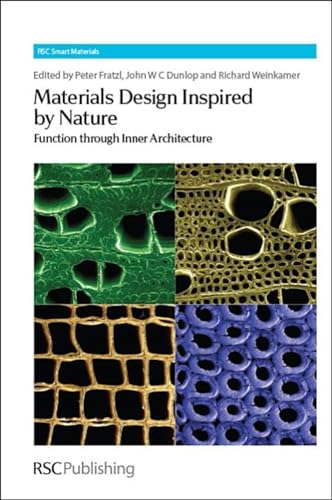
Materials Design Inspired by Nature: Function Through Inner Architecture (RSC Smart Materials, 4, Band 4) - Hardcover
Inhaltsangabe
The inner architecture of a material can have an astonishing effect on its overall properties and is vital to understand when designing new materials. Nature is a master at designing hierarchical structures and so researchers are looking at biological examples for inspiration to create new materials. Materials Design Inspired by Nature is the first book to address the relationship between the inner architecture of natural materials and their physical properties for materials design. The book explores examples from plants, the marine world, arthropods and bacteria, where the inner architecture is exploited to obtain specific mechanical, optical or magnetic properties along with how these design principles are used in man-made products. Experimental methods used to investigate hierarchical structures are also covered including X-ray scattering techniques, transmission electron microscopy and Raman microscopy. Written by leading experts in bio-inspired materials research, this is essential reading for anyone developing new materials.
Die Inhaltsangabe kann sich auf eine andere Ausgabe dieses Titels beziehen.
Über die Autorin bzw. den Autor
Peter Fratzl is Director at the Max Planck Institute of Colloids and Interfaces in Potsdam, Germany as well as Honorary Professor at Potsdam University and Humboldt University Berlin. His research interests are in biomimetic materials, including structure function relationships in biological materials and has over 300 publications on in scientific journals and books. Previous awards include an honorary doctorate from the University of Montpellier, France (2010), Gottfried Wilhelm Leibniz-Preis (2010) and together with Professor Robert Langer, MIT, the Max Planck Research Prize for pioneering work in the field of "Biological and Biomimetic Materials" MIT (2008).
John W. C. Dunlop is a research group leader at the Max Planck Institute of Colloids and Interfaces, Germany. His research interests include mechanics of actuating systems, modelling of tissue growth and mechanics of cellular materials.
Richard Weinkamer is a researcher at the Max Planck Institute of Colloid and Interfaces and his scientific interests include structure-function relations and mechanical properties of hierarchically structured biological tissues.
Von der hinteren Coverseite
The inner architecture of a material can have an astonishing effect on its overall properties and is vital to understand when designing new materials. Nature is a master at designing hierarchical structures and so researchers are looking at biological examples for inspiration, specifically to understand how nature arranges the inner architectures for a particular function in order to apply these design principles into man-made materials.
Materials Design Inspired by Nature is the first book to address the relationship between the inner architecture of natural materials and their physical properties for materials design. The book explores examples from plants, the marine world, arthropods and bacteria, where the inner architecture is exploited to obtain specific mechanical, optical or magnetic properties along with how these design principles are used in man-made products. Details of the experimental methods used to investigate hierarchical structures are also given.
Written by leading experts in bio-inspired materials research, this is essential reading for anyone developing new materials.
Aus dem Klappentext
The inner architecture of a material can have an astonishing effect on its overall properties and is vital to understand when designing new materials. Nature is a master at designing hierarchical structures and so researchers are looking at biological examples for inspiration, specifically to understand how nature arranges the inner architectures for a particular function in order to apply these design principles into man-made materials.
Materials Design Inspired by Nature is the first book to address the relationship between the inner architecture of natural materials and their physical properties for materials design. The book explores examples from plants, the marine world, arthropods and bacteria, where the inner architecture is exploited to obtain specific mechanical, optical or magnetic properties along with how these design principles are used in man-made products. Details of the experimental methods used to investigate hierarchical structures are also given.
Written by leading experts in bio-inspired materials research, this is essential reading for anyone developing new materials.
Auszug. © Genehmigter Nachdruck. Alle Rechte vorbehalten.
Materials Design Inspired by Nature
Function Through Inner Architecture
By Peter Fratzl, John W. C. Dunlop, Richard WeinkamerThe Royal Society of Chemistry
Copyright © 2013 The Royal Society of Chemistry
All rights reserved.
ISBN: 978-1-84973-553-7All rights reserved.
Contents
Chapter 1 Architectured Materials: An Alternative to Microstructure Control for Structural Materials Design? A Possible Playground for Bio-inspiration? Yves J.M. Bréchet,
Chapter 2 Bone Structural Adaptation and Wolff's Law Bettina Willie, Georg N. Duda and Richard Weinkamer,
Chapter 3 Understanding Hierarchy and Functions of Bone Using Scanning X-ray Scattering Methods Wolfgang Wagermaier, Aurelien Gourrier and Barbara Aichmayer,
Chapter 4 Advanced Transmission Electron Microscopy to Explore Early Stages of Bio(mimetic)mineralization Archan Dey and Nico A. J. M. Sommerdijk,
Chapter 5 Collagen-based Materials for Tissue Repair, from Bio-inspired to Biomimetic M. M. Giraud Guille, N. Nassif and F. M. Fernandes,
Chapter 6 Materials Design Inspired by Tree and Wood Architecture Ingo Burgert,
Chapter 7 Raman Microscopy: Insights into the Chemistry and Structure of Biological Materials N. Gierlinger, C. Reisecker, S. Hild and S. Gamsjaeger,
Chapter 8 The Mineralized Crustacean Cuticle: Hierarchical Structure and Mechanical Properties Oskar Paris, Markus A. Hartmann and Gerhard Fritz-Popovski,
Chapter 9 Multi-scale Modelling of a Biological Material: The Arthropod Exoskeleton Martin Friák, Helge-Otto Fabritius, Svetoslav Nikolov, Michal Petrov, Liverios Lymperakis, Christoph Sachs, Pavlína Elstnerová, Jörg Neugebauer and Dierk Raabe,
Chapter 10 Optical Biomimetics Andrew R. Parker,
Chapter 11 Magnetic Nanoparticles in Bacteria Maria Antonietta Carillo, Peter Vach and Damien Faivre,
Chapter 12 Hierarchical Protein Assemblies as a Basis for Materials Andrew Smith and Thomas Scheibel,
Chapter 13 Anti-adhesive Surfaces in Plants and Their Biomimetic Potential Elena V. Gorb and Stanislav N. Gorb,
Chapter 14 Bio-inspired Adhesive Surfaces: From Principles to Applications Elmar Kroner and Eduard Arzt,
Chapter 15 Replicating Biological Design Principles in Synthetic Composites André R. Studart, Rafael Libanori and Randall M. Erb,
Chapter 16 Bio-inspired Self-healing Materials Thomas Speck, Georg Bauer, Felix Flues, Katharina Oelker, Markus Rampf, Andreas C. Schüssele, Max von Tapavicza, Jürgen Bertling, Rolf Luchsinger, Anke Nellesen, Annette M. Schmidt, Rolf Mülhaupt and Olga Speck,
Subject Index,
CHAPTER 1
Architectured Materials: An Alternative to Microstructure Control for Structural Materials Design? A Possible Playground for Bioinspiration?
YVES J. M. BRÉCHET
SIMAP, Grenoble-INP, BP75, 38402, St Martin d'Heres Cedex, France
Email: Yves.brechet@grenoble-inp.fr
1.1 Introduction: Materials, Structure and Between
From the engineering viewpoint, materials are matter with a function. In order to fulfil this function, the properties of materials are only one of the variables; the shape and the scale can also contribute to give to a component the required response to an external stimulus, which is the so-called 'function'. If a buoyancy device is required, a material such as cork, whose density is lower than that of water, might be sought, but a steel hollow sphere might also suffice. If a conductor that can carry electricity with little joule loss and yet will remain flexible is required, the natural solution will be to look for mat
„Über diesen Titel“ kann sich auf eine andere Ausgabe dieses Titels beziehen.
Suchergebnisse für Materials Design Inspired by Nature: Function Through...

Internationale Ausgabe
MATERIALS DESIGN INSPIRED BY NATURE FUNCTION THROUGH INNER ARCHITECTURE (HB 2013)
Internationale AusgabeAnbieter: Romtrade Corp., STERLING HEIGHTS, MI, USA
Verkäuferbewertung 5 von 5 Sternen

Zustand: New. Brand New. Soft Cover International Edition. Different ISBN and Cover Image. Priced lower than the standard editions which is usually intended to make them more affordable for students abroad. The core content of the book is generally the same as the standard edition. The country selling restrictions may be printed on the book but is no problem for the self-use. This Item maybe shipped from US or any other country as we have multiple locations worldwide. Artikel-Nr. ABBB-500082

Beispielbild für diese ISBN
MATERIALS DESIGN INSPIRED BY NATURE FUNCTION THROUGH INNER ARCHITECTURE (HB 2013)
Anbieter: Romtrade Corp., STERLING HEIGHTS, MI, USA
Verkäuferbewertung 5 von 5 Sternen
Zustand: New. This is a Brand-new US Edition. This Item may be shipped from US or any other country as we have multiple locations worldwide. Artikel-Nr. ABBB-59348
Beispielbild für diese ISBN
Materials Design Inspired by Nature: Function Through Inner Architecture
Anbieter: Romtrade Corp., STERLING HEIGHTS, MI, USA
Verkäuferbewertung 5 von 5 Sternen
Zustand: New. This is a Brand-new US Edition. This Item may be shipped from US or any other country as we have multiple locations worldwide. Artikel-Nr. ABBB-203828
Beispielbild für diese ISBN
Materials Design Inspired by Nature: Function Through Inner Architecture (Smart Materials Series, Volume 4)
Verlag:
Royal Society of Chemistry, 2013
ISBN 10: 1849735530
ISBN 13: 9781849735537
Gebraucht
Hardcover
Anbieter: Phatpocket Limited, Waltham Abbey, HERTS, Vereinigtes Königreich
Verkäuferbewertung 5 von 5 Sternen
Zustand: Good. Your purchase helps support Sri Lankan Children's Charity 'The Rainbow Centre'. Ex-library, so some stamps and wear, but in good overall condition. Our donations to The Rainbow Centre have helped provide an education and a safe haven to hundreds of children who live in appalling conditions. Artikel-Nr. Z1-T-011-01969
Gebraucht kaufen
EUR 96,43
EUR 12,52 Versand
Versand von Vereinigtes Königreich nach USA
Versand von Vereinigtes Königreich nach USA
Anzahl: 1 verfügbar
Beispielbild für diese ISBN
Materials Design Inspired by Nature
Anbieter: Majestic Books, Hounslow, Vereinigtes Königreich
Verkäuferbewertung 4 von 5 Sternen

Zustand: New. pp. 420 420 Illus. (Col.). Artikel-Nr. 55092199
Neu kaufen
EUR 120,90
EUR 7,65 Versand
Versand von Vereinigtes Königreich nach USA
Versand von Vereinigtes Königreich nach USA
Anzahl: 4 verfügbar
Beispielbild für diese ISBN
MATERIALS DESIGN INSPIRED BY NATURE: FUNCTION THROUGH INNER ARCHITECTURE
Anbieter: Romtrade Corp., STERLING HEIGHTS, MI, USA
Verkäuferbewertung 5 von 5 Sternen
Zustand: New. This is a Brand-new US Edition. This Item may be shipped from US or any other country as we have multiple locations worldwide. Artikel-Nr. ABBB-192617
Beispielbild für diese ISBN
Materials Design Inspired by Nature
Anbieter: PBShop.store UK, Fairford, GLOS, Vereinigtes Königreich
Verkäuferbewertung 5 von 5 Sternen
HRD. Zustand: New. New Book. Shipped from UK. Established seller since 2000. Artikel-Nr. CW-9781849735537
Neu kaufen
EUR 207,40
EUR 6,91 Versand
Versand von Vereinigtes Königreich nach USA
Versand von Vereinigtes Königreich nach USA
Anzahl: 3 verfügbar
Beispielbild für diese ISBN
Materials Design Inspired by Nature: Function Through Inner Architecture (Smart Materials Series, Volume 4)
Anbieter: Ria Christie Collections, Uxbridge, Vereinigtes Königreich
Verkäuferbewertung 5 von 5 Sternen
Zustand: New. In English. Artikel-Nr. ria9781849735537_new
Neu kaufen
EUR 252,31
EUR 13,28 Versand
Versand von Vereinigtes Königreich nach USA
Versand von Vereinigtes Königreich nach USA
Anzahl: 6 verfügbar
Foto des Verkäufers
Materials Design Inspired by Nature
Anbieter: moluna, Greven, Deutschland
Verkäuferbewertung 5 von 5 Sternen
Gebunden. Zustand: New. The first book to address the relationship between inner architecture and properties of natural materials, essential reading for anyone in materials research.Über den AutorrnrnPeter Fratzl is Director at the Max Planck Institute of C. Artikel-Nr. 597106839
Neu kaufen
EUR 222,30
EUR 48,99 Versand
Versand von Deutschland nach USA
Versand von Deutschland nach USA
Anzahl: 5 verfügbar