
Verwandte Artikel zu Nanoporous Gold: From an Ancient Technology to a High-Tech...
Nanoporous Gold: From an Ancient Technology to a High-Tech Material (RSC Nanoscience & Nanotechnology) - Hardcover
Inhaltsangabe
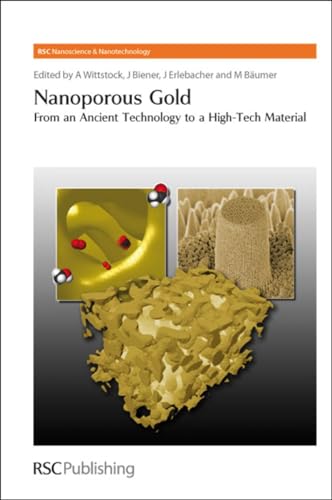
High-surface-area materials have recently attracted significant interest due to potential applications in various fields such as electrochemistry and catalysis, gas-phase catalysis, optics, sensors and actuators, energy harvesting and storage. In contrast to classical materials the properties of high-surface-area materials are no longer determined by their bulk, but by their nanoscale architecture. Nanoporous gold (np-Au) represents the fascinating class of mesoporous metals that have been intensively investigated in recent years. The current interest and the increasing number of scientific publications show that np-Au by itself is an outstanding nano-material that justifies a book devoted to all aspects of its properties and applications. The resulting publication is a discussion of this unique nano-material and is an accessible and comprehensive introduction to the field. The book provides a broad, multi-disciplinary platform to learn more about the properties of nanoporous gold from an inter-disciplinary perspective. It starts with an introduction and overview of state-of-the-art applications and techniques characterizing this material and its applications. It then covers the progress in research within the last years. The chapters are in-depth overviews written by the world's leading scientists in the particular field. Each chapter covers one technique or application so that the reader can easily target their favoured topic and will get the latest and state-of-the-art information in the field.
Die Inhaltsangabe kann sich auf eine andere Ausgabe dieses Titels beziehen.
Über die Autorin bzw. den Autor
Arne Wittstock is at the Universitat Bremen/Institute for Applied and Physical Chemistry and Lawrence Livermore National Laboratory, Physical and Life Science Directorate, Nanoscale Synthesis and Characterization Laboratory, USA. He studied chemistry at the University of Bremen and completed his diploma thesis at Kruss GmbH in Hamburg. Afterwards, he undertook his doctoral studies in Marcus Bõumer's group at the Institute for Applied and Physical Chemistry and received his PhD from the Department of Chemistry at Bremen University. Meanwhile he was also a visiting researcher at the Nanoscale Synthesis and Characterization Laboratory at the Lawrence Livermore National Laboratory. Since 2010, Arne Wittstock has co-supervised the projects on nanoporous gold at the Institute of Applied and Physical Chemistry and he also joined the Lawrence Livermore National Laboratory working on nanoscaled functional materials. His main research interests lie in the field of the physical chemistry of surfaces, nanostructured materials for energy-related applications, sensors, and catalysis. He has published several papers in Science, Nature Materials, Nano Letters and other key journals and also possesses patents. Juergen Biener is currently one of the leaders in the Nanoscale Synthesis and Characterization Laboratory at the Lawrence Livermore National Laboratory, USA and a Harvard affiliate. He studied chemistry at the Ludwig-Maximilians-Universitõt in Munich and completed his doctoral research in the field of surface science at the Max-Planck-Institute of Plasma Physics (IPP) in Garching. He received a fellowship from the German Academic Exchange Service (DAAD) to work with Bob Madix at Stanford University on metal oxide model catalysts. He then returned to the IPP to continue his research on plasma-wall interactions and in 2003 he accepted a visiting scientist position at the Center for Imaging and Mesoscale Structures at Harvard University where he started his work in the field of gold surface chemistry. Currently, his research interest lies at the intersection of surface chemistry, physics and mechanics of high-surface-area materials. He is the author of over 100 scientific publications, patent applications and book chapters. Jonah Erlebacher is at the Department of Materials Science and Engineering, Johns Hopkins University, USA. Marcus Baumer is a Professor at the Institute of Applied and Physical Chemistry at the University of Bremen where he leads a research group working on nanostructured surfaces and innovative catalytic materials. He graduated in chemistry and received his PhD at the Ruhr-University Bochum, Germany in 1994. In the following years, he carried out postdoctoral research at the Ruhr-University, Stanford University, USA and the Fritz-Haber-Institute, Berlin, Germany. In 2000, he received his habilitation in physical chemistry at the Technical University Berlin and became Professor at the University Bremen in 2002. His current research areas comprise nanoporous materials, colloidal nanoparticles and rare earth oxide materials and their use in heterogeneous catalysis and sensorics.
Auszug. © Genehmigter Nachdruck. Alle Rechte vorbehalten.
Nanoporous Gold
From an Ancient Technology to a High-Tech Material
By A. Wittstock, J. Biener, J. Erlebacher, M. BäumerThe Royal Society of Chemistry
Copyright © 2012 Royal Society of Chemistry
All rights reserved.
ISBN: 978-1-84973-374-8All rights reserved.
Contents
Chapter 1 Introduction to Nanoporous Gold Arne Wittstock, Jürgen Biener and Marcus Bäumer, 1,
Chapter 2 Fundamental Physics and Chemistry of Nanoporosity Evolution During Dealloying J. Erlebacher, R. C. Newman and K. Sieradzki, 11,
Chapter 3 Mechanistic Studies of Initial Dealloying Frank Uwe Renner, 30,
Chapter 4 Mechanical Properties of Nanoporous Gold Andrea M. Hodge and Thomas John Balk, 51,
Chapter 5 Microfabrication of Nanoporous Gold Oya Okman and Jeffrey W. Kysar, 69,
Chapter 6 Optical Properties and Applications of Nanoporous Metals X. Y. Lang and M. W. Chen, 97,
Chapter 7 Actuation with High-Surface-Area Materials L.-H. Shao, H.-J. Jin and J. Weissmüller, 137,
Chapter 8 Surface Chemistry and Catalysis Arne Wittstock, Jürgen Biener and Marcus Bäumer, 167,
Chapter 9 Electrocatalytical Properties of Nanoporous Gold Houyi Ma and Yi Ding, 199,
Chapter 10 Nanoporous Gold in Sensor Applications I-Wen Sun and Po-Yu Chen, 224,
Subject Index, 248,
CHAPTER 1
Introduction to Nanoporous Gold
ARNE WITTSTOCK, JÜRGEN BIENER AND MARCUS BÄUMER
1.1 Nanoporous Gold
Nanoporous gold is a corrosion-derived bulk nanostructured material. It is generated by the corrosion of an alloy of Au and a less noble metal, such as Ag or Cu. By electrochemical removal (dealloying) of the less noble constituent, the remaining gold undergoes a self-organization process forming a three-dimensional bicontinuous porous network of interconnected ligaments (Figure 1.1). Depending on the preparation conditions, the resulting pores and ligaments can be as small as 5 nm, but are typically around 30 to 40 nm. By IUPAC definition, the as-prepared material is mesoporous. Due to its high porosity and small feature size, this material has a specific surface area in the range of 10 m2 g-1. The void or pore volume in the resulting material mostly depends on the concentration of the less noble metal (e.g. Ag) in the starting compound. Because of fundamental limitations for bulk dealloying, such as the 'parting limit' (see Chapter 2) and the stability of the evolving porous network, alloys containing between 60 at.% and 80 at.% Ag are most viable. Processing (dealloying) of according alloys results in pore volumes between about 60% and 80%.
Early experimental work on corrosion-derived nanoporous Au by Pickering and Swann in the 1960s and by Forty in the 1970s focused on the corrosion aspect using this material and its starting alloys, respectively, as a model system for studies on the molecular mechanism of alloy corrosion. With the onset of nanotechnology in the late 1990s and the early 2000s, researchers revealed and developed the potential of this material for a variety of techno- logical aspects. As a consequence, the number of publications dealing with nanoporous Au has increased steeply by about 40% per year, from about 11 publication in the year 2001 to more than 150 in the year 2010. One of the reasons for the success of this material is the comparatively simple preparation of this nanomaterial using bench-top corrosion techniques to generate bulk samples several millimeters in size and even larger. By avoiding financially demanding techniques, such as electron beam lithography, this material became available to a variety of research groups working on the optical or mechanical properties, the catalysis or the electrochemistry of the material.
Besides the availability of the material for different research groups, another crucial factor fuelling interest in this material is its structural and chemical flexibility (see Figure 1.1). Microfabrication of the material using fast ion bombardment has been used to generate various micrometer-sized patterns and structures of interest for mechanical tests, for example. Temperature-activated ripening of the nanostructures opens the door to materials with pores and ligaments in the size regime between about 30 nm and several micrometers, without losing the typical bicontinuous structure of the material. By using templating techniques, such as slip casting of alloy-coated polystyrene beads and subsequent removal of the template, hierarchical nanoporous Au can be generated as well with relative densities as low as 2 to 3%. In addition to these structural variations, the materials surface can be chemically modified with metals, organic entities or metal oxides bringing forward its applications in electrochemistry (e.g. fuel-cell applications), sensorics, and catalysis.
Although the term 'nanotechnology' is rather new, the use of nanomaterials can be dated back several hundreds or even thousands of years. The first reports on the use of corrosion to generate nanoporous gold can be related to pre-Columbian civilizations, such as the Incans (see Chapter 2). Here, the superficial dealloying and subsequent burnishing of a comparably cheaper Au–Cu alloy (removal of the Cu from the alloy surface) was used to generate a shiny gold surface, giving the work piece the allure of pure gold. Undoubtedly, this must have caused severe frustration in the Spanish conquistadores when melting the looted, apparently pure, gold pieces back in Spain. However, artisans throughout the centuries have used this superficial enrichment of Au alloys as a means of gilding. The technique was thus dubbed depletion gilding or 'mis-en-colour', accordingly. For these reasons, when dealing with nanoporous gold, we speak of an ancient material yet with a novel technological impact.
1.2 Gold — Some Facts
Gold is an element that has inspired mankind at all times. Around 700 BC, the famous Greek poet Hesiod described the five ages of mankind in his poem Works and Days. The first age he calls the golden age of mankind, free from later gradual deterioration of moral values. Indeed, gold was the first metal recognized by humans even before bronze and iron. Traces of gold can be found in early human settlements (~8000 BC) in the Euphrat and Tigris river system, an area that is today part of the Iraq. Archeological findings of gold from later high civilizations such as Egypt and Mesopotamia can be dated back as early as 4000 BC. Back in those days, gold was already used as a means of payment, in the form of rings (about 2700 BC) and later in the form of coins (since 600 BC). The earliest craftsmanship, such as the funeral mask of the Egyptian Pharaoh Tutankhamun (1223 BC) or Solomon's famous temple in Jerusalem (build around 950 BC), allegedly overlaid with gold, bears testimony to this early and lasting fascination with gold.
The belief in gold as the embodiment of value continued throughout the centuries. Today, the drastically increasing demand for gold as a safe investment very much reflects this fact. One reason for investing in gold as a safe haven of treasure and investment is its nobleness and obvious inability to corrode like iron. Gold stays in its metallic form, apparently unaffected by dirt and corrosion. Another reason is that gold is rare. Elements heavier than iron (56Fe) cannot be generated by fusion reactions that occur in the sun but result from neutron-capture reactions as in supernovae, a comparatively rare astrophysical event. In the galaxy, elements such as gold are thus inherently rare.
The...
„Über diesen Titel“ kann sich auf eine andere Ausgabe dieses Titels beziehen.
Suchergebnisse für Nanoporous Gold: From an Ancient Technology to a High-Tech...

Beispielbild für diese ISBN
NANOPOROUS GOLD FROM AN ANCIENT TECHNOLOGY TO A HIGH TECH MATERIAL (HB 2012)
Anbieter: Romtrade Corp., STERLING HEIGHTS, MI, USA
Verkäuferbewertung 5 von 5 Sternen

Zustand: New. This is a Brand-new US Edition. This Item may be shipped from US or any other country as we have multiple locations worldwide. Artikel-Nr. ABBB-59346
Beispielbild für diese ISBN
Nanoporous Gold: From An Ancient Technology To A High-Tech Material
Anbieter: Romtrade Corp., STERLING HEIGHTS, MI, USA
Verkäuferbewertung 5 von 5 Sternen
Zustand: New. This is a Brand-new US Edition. This Item may be shipped from US or any other country as we have multiple locations worldwide. Artikel-Nr. ABBB-203759
Beispielbild für diese ISBN
Nanoporous Gold
Anbieter: Majestic Books, Hounslow, Vereinigtes Königreich
Verkäuferbewertung 4 von 5 Sternen

Zustand: New. pp. 264. Artikel-Nr. 53994575
Neu kaufen
EUR 99,81
EUR 7,65 Versand
Versand von Vereinigtes Königreich nach USA
Versand von Vereinigtes Königreich nach USA
Anzahl: 4 verfügbar
Beispielbild für diese ISBN
Nanoporous Gold: From an Ancient Technology to a High-Tech Material
Anbieter: Romtrade Corp., STERLING HEIGHTS, MI, USA
Verkäuferbewertung 5 von 5 Sternen
Zustand: New. This is a Brand-new US Edition. This Item may be shipped from US or any other country as we have multiple locations worldwide. Artikel-Nr. ABBB-137293
Beispielbild für diese ISBN
Nanoporous Gold: From an Ancient Technology to a High-Tech Material (Nanoscience & Nanotechnology Series, Volume 22)
Anbieter: Ria Christie Collections, Uxbridge, Vereinigtes Königreich
Verkäuferbewertung 5 von 5 Sternen
Zustand: New. In English. Artikel-Nr. ria9781849733748_new
Neu kaufen
EUR 213,85
EUR 13,28 Versand
Versand von Vereinigtes Königreich nach USA
Versand von Vereinigtes Königreich nach USA
Anzahl: 2 verfügbar
Beispielbild für diese ISBN
Nanoporous Gold
Anbieter: BUCHSERVICE / ANTIQUARIAT Lars Lutzer, Wahlstedt, Deutschland
Verkäuferbewertung 5 von 5 Sternen
Hardcover. Zustand: gut. 2012. Nanoporous Gold In englischer Sprache. pages. Artikel-Nr. BN188678
Gebraucht kaufen
EUR 189,00
EUR 39,95 Versand
Versand von Deutschland nach USA
Versand von Deutschland nach USA
Anzahl: 1 verfügbar
Foto des Verkäufers
Nanoporous Gold
Anbieter: moluna, Greven, Deutschland
Verkäuferbewertung 5 von 5 Sternen
Gebunden. Zustand: New. Provides a broad, multi-disciplinary platform to discuss and learn more about the fascinating properties of nanoporous gold from an inter-disciplinary perspective.Über den AutorrnrnArne Wittstock is at the Universitat Bremen/Institute f. Artikel-Nr. 597106776
Neu kaufen
EUR 189,05
EUR 48,99 Versand
Versand von Deutschland nach USA
Versand von Deutschland nach USA
Anzahl: 2 verfügbar