
Verwandte Artikel zu Materials Challenges: Inorganic Photovoltaic Solar...
Materials Challenges: Inorganic Photovoltaic Solar Energy (RSC Energy and Environment, 12) - Hardcover
Inhaltsangabe
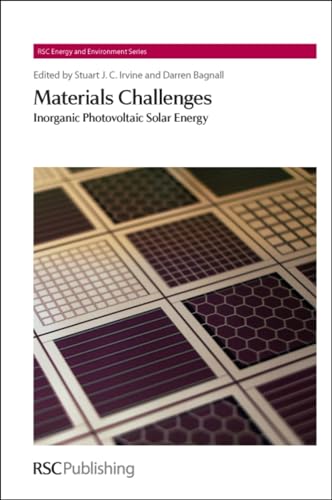
This authoritative reference covers the various aspects of materials science that will impact on the next generation of photovoltaic (PV) module technology. The emphasis on materials brings a fresh perspective to the literature and highlights crucial issues. Special attention is given to thin film PV materials, an area that is growing more rapidly than crystalline silicon and could dominate in the long term. The book addresses the fundamental aspects of PV solar cell materials and gives a comprehensive description of each major thin film material, either in research or production. Particular weight is given to the key materials drivers of solar conversion efficiency, long term stability, materials costs, and materials sustainability.
Die Inhaltsangabe kann sich auf eine andere Ausgabe dieses Titels beziehen.
Über die Autorinnen und Autoren
Stuart Irvine has over thirty years experience in thin film semiconductor deposition and characterisation for opto-electronic devices. Executive Director for the UK research consortium (PV Supergen) and Director of the Centre for Solar Energy Research at OpTIC Technium. Prof Bagnall is based in the new ú120M Southampton Nanofabrication Centre in Electronics and Computer Science. He has spent over 20 years researching a range of semiconductor technologies. His current research focuses on the application of nanotechnology to thin film silicon photovoltaic devices. He is a member of Supergen PV21 and a member of the UK-ISES and PVSAT organising committees.
Stuart Irvine has over thirty years experience in thin film semiconductor deposition and characterisation for opto-electronic devices. Executive Director for the UK research consortium (PV Supergen) and Director of the Centre for Solar Energy Research at OpTIC Technium. Prof Bagnall is based in the new ú120M Southampton Nanofabrication Centre in Electronics and Computer Science. He has spent over 20 years researching a range of semiconductor technologies. His current research focuses on the application of nanotechnology to thin film silicon photovoltaic devices. He is a member of Supergen PV21 and a member of the UK-ISES and PVSAT organising committees.
Von der hinteren Coverseite
Materials Challenges: Inorganic Photovoltaic Solar Energy
provides an authoritative reference on the various aspects of materials science that will impact the next generation of photovoltaic (PV) module technology. The materials emphasis will bring a fresh perspective to the literature and will highlight the many issues that are often buried in other texts where the solution to materials challenges can be crucial in developing a new PV technology. The emphasis of the book will be on the range of thin film PV materials. Thin film PV is growing more rapidly than crystalline silicon and although only 15% of the current market it could dominate in the longer term. This book addresses the fundamental aspects of PV solar cell materials and gives a comprehensive description of each of the major thin film materials either in research or in production. Particular attention will be given to the key materials drivers of solar conversion efficiency, long-term stability, material costs and materials sustainability.
Written by a distinguished team of experts, key chapters include Fundamentals of inorganic solar cells; Thin film silicon solar cells; TCOs; Cadmium telluride solar cells; CIS, CIGS, chalcogenides; New chalcogenides; III-V solar cells; Nanomaterials; Light capture; Photon management materials; Conclusions and future developments.
The book will be essential reading for materials scientists, chemists, energy technologists and all those involved in solid-state physics.
Auszug. © Genehmigter Nachdruck. Alle Rechte vorbehalten.
Materials Challenges
Inorganic Photovoltaic Solar Energy
By Stuart J. C. IrvineThe Royal Society of Chemistry
Copyright © 2015 The Royal Society of Chemistry
All rights reserved.
ISBN: 978-1-84973-187-4All rights reserved.
Contents
Chapter 1 Introduction and Techno-economic Background Stuart J. C. Irvine and Chiara Candelise, 1,
Chapter 2 Fundamentals of Thin Film PV Cells Stuart J. C. Irvine and Vincent Barrioz, 27,
Chapter 3 Crystalline Silicon Thin Film and Nanowire Solar Cells Hari S. Reehal and Jeremy Ball, 53,
Chapter 4 A Review of NREL Research into Transparent Conducting Oxides Timothy J. Coutts, James M. Burst, Joel N. Duenow, Xiaonan Li, and Timothy A. Gessert, 89,
Chapter 5 Thin Film Cadmium Telluride Solar Cells Andrew J. Clayton and Vincent Barrioz, 135,
Chapter 6 New Chalcogenide Materials for Thin Film Solar Cells David W. Lane, Kyle J. Hutchings, Robert McCracken, and Ian Forbes, 160,
Chapter 7 III–V Solar Cells James P. Connolly and Denis Mencaraglia, 209,
Chapter 8 Light Capture Stuart A. Boden and Tristan L. Temple, 247,
Chapter 9 Photon Frequency Management Materials for Efficient Solar Energy Collection Lefleris Danos, Thomas J. J. Meyer, Pattareeya Kittidachachan, Liping Fang, Thomas S. Parel, Nazila Soleimani and Tomas Markvart, 297,
Subject Index, 332,
CHAPTER 1
Introduction and Techno-economic Background
STUART J. C. IRVINE AND CHIARA CANDELISE
1.1 Potential for PV Energy Generation as Part of a Renewable Energy Mix
Climate change became one of the major drivers for changing the balance of energy generation and supply in the latter part of the 20th century and the beginning of the 21st century. The increase in carbon dioxide (CO2) concentration in the atmosphere over the past century to a figure approaching 400 parts per million (ppm) is taking it closer to the historical 450 ppm concentration where there was virtually no ice on the planet. The Intergovernmental Panel on Climate Change (IPCC) has set a maximum increase in global temperature of 2 °C which Hansen et al. argue can only be achieved if atmospheric CO2 falls to 350 ppm to avoid irreversible loss of the ice sheet. Meinshausen et al. 2 put a figure on cumulative CO2 emissions into the atmosphere of 1000 Gt between 2000 and 2050 would yield a 25% probability of exceeding the 2 °C threshold in global warming.
The world electricity supply is heavily dependent on coal, gas and oil, accounting for 62% of the total for Organisation for Economic Co-operation and Development (OECD) countries in the period January to April 2012, according to the International Energy Agency (IEA). In the same period the balance was made up of 19% nuclear, 14% hydro and a mere 5% for other renewable energy such as wind, solar and geothermal. However, this small contribution from renewable energy has been increasing and was up by 1% on the same period the previous year. Vries et al. have analysed the potential mix of wind, solar and biomass (WSB) to 2050 and concluded that this could be achieved at an energy cost of 10 US cents per kWh of energy, displacing fossil fuel electricity generation.
Although the annual growth of the photovoltaic (PV) sector has been in the range of 30 to 40% over the past 20 years, it is still at an early stage of potential development both in terms of capacity and price. A number of different scenarios exist to predict the future renewable energy mix that will displace combustion of fossil fuels. For example, the World Business Council for Sustainable Development (WBCSD) predicts 50% electricity generated from renewable energy sources by 2050 with 15% generated by solar PV. Other scenarios give a range for renewable energy generation from 31% from the IEA to a number of studies predicting 50%, including the German Advisory Council on Climate Change, Greenpeace and Shell's sustainable development plan. All the scenarios consider PV solar energy to be a significant part of the energy mix though the extent of penetration into the energy mix changes according to the different scenarios. Looking beyond 2050 the proportion of renewable energy and in particular PV solar energy will continue to grow and the German Solar Industry Association predicts that the proportion of PV solar electricity generation will increase to over 50% of the mix by the end of the century. In a separate study by Fthenakis et al. which looked at the potential for combined PV and concentrator solar power (CSP) in the USA, it was predicted that all the electrical energy could be produced from the Sun combined with compressed air energy storage.
In 2011 over 25 GW of PV was installed worldwide, taking the cumulated PV installations to over 50 GW. Most of these installations are based on crystalline silicon (c-Si), but the share of thin ?lm PV has grown over the past decade and currently stands at between 10 and 15%.
In terms of climate change there is a carbon cost in manufacture based on the dependence of electricity used in PV module manufacture on fossil fuel sources. The melting of silicon to form the c-Si requires a temperature of over 1400 °C. In contrast, thin film PV uses processing temperatures below 600 °C and therefore will require less energy. Pehnt carried out a lifecycle analysis of c-Si PV module manufacture. With the current German energy mix, where there is 566 g of CO2 per kWh of electricity, this leads to an emission of 100 g of CO2 equivalent per kWh of electricity generated over the lifetime of the PV module. As the proportion of non-fossil fuel energy sources in the energy mix increases this could be halved to 50 g of CO2 equivalent per kWh. This compares with around 10 g of CO2 equivalent per kWh for onshore wind and 1.5 MW hydropower. Other factors that will reduce this carbon emission are the efficiency of solar energy conversion and processing temperatures. Thin film PV is currently less efficient than c-Si, roughly 10% compared with 15% but the process energy per square metre is less, which leads to an overall reduction in CO2 emission. Fthenakis et al. estimated that less than 20 g CO2 equivalent per kWh was emitted for 9% efficient cadmium telluride modules.
Figure 1.1 illustrates that cadmium telluride (CdTe) thin film PV is very competitive in terms of environmental emissions compared with other technologies. Recent improvements in efficiency in thin film CdTe modules to more than 12% would reduce carbon emissions to less than 15 g CO2 equivalent per kWh. From these estimates it is clear that the adoption of thin film PV modules will make an impact on reducing carbon emissions in PV module manufacture.
In this book we examine the materials challenges for inorganic thin film PV that will influence both the environmental impact and the economic payback, as discussed later in this chapter.
1.2 Historical Development of Thin Film PV
Observation of the photovoltaic effect goes back to Becquerel, first published in 1839. However, practical devices were only realised with the development of high purity silicon for semiconductor devices and the first demonstration of a silicon PV cell at Bell Labs in 1954.10 The initial devices had a conversion efficiency of 6%, but this rapidly improved and established silicon solar cells as a source of power for the early satellites. By 1980 c-Si cells had reached 16% AM1.5 (air mass) efficiency and have continued to improve to the present day with record efficiency of 25%.
Although the global PV market is dominated by c-Si, there has...
„Über diesen Titel“ kann sich auf eine andere Ausgabe dieses Titels beziehen.
Suchergebnisse für Materials Challenges: Inorganic Photovoltaic Solar...

Beispielbild für diese ISBN
Materials Challenges: Inorganic Photovoltaic Solar Energy (Energy and Environment Series, Volume 12)
Anbieter: Majestic Books, Hounslow, Vereinigtes Königreich
Verkäuferbewertung 4 von 5 Sternen

Zustand: New. Artikel-Nr. 4325685
Neu kaufen
EUR 42,84
EUR 7,76 Versand
Versand von Vereinigtes Königreich nach USA
Versand von Vereinigtes Königreich nach USA
Anzahl: 4 verfügbar

Internationale Ausgabe
MATERIALS CHALLENGES INORGANIC PHOTOVOLTAIC SOLAR ENERGY (HB 2015)
Internationale AusgabeAnbieter: Romtrade Corp., STERLING HEIGHTS, MI, USA
Verkäuferbewertung 5 von 5 Sternen

Zustand: New. Brand New. Soft Cover International Edition. Different ISBN and Cover Image. Priced lower than the standard editions which is usually intended to make them more affordable for students abroad. The core content of the book is generally the same as the standard edition. The country selling restrictions may be printed on the book but is no problem for the self-use. This Item maybe shipped from US or any other country as we have multiple locations worldwide. Artikel-Nr. ABBB-73024
Beispielbild für diese ISBN
Materials Challenges: Inorganic Photovoltaic Solar Energy
Anbieter: Romtrade Corp., STERLING HEIGHTS, MI, USA
Verkäuferbewertung 5 von 5 Sternen
Zustand: New. This is a Brand-new US Edition. This Item may be shipped from US or any other country as we have multiple locations worldwide. Artikel-Nr. ABBB-203827
Beispielbild für diese ISBN
Materials Challenges: Inorganic Photovoltaic Solar Energy
Anbieter: Revaluation Books, Exeter, Vereinigtes Königreich
Verkäuferbewertung 5 von 5 Sternen
Hardcover. Zustand: Brand New. 304 pages. 9.00x5.00x1.00 inches. In Stock. Artikel-Nr. __184973187X
Neu kaufen
EUR 253,32
EUR 14,93 Versand
Versand von Vereinigtes Königreich nach USA
Versand von Vereinigtes Königreich nach USA
Anzahl: 1 verfügbar
Foto des Verkäufers
Materials Challenges
Anbieter: moluna, Greven, Deutschland
Verkäuferbewertung 5 von 5 Sternen
Zustand: New. This book will provide an authoritative reference on the various aspects of materials science that will impact the next generation of photovoltaic (PV) module technology.Über den AutorrnrnStuart Irvine has over thirty years experience i. Artikel-Nr. 597106726
Neu kaufen
EUR 234,40
EUR 48,99 Versand
Versand von Deutschland nach USA
Versand von Deutschland nach USA
Anzahl: 1 verfügbar
Beispielbild für diese ISBN
Materials Challenges: Inorganic Photovoltaic Solar Energy (Energy and Environment Series, Volume 12)
Anbieter: Ria Christie Collections, Uxbridge, Vereinigtes Königreich
Verkäuferbewertung 5 von 5 Sternen
Zustand: New. In English. Artikel-Nr. ria9781849731874_new
Neu kaufen
EUR 279,46
EUR 13,48 Versand
Versand von Vereinigtes Königreich nach USA
Versand von Vereinigtes Königreich nach USA
Anzahl: 1 verfügbar
Beispielbild für diese ISBN
Materials Challenges: Inorganic Photovoltaic Solar Energy
Anbieter: Revaluation Books, Exeter, Vereinigtes Königreich
Verkäuferbewertung 5 von 5 Sternen
Hardcover. Zustand: Brand New. 304 pages. 9.00x5.00x1.00 inches. In Stock. Artikel-Nr. x-184973187X
Neu kaufen
EUR 330,78
EUR 14,93 Versand
Versand von Vereinigtes Königreich nach USA
Versand von Vereinigtes Königreich nach USA
Anzahl: 1 verfügbar
Foto des Verkäufers
Materials Challenges : Inorganic Photovoltaic Solar Energy
Anbieter: AHA-BUCH GmbH, Einbeck, Deutschland
Verkäuferbewertung 5 von 5 Sternen
Buch. Zustand: Neu. Neuware - This authoritative reference covers the various aspects of materials science that will impact on the next generation of photovoltaic (PV) module technology. The emphasis on materials brings a fresh perspective to the literature and highlights crucial issues. Special attention is given to thin film PV materials, an area that is growing more rapidly than crystalline silicon and could dominate in the long term. The book addresses the fundamental aspects of PV solar cell materials and gives a comprehensive description of each major thin film material, either in research or production. Particular weight is given to the key materials drivers of solar conversion efficiency, long term stability, materials costs, and materials sustainability. Artikel-Nr. 9781849731874
Neu kaufen
EUR 312,69
EUR 35,00 Versand
Versand von Deutschland nach USA
Versand von Deutschland nach USA
Anzahl: 1 verfügbar