
Verwandte Artikel zu Analytical Archaeometry: Selected Topics
Inhaltsangabe
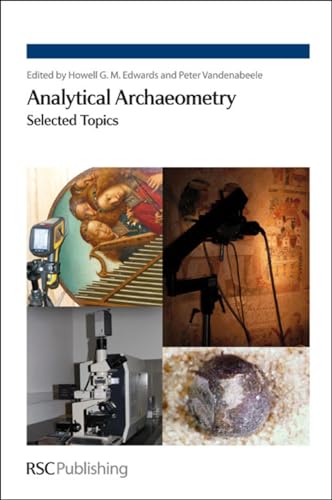
Analytical Archaeometry describes this interesting and challenging field of research - on the border between natural sciences (chemistry, spectroscopy, biology, geology) and humanities (archaeology, (art-)history, conservation sciences). It fills the gap between these two areas whilst focussing on the analytical aspects of this research field. The first part of the book studies the main analytical techniques used in this research field. The second part expands from the different types of materials usually encountered, and the final part is organised around a series of typical research questions. The book is not only focussed on archaeological materials, but is also accessible to a broader lay audience. Overall the book is clearly structured and gives insight into different approaches to the study of analytical providing extensive discussion on a wide range of techniques, materials, questions and applications. Due to the advances in analytical instrumentation and applications in this field, it is important to have all this information merged together. Academics as well as professionals in archaeology, art history, museum labs and conservation science will find this an invaluable reference source ensuring the reader is provided with the latest progress in this research field.
Die Inhaltsangabe kann sich auf eine andere Ausgabe dieses Titels beziehen.
Über die Autorinnen und Autoren
Professor Howell GM Edwards has published over 430 research papers in Raman spectroscopy and is on the Editorial Advisory Boards of the Journal of Raman Spectroscopy, Spectrochimica Acta: Biomolecular Spectroscopy, the Internet Journal of Vibrational Spectroscopy and the Asian Journal of Spectroscopy. He has supervised 40 research students for Ph.D degrees. Currently, he has research collaborations with groups in Spain, France, Denmark, Germany, Australia, Brazil and the USA. He has lectured widely on Raman spectroscopy and its applications including Plenary and Invited Lectures in Brazil, Australia, Finland, Denmark, Spain, France, South Africa, U.S.A and Germany. Sponsors of his research work include Bruker (Germany), Stiefel Pharmaceuticals, British Nuclear Fuels plc, ICI, BP, Purolite Intl. (USA), British Antarctic Survey, Repsol (Spain), the British Council and Elf Aquitaine (France). Professor Edwards is also national committee member of the Molecular Spectroscopy Group of the Royal Society of Chemistry and also of the UK Astrobiology Panel. Peter Vandenabeele is Professor of Archaeometry at the University of Ghent, Belgium. His main research interests are the application of Raman and analytical techniques to archaeology and art materials , dyestuffs , wall paintings and ceramics.
Professor Howell GM Edwards has published over 430 research papers in Raman spectroscopy and is on the Editorial Advisory Boards of the Journal of Raman Spectroscopy, Spectrochimica Acta: Biomolecular Spectroscopy, the Internet Journal of Vibrational Spectroscopy and the Asian Journal of Spectroscopy. He has supervised 40 research students for Ph.D degrees. Currently, he has research collaborations with groups in Spain, France, Denmark, Germany, Australia, Brazil and the USA. He has lectured widely on Raman spectroscopy and its applications including Plenary and Invited Lectures in Brazil, Australia, Finland, Denmark, Spain, France, South Africa, U.S.A and Germany. Sponsors of his research work include Bruker (Germany), Stiefel Pharmaceuticals, British Nuclear Fuels plc, ICI, BP, Purolite Intl. (USA), British Antarctic Survey, Repsol (Spain), the British Council and Elf Aquitaine (France). Professor Edwards is also national committee member of the Molecular Spectroscopy Group of the Royal Society of Chemistry and also of the UK Astrobiology Panel. Peter Vandenabeele is Professor of Archaeometry at the University of Ghent, Belgium. His main research interests are the application of Raman and analytical techniques to archaeology and art materials , dyestuffs , wall paintings and ceramics.
Von der hinteren Coverseite
Analytical Archaeometry describes this interesting and challenging field of research - on the border between natural sciences (chemistry, spectroscopy, biology, geology) and humanities (archaeology, (art-)history, conservation sciences). It fills the gap between these two areas whilst focussing on the analytical aspects of this research field. The first part of the book studies the main analytical techniques used in this research field. The second part expands from the different types of materials usually encountered, and the final part is organised around a series of typical research questions. The book is not only focussed on archaeological materials, but is also accessible to a broader lay audience. Overall the book is clearly structured and gives insight into different approaches to the study of analytical providing extensive discussion on a wide range of techniques, materials, questions and applications. Due to the advances in analytical instrumentation and applications in this field, it is important to have all this information merged together. Academics as well as professionals in archaeology, art history, museum labs and conservation science will find this an invaluable reference source ensuring the reader is provided with the latest progress in this research field.
Auszug. © Genehmigter Nachdruck. Alle Rechte vorbehalten.
Analytical Archaeometry
Selected Topics
By Howell Edwards, Peter VandenabeeleThe Royal Society of Chemistry
Copyright © 2012 The Royal Society of Chemistry
All rights reserved.
ISBN: 978-1-84973-162-1All rights reserved.
Contents
ANALYTICAL METHODS,
Chapter 1 Methods of Visualisation G. Verhoeven,
Chapter 2 Vibrational Spectroscopy: Theoretical Basis Relevant to Archaeometry and Archaeological Applications H. G. M. Edwards and P. Vandenabeele,
Chapter 3 X-Ray Methods H. Calvo del Castillo and D. Strivay,
Chapter 4 Radiocarbon Dating M. Van Strydonck,
Chapter 5 Separation Techniques in Archaeometry S. Saverwyns and I. Vanden Berghe,
Chapter 6 Mass Spectrometry I. Kuleff and R. Djingova,
Chapter 7 Electrochemical Techniques A. Doménech-Carbó,
MATERIALS,
Chapter 8 Pottery, Glass and Enamelled Artefacts: How to Extract Information on their Manufacture Technology, Origin and Age? Ph. Colomban,
Chapter 9 Glass L. Robinet and K. Eremin,
Chapter 10 Gemstones and Minerals S. Karampelas and L. Kiefert,
Chapter 11 Raman Spectroscopic Studies of Obsidian E. A. Carter, S. J. Kelloway, N. Kononenko and R. Torrence,
Chapter 12 Pigments and Dyes P. Vandenabeele and H.G. M. Edwards,
Chapter 13 Canvas and Panel Paintings: Techniques and Analyses E. Kouloumpi, A. P. Moutsatsou and A.-V. Terlixi,
Chapter 14 Corrosion of Ferrous Archaeological and Cultural Heritage Artefacts Ph. Dillmann and D. Neff,
Chapter 15 Resins and Fossil Resins J. Jehlicka,
Chapter 16 Archaeological Ivories: A Challenge for Analytical Raman Spectroscopy H. G. M. Edwards and S. O'Connor,
Chapter 17 Spectroscopy of Historic Textiles: a Unique 17th Century Bodice A. Hernanz, J. M. Gavira-Vallejo, M. C. Á lvarez, S. Martín, S. Montero, E. A. Carter, E. Gavrilenko and H. G. M. Edwards,
Chapter 18 Identification and Authentication R. A. Goodall,
Chapter 19 Technology of Production: The Master Potter 'Ali Muhammad Isfahani: Insights into the Production of Decorative Underglaze Painted Tiles in 19th Century Iran I. Reiche and F. Voigt,
Chapter 20 The Application of Analytical Archaeometry in Underwater Cultural Heritage — A Case Study from Patagonia, Argentina D. Elkin, H.G.M. Edwards and M.S. Maier,
Subject Index,
CHAPTER 1
Methods of Visualisation
G. VERHOEVEN
1.1 Introduction
In the fields of cultural heritage, archaeology, art history and museology, many examination methods are based on imaging techniques. To date, numerous different imaging approaches exist, and although most of them have already existed for several decades, recent advantages in hard- and software technology make their application more straightforward than ever. In this chapter, an elementary but essential coverage of photodetectors, illumination equipment and signal composition will be provided to better understand the basic principles of common non-destructive scientific visualisations such as broadband colour photography, non-visible ultraviolet and infrared imaging, fluorescent photography, spectral imaging and X-ray radiography. Although important, many means to characterise and depict archaeological and heritage object will not be discussed (such as particle induced X-ray emission or PIXE, ultrasound techniques, thermography, stereomicroscopy, computed tomography, neutron imaging), nor will the file formats needed to store these visualisations and many other related archiving issues. For those interested in these topics, the following chapters of this book and the excellent compendium of MacDonald are recommended. Although several practical examples will illustrate each and every visualisation technique tackled in this chapter, it is still necessary to go back to some basic physics. Since imaging art objects and archaeological artefacts are all based upon some essential principles of how matter interacts with radiant energy, this chapter will start with a concise exploration of the world of matter, charge and energy.
1.1.1 Electromagnetic Radiation
Matter can be described as anything that occupies space and has weight. It is constituted by elements in various combinations. These elements, all described in the periodic table, are made up of atoms. Such atoms can be seen as the smallest matter particle, retaining all physical characteristics of an element. Different atom models were proposed during the last two centuries. Today, the Bohr model — introduced by Niels Bohr in 1913 — is often used, as it offers an easy way to depict the atom besides a relative correctness. In this model, the central core or nucleus of the atom is made up of chargeless neutrons and positively charged protons, whose amount is indicated by the atomic number Z. To compensate for these positive charges, negatively charged particles or electrons orbit this nucleus. Hence, it is correct to say that electric charge is substance-like and that all physical objects are composed of electric charge.
Charge differs from energy. Energy should not be looked at as a substance but rather as an attribute of a system that always turns out to be conserved. To be able to track energy flows, energy can be conceptualised by the model of fields. In the same way that a massive object can produce a gravity field to which distant objects respond, electrical charges and magnets alter the region of space around them so that they can exert forces on distant objects. It is exactly this altered space that is called a field (more technically, these fields are just vector quantities). Scientists have known since the early part of the 19th century that electrical fields and magnetic fields are intimately related to each other: moving electric charges (i.e. electric current) create a magnetic field and a changing magnetic field creates electrical current (thus electrical fields). A consequence of this is that changing electric and magnetic fields should trigger each other. The Scottish mathematician and physicist James Clerk Maxwell (1831–1879) put these ideas together and mathematically described the relationship between the magnetic and electric fields, as well as the currents and charges that create them. To conclude this line of reasoning, Maxwell said that visible light is an electromagnetic (EM) wave, consisting of both an electric (E) and magnetic (B) field (Figure 1.1). Both fields are oscillating perpendicular to each other as well as perpendicular to the direction of propagation (which makes them a transverse wave), whilst propagating at 299 792 458 m s-1 in vacuum. The latter speed is known as the speed of light, denoted c, and decreases when light travels in air, glass, water or other transparent substances.
The electric and magnetic component vectors vibrate in phase and are sinusoidal in nature: they oscillate in a periodic fashion as they propagate through space and have peaks and troughs (see Figure 1.1). Being a self-propagating and periodic wave-like phenomenon, EM radiation is distinguished by the length of its waves, called the wavelength (ITLλITL), its magnitude of change or amplitude (A) as well as its frequency (ITLλITL): a figure — expressed in Hertz (Hz) — that indicates the number of complete waves or sinusoidal cycles passing a certain point in one second and thus inversely proportional to ITLλITL. No matter what portion of this broad spectrum is considered, they all obey the same physical laws and the...
„Über diesen Titel“ kann sich auf eine andere Ausgabe dieses Titels beziehen.
Suchergebnisse für Analytical Archaeometry: Selected Topics

Beispielbild für diese ISBN
Analytical Archaeometry: Selected Topics
Anbieter: Romtrade Corp., STERLING HEIGHTS, MI, USA
Verkäuferbewertung 5 von 5 Sternen

Zustand: New. This is a Brand-new US Edition. This Item may be shipped from US or any other country as we have multiple locations worldwide. Artikel-Nr. ABBB-203795
Beispielbild für diese ISBN
Analytical Archaeometry: Selected Topics
Anbieter: Romtrade Corp., STERLING HEIGHTS, MI, USA
Verkäuferbewertung 5 von 5 Sternen
Zustand: New. This is a Brand-new US Edition. This Item may be shipped from US or any other country as we have multiple locations worldwide. Artikel-Nr. ABBB-137041
Beispielbild für diese ISBN
Analytical Archaeometry
Anbieter: Majestic Books, Hounslow, Vereinigtes Königreich
Verkäuferbewertung 4 von 5 Sternen

Zustand: New. pp. 593 Illus. Artikel-Nr. 4325690
Neu kaufen
EUR 115,84
EUR 7,58 Versand
Versand von Vereinigtes Königreich nach USA
Versand von Vereinigtes Königreich nach USA
Anzahl: 1 verfügbar
Beispielbild für diese ISBN
Analytical Archaeometry
Anbieter: Romtrade Corp., STERLING HEIGHTS, MI, USA
Verkäuferbewertung 5 von 5 Sternen
Zustand: New. This is a Brand-new US Edition. This Item may be shipped from US or any other country as we have multiple locations worldwide. Artikel-Nr. ABBB-190998
Foto des Verkäufers
Analytical Archaeometry
Anbieter: moluna, Greven, Deutschland
Verkäuferbewertung 5 von 5 Sternen
Gebunden. Zustand: New. Analytical Archaeometry describes this interesting and challenging field of research - on the border between natural sciences (chemistry, spectroscopy, biology, geology) and humanities (archaeology, (art-)history, conservation sciences).Über de. Artikel-Nr. 597106708
Neu kaufen
EUR 211,88
EUR 48,99 Versand
Versand von Deutschland nach USA
Versand von Deutschland nach USA
Anzahl: Mehr als 20 verfügbar
Beispielbild für diese ISBN
Analytical Archaeometry: Selected Topics
Anbieter: Revaluation Books, Exeter, Vereinigtes Königreich
Verkäuferbewertung 5 von 5 Sternen
Hardcover. Zustand: Brand New. 1st edition. 604 pages. 9.25x6.25x1.75 inches. In Stock. Artikel-Nr. x-1849731624
Neu kaufen
EUR 293,31
EUR 17,50 Versand
Versand von Vereinigtes Königreich nach USA
Versand von Vereinigtes Königreich nach USA
Anzahl: 1 verfügbar
Foto des Verkäufers
Analytical Archaeometry : Selected Topics
Anbieter: AHA-BUCH GmbH, Einbeck, Deutschland
Verkäuferbewertung 5 von 5 Sternen
Buch. Zustand: Neu. Neuware - Analytical Archaeometry describes this interesting and challenging field of research - on the border between natural sciences (chemistry, spectroscopy, biology, geology) and humanities (archaeology, (art-)history, conservation sciences). It fills the gap between these two areas whilst focussing on the analytical aspects of this research field. The first part of the book studies the main analytical techniques used in this research field. The second part expands from the different types of materials usually encountered, and the final part is organised around a series of typical research questions. The book is not only focussed on archaeological materials, but is also accessible to a broader lay audience. Overall the book is clearly structured and gives insight into different approaches to the study of analytical providing extensive discussion on a wide range of techniques, materials, questions and applications. Due to the advances in analytical instrumentation and applications in this field, it is important to have all this information merged together. Academics as well as professionals in archaeology, art history, museum labs and conservation science will find this an invaluable reference source ensuring the reader is provided with the latest progress in this research field. Artikel-Nr. 9781849731621
Neu kaufen
EUR 296,52
EUR 43,04 Versand
Versand von Deutschland nach USA
Versand von Deutschland nach USA
Anzahl: 1 verfügbar