
Verwandte Artikel zu Computational Nanoscience: Rsc (Rsc Theoretical and...
Computational Nanoscience: Rsc (Rsc Theoretical and Computational Chemistry Series, Band 4) - Hardcover
Inhaltsangabe
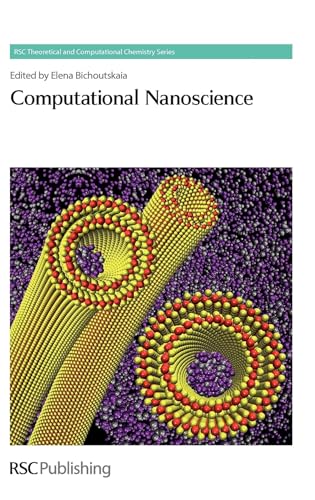
Nanoscience is one of the most exciting areas of modern physical science as it encompasses a range of techniques rather than a single discipline. It stretches across the whole spectrum of science including: medicine and health, physics, engineering and chemistry. Providing a deep understanding of the behaviour of matter at the scale of individual atoms and molecules, it provides a crucial step towards future applications of nanotechnology. The remarkable improvements in both theoretical methods and computational techniques make it possible for modern computational nanoscience to achieve a new level of chemical accuracy. It is now a discipline capable of leading and guiding experimental efforts rather than just following others. Computational Nanoscience addresses modern challenges in computational science, within the context of the rapidly evolving field of nanotechnology. It satisfies the need for a comprehensive, yet concise and up-to-date, survey of new developments and applications presented by the world's leading academics. It documents major, recent advances in scientific computation, mathematical models and theory development that specifically target the applications in nanotechnology. Suitable for theoreticians, researchers and students, the book shows readers what computational nanoscience can achieve, and how it may be applied in their own work. The twelve chapters cover topics including the concepts behind recent breakthroughs, the development of cutting edge simulation tools, and the variety of new applications.
Die Inhaltsangabe kann sich auf eine andere Ausgabe dieses Titels beziehen.
Über die Autorinnen und Autoren
Elena Bichoutskaia is based in the Department of Chemistry at the University of Nottingham. Prior to this she worked in the Departments of Chemistry at the Universities of Cambridge and Sussex and held a Royal Society/NATO Fellowship at The Queen's University of Belfast. She has contributed to 35 academic papers and is the recipient of eight academic awards. Dr Bichoutskaia has also been invited to speak at numerous seminars, symposia and conferences. She has extensive university teaching experience and was involved in the development of the new Natural Sciences (BSc Honours and MSci Honours) degree courses at the University of Nottingham.
Elena Bichoutskaia is based in the Department of Chemistry at the University of Nottingham. Prior to this she worked in the Departments of Chemistry at the Universities of Cambridge and Sussex and held a Royal Society/NATO Fellowship at The Queen's University of Belfast. She has contributed to 35 academic papers and is the recipient of eight academic awards. Dr Bichoutskaia has also been invited to speak at numerous seminars, symposia and conferences. She has extensive university teaching experience and was involved in the development of the new Natural Sciences (BSc Honours and MSci Honours) degree courses at the University of Nottingham.
Von der hinteren Coverseite
Nanoscience is one of the most exciting scientific disciplines as it is concerned with materials and systems, which exhibit novel and significantly improved physical, chemical and biological properties due to their small nanoscale size. It stretches across the whole spectrum of modern science including medicine and health, physics, engineering and chemistry. Providing a deep understanding of the behaviour of matter at the scale of individual atoms and molecules, it takes a crucial step towards future applications of nanotechnology. The remarkable improvements in both theoretical methods and computational techniques make it possible for computational nanoscience to achieve a new level of accuracy. Computational nanoscience is now a discipline capable of leading and guiding experimental efforts. Computational Nanoscience addresses modern challenges in computational science, within the context of the rapidly evolving field of nanotechnology. It satisfies the need for a comprehensive, yet concise and up-to-date, survey of new developments and applications presented by the world's leading academics. It documents major, recent advances in scientific computation, mathematical models and theory development that specifically target the applications in nanotechnology. Suitable for theoreticians, experimental researchers and students, the book shows readers what computational nanoscience can achieve, and how it may be applied in their own work. The twelve chapters cover topics including the concepts behind recent breakthroughs in nanoscience, the development of cutting edge simulation tools, and the variety of new applications.
Auszug. © Genehmigter Nachdruck. Alle Rechte vorbehalten.
Computational Nanoscience
By Elena BichoutskaiaThe Royal Society of Chemistry
Copyright © 2011 Royal Society of Chemistry
All rights reserved.
ISBN: 978-1-84973-133-1All rights reserved.
Contents
Chapter 1 Algorithms for Predicting the Physical Properties of Nanocrystals and Large Clusters James R. Chelikowsky, 1,
Chapter 2 Rational Design of Mixed Nanoclusters: Metal Shells Supported and Shaped by Molecular Cores Fedor Y. Naumkin, 26,
Chapter 3 Self-Assembly of Nanoclusters: An Energy Landscape Perspective Dwaipayan Chakrabarti, Szilard N. Fejer and David J. Wales, 58,
Chapter 4 Phase Transition under Confinement Jayant K. Singh, Hugh Docherty and Peter T. Cummings, 82,
Chapter 5 Simulating Thermomechanical Phenomena of Nanoscale Systems P. Alex Greaney and Jeffrey C. Grossman, 109,
Chapter 6 Computational Electrodynamics Methods Nadine Harris, Logan K. Ausman, Jeffrey M. McMahon, David J. Masiello and George C. Schatz, 147,
Chapter 7 Electron Transport Theory for Large Systems Stefano Sanvito, 179,
Chapter 8 Theoretical Strategies for Functionalisation and Encapsulation of Nanotubes Gotthard Seifert, Matteo Baldoni, Francesco Mercuri and Andrey Enyashin, 225,
Chapter 9 Density Functional Calculations of NMR Chemical Shifts in Carbon Nanotubes Eva Zurek and Jochen Autschbach, 279,
Chapter 10 Computational Study of the Formation of Inorganic Nanotubes Mark Wilson, 307,
Chapter 11 Native and Irradiation-Induced Defects in Graphene: What Can We Learn from Atomistic Simulations? Jani Kotakoski and Arkady V. Krasheninnikov, 334,
Chapter 12 The Atomic-, Nano-, and Mesoscale Origins of Graphite's Response to Energetic Particles Malcolm I. Heggie and Christopher D. Latham, 377,
Subject Index, 414,
CHAPTER 1
Algorithms for Predicting the Physical Properties of Nanocrystals and Large Clusters
JAMES R. CHELIKOWSKY
Center for Computational Materials, Institute for Computational
Engineering and Sciences, University of Texas at Austin, Austin, Texas 78712, USA; Departments of Physics and Chemical Engineering, University of Texas at Austin, Austin, Texas 78712, USA
1.1 Introduction
Quantum confinement offers one the opportunity to alter physical properties of matter without changing the chemical composition. For example, quantum confinement can be used to tune the optical gap across the visible spectrum in CdSe nanocrystals or it can be used to modify the magnetic moment of ferromagnetic clusters.
However, constructing an efficacious algorithm for predicting the role of quantum confinement and its role in determining the properties of nanocrystals is a difficult task owing to the complexity of nanocrystals, which often contain thousands of atoms. Here, I will illustrate new algorithms for nanoscale systems. These algorithms are especially designed for highly parallel platforms. The nature of these algorithms will be discussed and applied to complex systems such as magnetic clusters, and doped semiconductor nanocrystals.
1.2 The Electronic Structure Problem
Many properties of materials can be predicted by a solution of the Kohn–Sham equation:
[MATHEMATICAL EXPRESSION OMITTED], (1.1)
where Vpion is an ionic pseudopotential, VH is the Hartree or Coulomb potential, and Vxc is the exchange-correlation potential. The Hartree and exchange-correlation potentials can be determined from the electronic charge density. The density is given by
[MATHEMATICAL EXPRESSION OMITTED]. (1.2)
The summation is over all occupied states. The Hartree potential is determined by
[MATHEMATICAL EXPRESSION OMITTED]. (1.3)
This term can be interpreted as the electrostatic interaction of a point charge with the charge density of the system.
A physical interpretation of the exchange-correlation potential is more difficult as it has no classical analogue. This potential can be evaluated using a local density approximation. The central tenet of this approximation is that the total exchange-correlation energy may be written as a universal functional of the density:
[MATHEMATICAL EXPRESSION OMITTED], (1.4)
where εxc is the exchange-correlation energy density. Exc and εxc are to be interpreted as depending solely on the charge density. The exchangecorrelation potential, Vxc, is then obtained as [MATHEMATICAL EXPRESSION OMITTED].
It is not difficult to solve the Kohn–Sham equation (eqn (1.1)) for an atom as the atomic charge density can be taken to be spherically symmetric. Thus, the Kohn–Sham problem reduces to solving a one-dimensional problem. The Hartree and exchange-correlation potentials can be iterated to form a self-consistent field. This atomic solution provides the input to construct a pseudo-potential representing the effect of the core electrons and nucleus. The "ion-core" pseudopotential, Vpion, can be transferred to other systems such as molecules and nanocrystals.
The Kohn–Sham equations represent a nonlinear, self-consistent eigenvalue problem. Typically, a solution is obtained by first approximating the Hartree and exchange-correlation potentials using a superposition of atomic charge densities. The Kohn–Sham equation is then solved using these approximate potentials. From the solution, new wavefunctions and charge densities are obtained and used to construct updated Hartree and exchange-correlation potentials. The process is repeated until the "input" and "output" potentials agree and a self-consistent solution is realised. At this point, the total electronic energy can be computed along with a variety of other electronic properties. Once the Kohn–Sham equation is solved, the total electronic energy, ET, of the system can be evaluated from
[MATHEMATICAL EXPRESSION OMITTED]. (1.5)
The structural energy can be obtained by adding the ion-core electrostatic terms. The forces can be obtained by taking the derivative of the energy with respect to position as from the Hellmann–Feynman theorem.
1.3 Algorithms for Solving the Kohn–Sham Equation
The Kohn–Sham equation as cast in eqn (1.1) can be solved using a variety of techniques. Often, the wavefunctions can be expanded in a basis such as plane waves or gaussians and the resulting secular equations can be solved using standard diagonalisation packages such as those found in VASP.
Here, we focus on a different approach. We solve the Kohn–Sham equation without resort to an explicit basis. We solve for the wavefunctions on a grid with a fixed domain, which encompasses the physical system of interest. The grid need not be uniform, but it greatly simplifies the problem if it is. The wavefunctions outside of the domain are required to vanish for confined sys- tems or assume periodic boundary conditions for systems with translational symmetry. In contrast to methods employing an explicit basis, such boundary conditions are easily incorporated. In particular, real-space methods do not require the use of supercells for localised systems. As such, charged systems can easily be examined without considering any electrostatic divergences. The Hartree potential is also solved on the grid from eqn (1.3) using conjugate-gradient minimisation. For confined systems, the boundary condition for this Poisson equation can be obtained by first performing a multipole expansion of the electronic charge density, the Hartree potential on the boundary of the domain can then be evaluated using the multipoles. A few...
„Über diesen Titel“ kann sich auf eine andere Ausgabe dieses Titels beziehen.
Suchergebnisse für Computational Nanoscience: Rsc (Rsc Theoretical and...

Beispielbild für diese ISBN
Computational Nanoscience: Rsc: Volume 4 (Theoretical and Computational Chemistry Series)
Verlag:
Royal Society of Chemistry, 2011
ISBN 10: 1849731330
ISBN 13: 9781849731331
Gebraucht
Hardcover
Erstausgabe
Anbieter: Prior Books Ltd, Cheltenham, Vereinigtes Königreich
Verkäuferbewertung 5 von 5 Sternen

Hardcover. Zustand: Like New. First Edition. Publisher's hardback in nearly new condition: firm and square, strong joints, sharp corners, no bumps. Contents crisp, tight and clean; no pen-marks. Not from a library so no such stamps or labels. Looks unread. Thus a tidy book in very presentable condition. Artikel-Nr. 212177
Gebraucht kaufen
EUR 44,39
EUR 25,62 Versand
Versand von Vereinigtes Königreich nach USA
Versand von Vereinigtes Königreich nach USA
Anzahl: 1 verfügbar
Beispielbild für diese ISBN
Computational Nanoscience
Anbieter: PBShop.store US, Wood Dale, IL, USA
Verkäuferbewertung 5 von 5 Sternen
HRD. Zustand: New. New Book. Shipped from UK. Established seller since 2000. Artikel-Nr. CX-9781849731331
Neu kaufen
EUR 186,01
Versand gratis
Versand innerhalb von USA
Versand innerhalb von USA
Anzahl: 15 verfügbar
Beispielbild für diese ISBN
Computational Nanoscience
Anbieter: PBShop.store UK, Fairford, GLOS, Vereinigtes Königreich
Verkäuferbewertung 5 von 5 Sternen
HRD. Zustand: New. New Book. Shipped from UK. Established seller since 2000. Artikel-Nr. CX-9781849731331
Neu kaufen
EUR 180,75
EUR 6,84 Versand
Versand von Vereinigtes Königreich nach USA
Versand von Vereinigtes Königreich nach USA
Anzahl: 15 verfügbar
Beispielbild für diese ISBN
Computational Nanoscience (Theoretical and Computational Chemistry Series, Volume 4)
Anbieter: Ria Christie Collections, Uxbridge, Vereinigtes Königreich
Verkäuferbewertung 5 von 5 Sternen
Zustand: New. In English. Artikel-Nr. ria9781849731331_new
Neu kaufen
EUR 199,15
EUR 13,15 Versand
Versand von Vereinigtes Königreich nach USA
Versand von Vereinigtes Königreich nach USA
Anzahl: 1 verfügbar
Foto des Verkäufers
Computational Nanoscience
Anbieter: moluna, Greven, Deutschland
Verkäuferbewertung 5 von 5 Sternen
Gebunden. Zustand: New. This comprehensive and up-to-date survey of new developments and applications in computational nanoscience is suitable for theoreticians, researchers and students.Über den AutorrnrnElena Bichoutskaia is based in the Department of Chemis. Artikel-Nr. 597106684
Neu kaufen
EUR 194,16
EUR 48,99 Versand
Versand von Deutschland nach USA
Versand von Deutschland nach USA
Anzahl: Mehr als 20 verfügbar
Beispielbild für diese ISBN
Computational Nanoscience
Anbieter: Revaluation Books, Exeter, Vereinigtes Königreich
Verkäuferbewertung 5 von 5 Sternen
Hardcover. Zustand: Brand New. 1st edition. 444 pages. 9.25x6.50x1.25 inches. In Stock. Artikel-Nr. x-1849731330
Neu kaufen
EUR 258,37
EUR 14,56 Versand
Versand von Vereinigtes Königreich nach USA
Versand von Vereinigtes Königreich nach USA
Anzahl: 2 verfügbar
Foto des Verkäufers
Computational Nanoscience
Anbieter: AHA-BUCH GmbH, Einbeck, Deutschland
Verkäuferbewertung 5 von 5 Sternen
Buch. Zustand: Neu. Neuware - Computational Nanoscience documents major recent advances in scientific computation, mathematical models and theory development that specifically target the future applications of nanotechnology. The remarkable improvements in both theoretical methods and computer technology make it now possible for modern computational nanoscience to achieve a new level of chemical accuracy. It places computational nanoscience in the position where it can lead and guide the experimental efforts. This book will satisfy the current need for a comprehensive, yet concise and up-to-date, survey of the new developments and applications. Written by the world's leading academics, this book is suitable for a readership made up of theoreticians and also experimental researchers who can learn what computational nanoscience can achieve and how it maybe applied to their work. Post-graduate and undergraduate students will also find this a useful resource. Artikel-Nr. 9781849731331
Neu kaufen
EUR 247,51
EUR 30,50 Versand
Versand von Deutschland nach USA
Versand von Deutschland nach USA
Anzahl: 2 verfügbar