
Rising Sun: The Decline and Fall of the Japanese Empire, 1936-1945 - Softcover
Buch 2 von 8: Modern Library War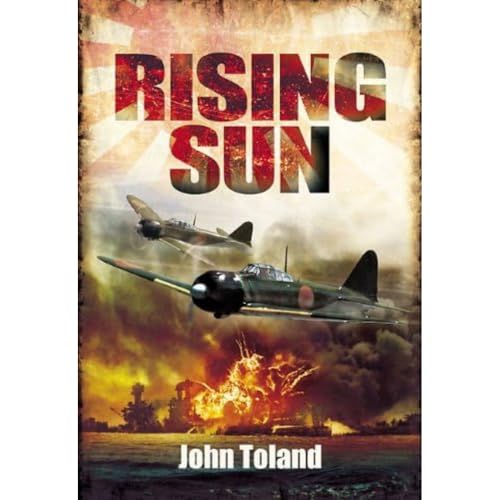
Inhaltsangabe
This magnificent Pulitzer Prize-winning history, told primarily from the Japanese viewpoint, traces the dramatic fortunes of the Empire of the Sun from the invasion of Manchuria to the dropping of the atomic bombs, demolishing many myths surrounding this catastrophic conflict.Why did the dawn attack on Pearl Harbor occur? Was was inevitable? Was the Emperor a puppet or a warmonger? And, finally, what inspired the barbaric actions of those who fought, and who speak here of the unspeakable - murder, cannibalism and desertion? 'Unbelievably rich … Readable and exciting' Newsweek'The most readable, yet informative account of the Pacific War' Chicago Sunday Times
Die Inhaltsangabe kann sich auf eine andere Ausgabe dieses Titels beziehen.
Auszug. © Genehmigter Nachdruck. Alle Rechte vorbehalten.
The Rising Sun
The Decline and Fall of the Japanese Empire 1936–1945
By John TolandPen and Sword Books Ltd
Copyright © 2011 John Toland
All rights reserved.
ISBN: 978-1-84884-525-1All rights reserved.
Contents
Foreword,
Part One-The Roots of War,
1 Gekokujo,
2 To the Marco Polo Bridge,
3 "Then the War Will Be a Desperate One",
Part Two-The Lowering Clouds,
4 "Go Back to Blank Paper",
5 The Fatal Note,
6 Operation Z,
7 "This War May Come Quicker Than Anyone Dreams",
Part Three-Banzai!,
8 "I Shall Never Look Back",
9 "The Formidable Years That Lie Before Us",
10 "For a Wasted Hope and Sure Defeat",
11 "To Show Them Mercy Is to Prolong the War",
12 "But Not in Shame,
13 The Tide Turns,
Part Four-Isle of Death,
14 Operation Shoestring,
15 Green Hell,
16 "I Deserve Ten Thousand Deaths",
17 The End,
Part Five-The Gathering Forces,
18 Of Mice and Men,
19 To the Marianas,
20 "Seven Lives to Repay Our Country!",
Part Six — The Decisive Battle,
21 "Let No Heart Be Faint",
22 The Battle of Leyte Gulf,
23 The Battle of Breakneck Ridge,
24 Debacle,
Part Seven — Beyond the Bitter End,
25 "Our Golden Opportunity",
26 "Like Hell with the Fire Out",
27 The Flowers of Edo,
28 The Last Sortie,
29 The Iron Typhoon,
30 The Stragglers,
Part Eight — "One Hundred Million Die Together",
31 In Quest of Peace,
32 "That Was Not Any Decision That You Had To Worry About",
33 Hiroshima,
34 ... and Nagasaki,
35 "To Bear the Unbearable",
36 The Palace Revolt,
37 The Voice of the Crane,
Epilogue,
Acknowledgements,
Sources,
Notes,
Index,
CHAPTER 1
Gekokujo
1.
The sky over Tokyo on the afternoon of February 25, 1936, was dark and foreboding. A thick blanket of snow already covered the city and there was threat of more to come. Three nights earlier more than a foot had fallen, breaking a record of fifty-four years, and causing such a traffic snarl that some theaters had to be turned into temporary hotels for audiences unable to get home.
Even under its white cloak of snow, Tokyo looked almost as Western as Oriental. Japan had left much of its feudal past behind to become by far the most progressive, westernized nation of Asia. A few hundred yards from the Imperial Palace with its traditional tile roof was a modern four-story concrete building, the Imperial Household Ministry, where all court business was conducted and the Emperor's offices were located. Just outside the ancient stone walls and moat surrounding the spacious Palace grounds was the same mélange of East and West: a long line of modern structures, including the Imperial Theater and the Dai Ichi Building, as Occidental as the skyline of Chicago, while a few blocks away, in narrow cobblestone streets, were row upon row of geisha houses, sushi stands and kimono stores, and assorted little ramshackle shops, gay even on that cloudy day with their flapping doorway curtains and colorful lanterns.
Next to the Palace on a small hill was the not quite completed Diet Building, constructed mainly of stone from Okinawa and looking quasi-Egyptian. Behind this commanding edifice was a cluster of spacious houses, the official residence of government leaders. The largest was that of the Prime Minister. It was two buildings in one, the business part Western in the early Frank Lloyd Wright style, the living quarters Japanese with paper-thin walls, tatami floors and sliding doors.
But beneath the peaceful exterior of Tokyo seethed an unrest which would soon spill violently into the snow-covered streets. At one end of the Palace grounds were the barracks of the 1st (Gem) Division. Here authorities were already prepared for trouble after a tip about a military insurrection from a major in the War Ministry: he had learned from a young officer that a group of radicals planned to assassinate several advisers to the Emperor that day. Suspects had been put under surveillance, and important public figures were given emergency bodyguards. The doors of the Prime Minister's official residence were reinforced with steel, iron bars installed in the windows, and a warning system connected directly to police headquarters. But the kempeitai (military police organization) and the regular police felt they could easily handle the situation. After all, what real damage could a handful of rebels do, however strongly motivated? And by now they were wondering how reliable the information was that the uprising was at hand. The day was almost over.
It seems strange that they were so complacent, since the spirit of rebellion was high among elite troops charged with defense of the Palace grounds. Their defiance was so apparent that they were on orders to be shipped out to Manchuria in a few days, and their contempt for authority so open that one unit, ostensibly on maneuvers, had urinated in cadence at metropolitan police headquarters. Fourteen hundred of these unruly officers and men were preparing to revolt. Just before dawn the next morning, attack groups would strike simultaneously at six Tokyo targets: the homes of several government leaders, as well as metropolitan police headquarters.
While intricate preparations for these attacks were proceeding, pleasure seekers roamed the darkening streets in search of entertainment. Already the Ginza, Tokyo's Broadway-Fifth Avenue, was teeming. To young Japanese it had long been a romantic symbol of the outside world, a fairyland of neon lights, boutiques, coffee shops, American and European movies, Western-style dance halls and restaurants. A few blocks away, in the Akasaka section, where the kimono was common for both men and women, the old Japan also anticipated a night of pleasure. Geishas looking like something out of antiquity in their theatrical makeup and resplendent costumes were pulled in rickshaws through the winding, willow-lined streets. Here the lights were more muted, and the traditional red lanterns carried by the police gave off a soft, nostalgic glow. It was a charming woodcut come alive.
These insurrectionists were not motivated by personal ambition. Like half a dozen groups before them–all of which had failed–they were about to try once again to redress the social injustices in Japan through force and assassination. Tradition had legitimized such criminal action, and the Japanese had given it a special name, gekokujo (insubordination), a term first used in the fifteenth century when rebellion was rampant on every level, with provincial lords refusing to obey the shogun, who in turn ignored the orders of the emperor.
The crumbling of autocracy in Europe after World War I, followed by the tide of democracy, socialism and Communism, had had dramatic impact on the young people of Japan, and they too set up a cry for change. Political parties emerged and a universal manhood suffrage bill was enacted in 1924. But it all happened too fast. Too many Japanese looked upon politics as a game or a source of easy money and there was a series of exposés–the Matsushima Red-Light District Scandal, the Railway Scandal, the Korean Scandal. Charges of bribery and corruption resulted in mob brawls on the floor of the Diet.
The population explosion which accompanied Japan's westernization added to the confusion. Hokkaido, Honshu, Kyushu and Shikoku (her four main islands, comprising an area...
„Über diesen Titel“ kann sich auf eine andere Ausgabe dieses Titels beziehen.
Weitere beliebte Ausgaben desselben Titels

Suchergebnisse für Rising Sun: The Decline and Fall of the Japanese Empire,...

Foto des Verkäufers
Rising Sun
Anbieter: MusicMagpie, Stockport, Vereinigtes Königreich
Verkäuferbewertung 5 von 5 Sternen

Zustand: Very Good. 1776345092. 4/16/2026 1:11:32 PM. Artikel-Nr. U9781848845251
Gebraucht kaufen
EUR 11,75
EUR 6,36 Versand
Versand von Vereinigtes Königreich nach USA
Versand von Vereinigtes Königreich nach USA
Anzahl: 1 verfügbar