
Verwandte Artikel zu The Business of Human Rights: An Evolving Agenda for...
Inhaltsangabe
An essential text that provides a human rights approach to corporate responsibilities across the globe.
Die Inhaltsangabe kann sich auf eine andere Ausgabe dieses Titels beziehen.
Über die Autorin bzw. den Autor
Helen Yanacopulos is a senior lecturer in international politics and development. She worked for ten years in the corporate and non-profit sectors before returning to academia to complete an MA in development studies at the University of East Anglia and a PhD in social and political science at the University of Cambridge. She has been at the Open University since 2000 where she has taught courses in international studies and development studies. Her research has been primarily focussed on transnational networks of NGOs, social movements and civil society, specifically: the intersection of technology, civil society and political action; global justice focussed networks; transnational governance; and, the construction and representation of international development. She has acted as a consultant for international organisations and NGOs, and has been a consultant on seven BBC documentaries. Helen has recently been appointed the programme director for the environment, development and international studies programmes and course at the OU.
Auszug. © Genehmigter Nachdruck. Alle Rechte vorbehalten.
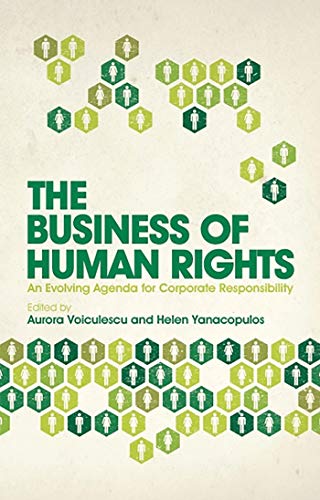
The Business of Human Rights
An Evolving Agenda for Corporate Responsibility
By Aurora Voiculescu, Helen YanacopulosZed Books Ltd
Copyright © 2011 The Open University
All rights reserved.
ISBN: 978-1-84813-862-9All rights reserved.
Contents
Figures and tables, vi,
Abbreviations and acronyms, vii,
1 Human rights in business contexts: an overview AURORA VOICULESCU AND HELEN YANACOPULOS, 1,
2 Human rights and the normative ordering of global capitalism AURORA VOICULESCU, 10,
3 Brands, corporate social responsibility and reputation management FIONA HARRIS, 29,
4 Transforming labour standards into labour rights PIYA PANGSAPA AND MARK J. SMITH, 55,
5 Violent corporate crime, corporate social responsibility and human rights GARY SLAPPER, 79,
6 Access to medicines: intellectual property rights, human rights and justice KEREN BRIGHT AND LOIS MURAGURI, 101,
7 Foundations – actors of change? HELEN YANACOPULOS, 122,
8 Combating transnational corporate corruption: enhancing human rights and good governance JOHN HATCHARD, 143,
9 Business in zones of conflict: an emergent corporate security responsibility? NICOLE DIETELHOFF AND KLAUS DIETER WOLF, 166,
10 Human rights, ethics and international business: the case of Nigeria OLUFEMI AMAO, 188,
11 Clusters of injustice: human rights, labour standards and environmental sustainability MARK J. SMITH AND PIYA PANGSAPA, 214,
Index, 235,
CHAPTER 1
Human rights in business contexts: an overview
AURORA VOICULESCU AND HELEN YANACOPULOS
The business and human rights nexus
The role and responsibility of business in issues of labour, environment and society has been a key point of discussion over the past few decades, and has led to such terms as 'corporate social responsibility' entering common parlance. Corporations have rushed to incorporate voluntary instruments into their business practices – frequently as a response to public criticism, but also frequently as a means of 'doing good'. Businesses have been encouraged to do this by international frameworks and declarations, and by pressure to ensure that they achieve some international standards. The framework of human rights has become an international social norm, to which many international businesses now subscribe.
Why has this been seen as necessary? First of all, large corporations have become increasingly international (some would say 'global') and, in terms of their supply chains, even more interconnected than before with medium-sized and smaller producers across the globe. In their primary aim of reducing costs (and consequently increasing their profit margins), corporations have fuelled what has been called the 'race to the bottom' – finding the cheapest labour to produce their products. Furthermore, in trying to maximise profits, some corporations have frequently cut corners, resulting in damage to the environment where products are produced or disposed of (typically not the same locations as where the products are consumed). This has inevitably generated harsh public criticism. The internationalisation and globalisation of business has also meant that, whereas in the past businesses have been linked to local communities via production and consumption, this link is now (with few exceptions) severed.
Second, frequently there is a disjuncture between the needs of individuals and societies, and the agencies – largely governmental – that can (or have the duty to) provide/protect/promote/fulfil these needs. This broken link may be detected with regard to instances of individual harm and the perpetrator agency (for instance a transnational corporation), as well as instances of harm and the compensatory agency (generally, national governments). However, aside from this severed link between needs and the duty-bearing agencies, there is also a perceived conceptual and legal dislocation of duties and responsibilities.
Corporate social responsibility
Businesses today are expected to conduct their operations responsibly and with accountability to wider society. The responsibility and accountability derived from these expectations have found their platform in the corporate social responsibility debate. The concept of corporate social responsibility itself is multifaceted. Zenisek (1979), for instance, spoke of corporate social responsibility as meaning 'something', but not always the same 'something' to everyone. To some it conveys the idea of legal responsibility or liability; to others it means socially responsible behaviour in an ethical sense; to still others the meaning transmitted is that of 'responsible for' in a causal mode; many simply equate it with 'charitable contributions'; many of those who embrace it see it as a mere synonym for 'legitimacy'; a few see it as a sort of fiduciary duty.
In a similar vein, Carroll (1979) suggested that the definition of corporate social responsibility (CSR) should encompass the range of social expectations placed on companies, including economic, legal, ethical and philanthropic responsibilities. From this perspective, he spoke of at least four types of corporate responsibility. First of all, of course, there is economic responsibility, which corresponds readily with a business's self-perception of its scope and role in society. This would imply the primary responsibility of a business organisation to produce goods and services in a way that is profitable for its owners.
Second, while assuming their fundamental economic role, companies are expected to comply with the laws and regulations that reflect society's values and norms. Legal expectations apply to companies as legal entities that can act as persons; but they also affect individuals in their role as employees. This represents the legal dimension of a business organisation's social responsibilities.
Third, business organisations are expected to abide by the ethical norms of society. Carroll argues that, because these norms are not written down in law, they are more ambiguous than legal requirements and therefore more difficult for companies to anticipate and follow. Nevertheless, as we shall see throughout this volume, there is an inherent link between legal and ethical responsibilities, because ethical expectations can be seen to underpin and predict the emergence of new laws and regulations. For example, social movements – including those that promote labour rights, women's rights and environmental protection - have advocated values that have later been codified into law. Moreover, the law has its own insidious ways of cross-pollinating what was initially regarded as the domain of voluntarism and philanthropy.
Philanthropy is the fourth dimension of the business responsibilities identified by Carroll. Businesses may, for instance, engage in activities that go beyond the expectations of society – through such activities as volunteer work, sponsorship of philanthropic projects and donations to public and non-profit organisations (such as sports clubs). Even though lack of engagement in discretionary activities is not perceived as irresponsible, it is quite common for companies to carry out such roles in society. Carroll's four-part model is useful in distinguishing and clarifying the motives and contradictions behind corporate behaviour (Griseri and Seppala 2010).
Stemming from the CSR debate, as well as from a host of complex factors related to globalisation processes, is the growing acknowledgement of international human rights as potential rules of a globally...
„Über diesen Titel“ kann sich auf eine andere Ausgabe dieses Titels beziehen.
Weitere beliebte Ausgaben desselben Titels

Suchergebnisse für The Business of Human Rights: An Evolving Agenda for...

Foto des Verkäufers
The Business of Human Rights: An Evolving Agenda for Corporate Responsibility
Anbieter: WeBuyBooks, Rossendale, LANCS, Vereinigtes Königreich
Verkäuferbewertung 5 von 5 Sternen

Zustand: Good. Most items will be dispatched the same or the next working day. A copy that has been read but remains in clean condition. All of the pages are intact and the cover is intact and the spine may show signs of wear. The book may have minor markings which are not specifically mentioned. Artikel-Nr. rev9928294191
Gebraucht kaufen
EUR 1,19
EUR 5,92 Versand
Versand von Vereinigtes Königreich nach USA
Versand von Vereinigtes Königreich nach USA
Anzahl: 1 verfügbar
Beispielbild für diese ISBN
The Business of Human Rights : An Evolving Agenda for Corporate Responsibility
Anbieter: Better World Books, Mishawaka, IN, USA
Verkäuferbewertung 5 von 5 Sternen
Zustand: Good. Pages intact with minimal writing/highlighting. The binding may be loose and creased. Dust jackets/supplements are not included. Stock photo provided. Product includes identifying sticker. Better World Books: Buy Books. Do Good. Artikel-Nr. 40491729-20
Gebraucht kaufen
EUR 7,26
Versand gratis
Versand innerhalb von USA
Versand innerhalb von USA
Anzahl: 1 verfügbar
Beispielbild für diese ISBN
The Business of Human Rights: An Evolving Agenda for Corporate Responsibility
Anbieter: AwesomeBooks, Wallingford, Vereinigtes Königreich
Verkäuferbewertung 5 von 5 Sternen
Paperback. Zustand: Very Good. The Business of Human Rights: An Evolving Agenda for Corporate Responsibility This book is in very good condition and will be shipped within 24 hours of ordering. The cover may have some limited signs of wear but the pages are clean, intact and the spine remains undamaged. This book has clearly been well maintained and looked after thus far. Money back guarantee if you are not satisfied. See all our books here, order more than 1 book and get discounted shipping. Artikel-Nr. 7719-9781848138629
Gebraucht kaufen
EUR 3,76
EUR 4,80 Versand
Versand von Vereinigtes Königreich nach USA
Versand von Vereinigtes Königreich nach USA
Anzahl: 2 verfügbar
Beispielbild für diese ISBN
The Business of Human Rights: An Evolving Agenda for Corporate Responsibility
Anbieter: WorldofBooks, Goring-By-Sea, WS, Vereinigtes Königreich
Verkäuferbewertung 5 von 5 Sternen
Paperback. Zustand: Very Good. The book has been read, but is in excellent condition. Pages are intact and not marred by notes or highlighting. The spine remains undamaged. Artikel-Nr. GOR005745691
Gebraucht kaufen
EUR 2,52
EUR 6,52 Versand
Versand von Vereinigtes Königreich nach USA
Versand von Vereinigtes Königreich nach USA
Anzahl: 1 verfügbar
Beispielbild für diese ISBN
The Business of Human Rights : An Evolving Agenda for Corporate Responsibility
Anbieter: Better World Books Ltd, Dunfermline, Vereinigtes Königreich
Verkäuferbewertung 5 von 5 Sternen
Zustand: Good. Former library copy. Pages intact with minimal writing/highlighting. The binding may be loose and creased. Dust jackets/supplements are not included. Includes library markings. Stock photo provided. Product includes identifying sticker. Better World Books: Buy Books. Do Good. Artikel-Nr. 42585446-75
Gebraucht kaufen
EUR 5,57
EUR 5,82 Versand
Versand von Vereinigtes Königreich nach USA
Versand von Vereinigtes Königreich nach USA
Anzahl: 1 verfügbar
Beispielbild für diese ISBN
The Business of Human Rights : An Evolving Agenda for Corporate Responsibility
Anbieter: Better World Books Ltd, Dunfermline, Vereinigtes Königreich
Verkäuferbewertung 5 von 5 Sternen
Zustand: Very Good. Former library copy. Pages intact with possible writing/highlighting. Binding strong with minor wear. Dust jackets/supplements may not be included. Includes library markings. Stock photo provided. Product includes identifying sticker. Better World Books: Buy Books. Do Good. Artikel-Nr. GRP90582620
Gebraucht kaufen
EUR 5,57
EUR 5,82 Versand
Versand von Vereinigtes Königreich nach USA
Versand von Vereinigtes Königreich nach USA
Anzahl: 2 verfügbar
Beispielbild für diese ISBN
The Business of Human Rights: An Evolving Agenda for Corporate Responsibility
Anbieter: Bahamut Media, Reading, Vereinigtes Königreich
Verkäuferbewertung 5 von 5 Sternen
Paperback. Zustand: Very Good. Shipped within 24 hours from our UK warehouse. Clean, undamaged book with no damage to pages and minimal wear to the cover. Spine still tight, in very good condition. Remember if you are not happy, you are covered by our 100% money back guarantee. Artikel-Nr. 6545-9781848138629
Gebraucht kaufen
EUR 4,42
EUR 8,13 Versand
Versand von Vereinigtes Königreich nach USA
Versand von Vereinigtes Königreich nach USA
Anzahl: 1 verfügbar
Beispielbild für diese ISBN
The Business of Human Rights
Anbieter: PBShop.store US, Wood Dale, IL, USA
Verkäuferbewertung 5 von 5 Sternen
PAP. Zustand: New. New Book. Shipped from UK. Established seller since 2000. Artikel-Nr. HU-9781848138629
Beispielbild für diese ISBN
The Business of Human Rights
Anbieter: PBShop.store UK, Fairford, GLOS, Vereinigtes Königreich
Verkäuferbewertung 5 von 5 Sternen
PAP. Zustand: New. New Book. Shipped from UK. Established seller since 2000. Artikel-Nr. HU-9781848138629
Neu kaufen
EUR 34,63
EUR 4,85 Versand
Versand von Vereinigtes Königreich nach USA
Versand von Vereinigtes Königreich nach USA
Anzahl: 10 verfügbar
Beispielbild für diese ISBN
The Business of Human Rights
Anbieter: Majestic Books, Hounslow, Vereinigtes Königreich
Verkäuferbewertung 4 von 5 Sternen

Zustand: New. pp. 272. Artikel-Nr. 7141491
Neu kaufen
EUR 34,58
EUR 7,57 Versand
Versand von Vereinigtes Königreich nach USA
Versand von Vereinigtes Königreich nach USA
Anzahl: 3 verfügbar