
Inhaltsangabe
Since 2008, we have found ourselves confronted by an historic financial holocaust that world leaders have struggled to come to terms with. All have willfully ignored its long-term, systemic causes and are thus unable to chart a way to survival. As explained by Harry Shutt - who was almost alone in foreseeing such a disaster in the 1990s (in The Trouble with Capitalism) their continued denial stems from a vested interest in maintaining a capitalist profits system which is not only as destructive as it was in the 1930s but as outmoded as feudalism was in 1789. Thus it can now only be sustained by an increasing reliance to official misinformation, massive criminal fraud and the ever greater dependence of private corporations on state subsidy.
This book makes clear why the desperate resort of Western governments to 'extraordinary measures' to try and avert economic collapse is bound to fail. It also forcefully demonstrates why our only hope of reversing the tide is to abandon the traditional economic logic of endlessly expanding production in favour of responding to the aspirations of ordinary people. Such a transformation, argues Shutt, would make possible the allocation of resources to more socially desirable ends, including the assurance of basic economic security for all as a right of citizenship.
Die Inhaltsangabe kann sich auf eine andere Ausgabe dieses Titels beziehen.
Über die Autorin bzw. den Autor
Harry Shutt was educated at Oxford and Warwick Universities. He worked for six years in the Development and Planning Division of the Economist Intelligence Unit (EIU). He then moved to the Research Department of the General and Municipal Workers' Union (1973-76) and subsequently became Chief Economist at the Fund for Research and Investment for the Development of Africa (1977-79). Since then he has been an independent economic consultant. His books include 'The Myth of Free Trade: Patterns of Protectionism Since 1945', (Basil Blackwell/The Economist, 1985), 'The Trouble with Capitalism: An Inquiry into the Causes of Global Economic Failure', (Zed Books, 1999), 'A New Democracy: Alternatives to a Bankrupt World Order' (Zed Books, 2001) and 'The Decline of Capitalism: Can a Self-Regulated Profits System Survive (Zed Books, 2004).
Auszug. © Genehmigter Nachdruck. Alle Rechte vorbehalten.
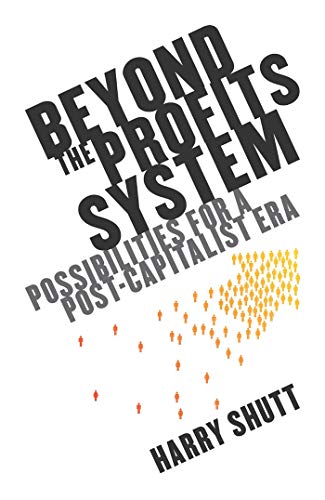
Beyond the Profits System
Possibilities for a Post-Capitalist Era
By Harry ShuttFernwood Publishing and Zed Books Ltd
Copyright © 2010 Harry Shutt
All rights reserved.
ISBN: 978-1-84813-417-1All rights reserved.
Contents
Introduction, 1,
1 Anatomy of a crisis, 5,
2 The official response: a study in delusion, 31,
3 Facing up to systemic failure, 49,
4 The price of profit-driven growth, 65,
5 A new model: ending the tyranny of production, 93,
6 Evolving a more rational economic system, 111,
7 Ideology for the twenty-first century: cooperation, creativeness, equality, 133,
8 Deepening democracy, 149,
9 Capitulation or catastrophe?, 165,
Index, 175,
CHAPTER 1
Anatomy of a crisis
The global financial and economic crisis which began in 2007 has unquestionably been the most severe to have afflicted the world economy since that of 1929–33. The latter marked the start of the Great Depression of the 1930s – a disaster which was only finally ended by the stimulus of massive destruction and armaments production induced by World War II. The huge scale of wealth and livelihood destruction caused by the present disaster – which is ongoing at the time of writing (summer 2009) – is reflected in the fact that the market capitalisation of the world's major stock exchanges fell by 47 per cent in value (a loss of $29.4 trillion – equal to about half of global GDP) in the twelve months to December 2008. To put this in perspective, the proportionate scale of loss not only dwarfed that in any previous calendar year on record (at least since World War II) but compares with a net decline of only 35 per cent over the whole of the previous market collapse (from end 1999 to end 2002).
One of the most striking phenomena of the unfolding crisis has been the uniformly superficial nature of the analysis of its causes presented by mainstream observers, whether government officials, academics or business representatives. Thus it is commonly stated that the crisis was caused by a combination of imprudent investment by bankers and others (often incentivised by reward structures appealing to extreme greed) and unduly lax official regulation and supervision of markets. Yet the obvious question begged by such explanations – of how or why such a dysfunctional climate came to be created – is never addressed in any serious fashion. This omission is all the more remarkable when it is well known, for example, that
• the US Glass-Steagall Act – enacted in 1933 in order to outlaw many of the conflicts of interest and excesses in the financial markets that had led to the Wall Street crash of 1929 – was repealed in 1999 by the Clinton administration with bipartisan support in Congress, thereby facilitating a reprise of the more or less criminal practices of seventy years earlier and thus contributing greatly to the present financial market implosion;
• the Commodity Futures Modernization Act of 2000 – also enacted by President Clinton with strong Republican support – legalised forms of speculation (in commodities and financial derivatives such as credit default swaps – see below) that were previously classified as illegal gambling.
The inescapable conclusion, therefore, is that the crisis was the product of a conscious process of facilitating ever greater risk of massive systemic failure. At the same time, given the competitive, profit-maximising climate in which financial institutions are operating, and the creation of incentive and reward structures encouraging the pursuit of short-term gain at all costs – individual agents effectively had no choice but to exploit every loophole to push risk-taking to the limit of what was allowed – and often beyond it.
Moreover, the power of the vested interests behind this compulsion has been revealed by the lack of will on the part of regulators such as the Securities Exchange Commission in the USA and the Bank of England and Financial Services Authority in Britain to enforce those rules that remained in force – such as the laws against fraud. Given the obvious culpability of the ruling establishment revealed by this line of enquiry it is perhaps only too unremarkable that mainstream analysts do not wish to pursue it – all the more so as it serves to highlight the fundamental unacceptability of a system dependent on sustaining impossibly high levels of economic growth.
If this anarchic situation was deliberately contrived, one might suppose that those now ostensibly seeking ways to order affairs better in future would try to discover why such a high-risk policy has been consciously pursued. To this question there can be only one plausible answer (which obviously cannot be spoken in mainstream circles): the compulsion to find ever more outlets for the rising volume of investible funds generated by the inexorable expansion of accumulated profits as the global economy has continued to grow over the years (albeit at a progressively slower rate from the 1970s). This in turn points to a recognition (if only unconscious) on the part of the ruling establishment that the historic source of capitalist instability – the business cycle of boom and bust, linked to the phenomenon of the falling rate of profit, first identified by Karl Marx – was reasserting itself.
Consistent with their general reluctance to apportion blame, there has been little attempt in establishment circles to expose the serial dishonesty of such key officials as Alan Greenspan, chairman of the US Federal Reserve Board, 1987–2006. The latter, having famously warned of the 'irrational exuberance' of stock-market investors as prices on Wall Street soared in late 1996, nevertheless sought to justify them in 1999 at levels which by then had doubled again, on the manifestly spurious grounds that rapidly rising productivity in the USA meant that they were indefinitely sustainable - even though such a consideration was at best irrelevant, bearing in mind that weak demand in a slowing world economy was a decisively negative factor of far greater significance. Linked to this argument, the chairman also gave his blessing to the view that the so-called New Economy – based on the wonders of electronics, cyber-technology and enhanced telecommunications – could somehow provide the basis for sustained rapid growth. When shortly afterwards the related 'dotcom' bubble burst with disastrous consequences for the markets, Greenspan and his colleagues at the Fed proceeded to cut interest rates to 1 per cent in a determined and successful attempt to generate a speculative revival in asset prices. When this resulted in a manifestly unsustainable real-estate bubble, whose collapse in 2007 (after Greenspan had left office) was to be the catalyst of the present crisis, he quite falsely claimed throughout that it was impossible to identify the existence of such bubbles until after they had burst. So far from denouncing this systematic falsehood and betrayal of the public interest, politicians of both Republican and Democratic parties for years uniformly lauded Greenspan as a 'national treasure' and indispensable guarantor of economic prosperity.
The roots of disaster
In truth this tendency of the global establishment to engage in escapist fantasy may be considered understandable in view of the political realities that had become established after World War II. For it was a political article of faith for long after the war that Western governments – at least...
„Über diesen Titel“ kann sich auf eine andere Ausgabe dieses Titels beziehen.
Weitere beliebte Ausgaben desselben Titels

Suchergebnisse für Beyond the Profits System: Possibilities for the Post-Capita...

Beispielbild für diese ISBN
Beyond the Profits System
Anbieter: ThriftBooks-Atlanta, AUSTELL, GA, USA
Verkäuferbewertung 5 von 5 Sternen

Paperback. Zustand: Very Good. No Jacket. May have limited writing in cover pages. Pages are unmarked. ~ ThriftBooks: Read More, Spend Less. Artikel-Nr. G1848134177I4N00
Gebraucht kaufen
EUR 9,60
Versand gratis
Versand innerhalb von USA
Versand innerhalb von USA
Anzahl: 1 verfügbar
Beispielbild für diese ISBN
Beyond the Profits System : Possibilities for a Post-Capitalist Era
Anbieter: Better World Books Ltd, Dunfermline, Vereinigtes Königreich
Verkäuferbewertung 5 von 5 Sternen
Zustand: Very Good. Pages intact with possible writing/highlighting. Binding strong with minor wear. Dust jackets/supplements may not be included. Stock photo provided. Product includes identifying sticker. Better World Books: Buy Books. Do Good. Artikel-Nr. GRP94220971
Gebraucht kaufen
EUR 9,68
EUR 5,86 Versand
Versand von Vereinigtes Königreich nach USA
Versand von Vereinigtes Königreich nach USA
Anzahl: 1 verfügbar
Beispielbild für diese ISBN
Beyond the Profits System. Possibilities for a Post-Capitalist Era
Verlag:
Fernwood/Zen, Canada/New York, 2010
ISBN 10: 1848134177
ISBN 13: 9781848134171
Gebraucht
Soft cover
Anbieter: The London Bookworm, East Sussex, Vereinigtes Königreich
Verkäuferbewertung 5 von 5 Sternen
Soft cover. Zustand: Good. 1st Paperback Edition. Paperback. Beyond the Profits System. Mark to top corner of last few pages. This book makes clear why the desperate resort of Western governments to 'extraordinary measures' to try to avert economic collapse is bound to fail. It also forcefully demonstrates why we must abandon the traditional economic logive of endlessly expanding production in pursuit of maximum private profit. Rather, our only hope of salvation lies in cooperatively responding to the aspirations of different communities while assuring the basic security of all. 182 pp. (We carry a wide selection of titles in The Arts, Theology, History, Politics, Social and Physical Sciences. academic and scholarly books and Modern First Editions ,and all types of Academic Literature.). Artikel-Nr. 091211
Gebraucht kaufen
EUR 12,08
EUR 28,15 Versand
Versand von Vereinigtes Königreich nach USA
Versand von Vereinigtes Königreich nach USA
Anzahl: 1 verfügbar
Beispielbild für diese ISBN
Beyond the Profits System: Possibilities for a Post-Capitalist Era
Anbieter: Ria Christie Collections, Uxbridge, Vereinigtes Königreich
Verkäuferbewertung 5 von 5 Sternen
Zustand: New. In. Artikel-Nr. ria9781848134171_new
Neu kaufen
EUR 32,38
EUR 14,05 Versand
Versand von Vereinigtes Königreich nach USA
Versand von Vereinigtes Königreich nach USA
Anzahl: Mehr als 20 verfügbar
Beispielbild für diese ISBN
Beyond the Profits System: Possibilities for a Post-Capitalist Era
Anbieter: Kennys Bookstore, Olney, MD, USA
Verkäuferbewertung 5 von 5 Sternen
Zustand: New. Offers a different analysis to the mainstream, establishment commentators who have struggled to come to terms with the crisis. This book provides not merely a comprehensive background to the flawed ideologies that precipitated the collapse, but also a radical way forward in light of the catastrophe. Num Pages: 192 pages. BIC Classification: KCA; KCX. Category: (G) General (US: Trade). Dimension: 199 x 129 x 12. Weight in Grams: 202. . 2010. First Edition. paperback. . . . . Books ship from the US and Ireland. Artikel-Nr. V9781848134171
Neu kaufen
EUR 46,95
EUR 9,22 Versand
Versand innerhalb von USA
Versand innerhalb von USA
Anzahl: Mehr als 20 verfügbar
Beispielbild für diese ISBN
Beyond the Profits System: Possibilities for the Post-capitalist Era
Anbieter: Revaluation Books, Exeter, Vereinigtes Königreich
Verkäuferbewertung 5 von 5 Sternen
Paperback. Zustand: Brand New. 182 pages. 7.75x5.00x0.50 inches. In Stock. Artikel-Nr. x-1848134177
Neu kaufen
EUR 49,36
EUR 11,73 Versand
Versand von Vereinigtes Königreich nach USA
Versand von Vereinigtes Königreich nach USA
Anzahl: 2 verfügbar