
Verwandte Artikel zu Context, Individual Differences and Pragmatic Competence...
Context, Individual Differences and Pragmatic Competence (Second Language Acquisition, 62) - Softcover
Buch 64 von 188: Second Language Acquisition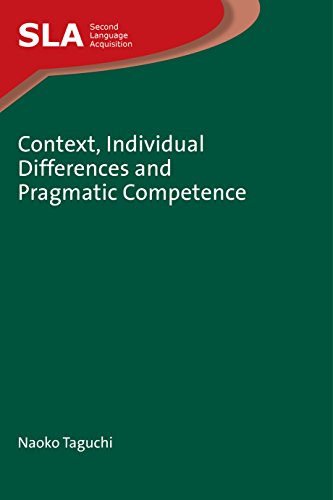
Inhaltsangabe
Pragmatic competence plays a key role in the era of globalization where communication across cultural boundaries is an everyday phenomenon. The ability to use language in a socially appropriate manner is critical, as lack of it may lead to cross-cultural miscommunication or cultural stereotyping. This book describes second language learners' development of pragmatic competence. It proposes an original theoretical framework combining a pragmatics and psycholinguistics approach, and uses a variety of research instruments, both quantitative and qualitative, to describe pragmatic development over one year. Situated in a bilingual university in Japan, the study reveals patterns of change across different pragmatic abilities among Japanese learners of English. The book offers implications for SLA theories, the teaching and assessment of pragmatic competence, and intercultural communication.
Die Inhaltsangabe kann sich auf eine andere Ausgabe dieses Titels beziehen.
Über die Autorin bzw. den Autor
Naoko Taguchi is Associate Professor in the Modern Languages Department at Carnegie Mellon University. Her research interests include second language pragmatics, classroom-based research, English-medium education and Japanese SLA. Her recent publications include Context, Individual Differences and Pragmatic Competence (Multilingual Matters, 2014) and Technology in Interlanguage Pragmatics Research and Teaching (coedited with Julie Sykes, John Benjamins, 2013).
Auszug. © Genehmigter Nachdruck. Alle Rechte vorbehalten.
Context, Individual Differences and Pragmatic Competence
By Naoko TaguchiMultilingual Matters
Copyright © 2012 Naoko Taguchi
All rights reserved.
ISBN: 978-1-84769-608-3All rights reserved.
Contents
Preface,
1 Context, Individual Differences and Pragmatic Development: An Introduction,
2 Longitudinal Studies in Interlanguage Pragmatics,
3 Theoretical Framework, Research Questions and Methodology of the Study,
4 Patterns and Rate of Pragmatic Development,
5 Individual Differences in Pragmatic Development,
6 Summary and Conclusion,
Appendix A: Language Contact Profile (LCP),
Appendix B: Descriptive Statistics of LCP Results,
Appendix C: Pragmatic Listening Test (PLT) Items,
Appendix D: Pragmatic Speaking Test (PST) Situational Scenarios,
Appendix E: Evaluation of Speech Acts: Grammar Rating Scale,
Appendix F: Evaluation of Speech Acts: Appropriateness Rating Scale,
Appendix G: Grammar Test for Target Pragmalinguistic Features,
Appendix H: Coding Frameworks for Speech Act Expressions,
References,
Index,
CHAPTER 1
Context, Individual Differences and Pragmatic Development: An Introduction
Introduction
Interlanguage pragmatics (ILP), analogous to interlanguage grammar or interlanguage lexicon, is a branch of study in second language acquisition (SLA) that focuses on second language learners' knowledge, use and development in performance of sociocultural functions in context. The original definition of ILP can be traced back to Kasper and Dahl, who stated that ' interlanguage pragmatics will be defined in a narrow sense, referring to non-native speakers' (NNSs') comprehension and production of speech acts, and how their L2-related speech act knowledge is acquired' (Kasper & Dahl, 1991: 216).
Two decades after this definition debuted in the field, we have accumulated a large, diverse body of international literature that has collectively expanded the scope of ILP research beyond 'comprehension and production of speech acts' and beyond an examination of pragmatic 'knowledge'. 'Ability to perform language functions' and 'knowledge of socially appropriate language use' are now defining characteristics of pragmatic competence in the theoretical models of communicative competence (Bachman & Palmer, 1996, 2010; Canale & Swain, 1980; Hymes, 1972). These features have been operationalized in a variety of ways as measurable constructs, and specific tasks and analytical methods have since been identified to elicit and examine these constructs. Target pragmatic features investigated to date are wide ranging, including: speech acts, conversational implicature, formal vs. informal speech styles, honorifics and politeness terms, terms of address, rituals of small talk and other discourse genres, routines and formulaic expressions and conversation management devices (e.g. reactive tokens, discourse markers and turn-taking). Learners' knowledge of these pragmatic features as well as their processing efficiency in using this knowledge in real time have been examined through a variety of methods, ranging from ethnographic studies that involve observation of naturalistic interaction to descriptive–experimental studies that use construct-eliciting instruments.
Numerous ILP studies introduced over the last few decades – whether descriptive, quasi-experimental, qualitative or quantitative – have centered on developmental issues of pragmatic competence. Such studies have addressed a range of questions about pragmatic development among individuals who have learned an additional language through various venues, such as formal schooling, sojourns or in naturalistic settings. These studies have posed many questions: Do learners register meaningful gains in pragmatic competence, outside of grammatical, lexical and phonological competence? Do they demonstrate an even pace in development across pragmatic functions, or do some functions develop more quickly than others? Does pragmatic competence develop naturally with 'time', or does its development require instructional intervention, feedback and modeling? Do L1–L2 similarities and differences in forms, conventions and cultural norms lead to positive or negative L1 transfer, consequently affecting the rate and patterns of development? Is pragmatic growth constrained by learners' grammatical knowledge and general proficiency? Does exposure to target language input and learners' amount of contact with native speakers facilitate pragmatic development, or do formal classroom settings afford ample sociocultural opportunities that lead to increased pragmatic abilities?
Accumulated research findings have, either individually or collectively, provided answers to these empirical questions. Particularly relevant to this monograph is a line of longitudinal studies, which, by definition, involve observation of the same participant(s) over an extended period of time. Ortega and Iberri-Shea (2005) proposed four criteria by which to evaluate longitudinal investigation: (1) the length of the study, (2) the presence of multiwave data collection, (3) a conceptual focus on capturing change by design and (4) a focus on establishing antecedent–consequent relationships by tracking a phenomenon in its naturalistic context. By 2010, about two dozen ILP studies conformed to these criteria. These studies have brought to light relevant insights into learners' pathways in evolving pragmatic abilities, helping to establish causal relationships between change and time (see Chapter 2 for a review of these studies).
Development of pragmatic competence is best observed longitudinally for several reasons. First, pragmatic development is a long-term process because it requires abilities to manage a complex interplay of language, language users and context of interaction. This complexity is reflected in the distinction between the concept of pragmalinguistics and sociopragmatics. Pragmalinguistics refers to the linguistic resources available for performing language functions, while sociopragmatics refers to a language user's assessment of the context in which those linguistic resources are implemented (Leech, 1983; Thomas, 1983). Pragmatic development entails acquisition of both these knowledge bases and efficient control of each of them in spontaneous communication. Learners need to have a range of linguistic resources, as well as the ability to evaluate layers of contextual information, select the most appropriate resources and use them efficiently. For instance, when a speaker wants to refuse someone's invitation, they need to know what syntactic forms and lexis to use. They also need to know whether such a refusal is acceptable in this particular situation in the target culture, and if it is acceptable, they need to know what language to use to express refusal to whom under what circumstances. This combination of linguistic ability and sociocultural sensitivity that is involved in pragmatic competence takes time to acquire.
The distinction between pragmalinguistics and sociopragmatics also indicates that pragmatic competence may not develop hand in hand with grammatical ability. Instead, these two abilities may follow separate trajectories toward their full development. In fact, previous literature showed that while a threshold level of grammatical ability (or general proficiency) is needed for a learner to encode pragmatic functions, a high level of grammatical competence does not always guarantee a corresponding high level of pragmatic competence (Bardovi-Harlig, 1999, 2000). Empirical evidence has shown...
„Über diesen Titel“ kann sich auf eine andere Ausgabe dieses Titels beziehen.
Suchergebnisse für Context, Individual Differences and Pragmatic Competence...

Beispielbild für diese ISBN
Context, Individual Differences and Pragmatic Competence (Volume 62)
Anbieter: Anybook.com, Lincoln, Vereinigtes Königreich
Verkäuferbewertung 5 von 5 Sternen

Zustand: Good. Volume 62. This is an ex-library book and may have the usual library/used-book markings inside.This book has soft covers. In good all round condition. Please note the Image in this listing is a stock photo and may not match the covers of the actual item,600grams, ISBN:9781847696083. Artikel-Nr. 5595007
Gebraucht kaufen
EUR 26,20
EUR 15,47 Versand
Versand von Vereinigtes Königreich nach USA
Versand von Vereinigtes Königreich nach USA
Anzahl: 1 verfügbar
Beispielbild für diese ISBN
Context, Individual Differences and Pragmatic Competence (Second Language Acquisition)
Anbieter: Anybook.com, Lincoln, Vereinigtes Königreich
Verkäuferbewertung 5 von 5 Sternen
Zustand: Good. This is an ex-library book and may have the usual library/used-book markings inside.This book has soft covers. In good all round condition. Library sticker on front cover. Please note the Image in this listing is a stock photo and may not match the covers of the actual item,600grams, ISBN:9781847696083. Artikel-Nr. 4327006
Gebraucht kaufen
EUR 26,20
EUR 15,47 Versand
Versand von Vereinigtes Königreich nach USA
Versand von Vereinigtes Königreich nach USA
Anzahl: 1 verfügbar
Beispielbild für diese ISBN
Context, Individual Differences and Pragmatic Competence
Anbieter: PBShop.store UK, Fairford, GLOS, Vereinigtes Königreich
Verkäuferbewertung 5 von 5 Sternen
PAP. Zustand: New. New Book. Shipped from UK. Established seller since 2000. Artikel-Nr. CX-9781847696083
Neu kaufen
EUR 43,58
EUR 5,95 Versand
Versand von Vereinigtes Königreich nach USA
Versand von Vereinigtes Königreich nach USA
Anzahl: 15 verfügbar
Beispielbild für diese ISBN
Context, Individual Differences and Pragmatic Competence
Anbieter: PBShop.store US, Wood Dale, IL, USA
Verkäuferbewertung 5 von 5 Sternen
PAP. Zustand: New. New Book. Shipped from UK. Established seller since 2000. Artikel-Nr. CX-9781847696083
Beispielbild für diese ISBN
Context, Individual Differences and Pragmatic Competence (Second Language Acquisition, 62)
Anbieter: Ria Christie Collections, Uxbridge, Vereinigtes Königreich
Verkäuferbewertung 5 von 5 Sternen
Zustand: New. In English. Artikel-Nr. ria9781847696083_new
Neu kaufen
EUR 54,53
EUR 13,39 Versand
Versand von Vereinigtes Königreich nach USA
Versand von Vereinigtes Königreich nach USA
Anzahl: Mehr als 20 verfügbar
Beispielbild für diese ISBN
Context, Individual Differences and Pragmatic Competence
Anbieter: Revaluation Books, Exeter, Vereinigtes Königreich
Verkäuferbewertung 5 von 5 Sternen
Paperback. Zustand: Brand New. 320 pages. 9.00x6.00x0.75 inches. In Stock. Artikel-Nr. x-1847696082
Neu kaufen
EUR 85,37
EUR 11,86 Versand
Versand von Vereinigtes Königreich nach USA
Versand von Vereinigtes Königreich nach USA
Anzahl: 2 verfügbar