
Verwandte Artikel zu An Introduction to Bilingual Development (Mm Textbooks)
Inhaltsangabe
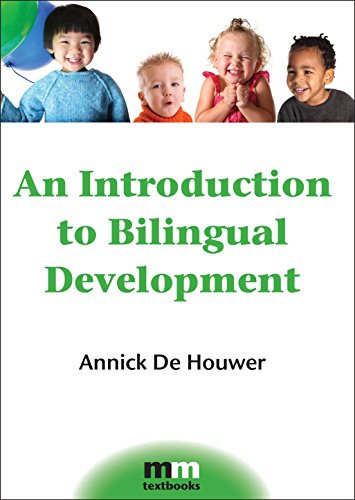
Increasingly, children grow up hearing two languages from birth. This introductory textbook shows how children learn to understand and speak those languages against the backdrop of their language learning environments. A narrative around the bilingual development of four young children with different language profiles helps to explain the latest research findings in a lively and accessible manner. The narrative describes how bilingually raised children learn to understand and use sounds, words and sentences in two languages, and how they are able to use each of their languages in socially appropriate ways. Positive attitudes towards bilingual development from the people in bilingual children's environments and their recognition that child bilingualism is not monolingualism-times-two are the main ingredients ensuring that children grow up to be happy and expert speakers of two languages.
Die Inhaltsangabe kann sich auf eine andere Ausgabe dieses Titels beziehen.
Über die Autorin bzw. den Autor
Annick De Houwer has recently been appointed as Chair of Language Acquisition and Teaching at the University of Erfurt in Germany. She is also the new Director of the Language Center there. In addition, Professor De Houwer holds the title of Collaborative Investigator to the Eunice Kennedy Shriver National Institute of Child Health and Human Development (U.S.A.). Her PhD was based on a dissertation on bilingual acquisition, a topic she has since continued to work on steadily. Her book The Acquisition of Two Languages from Birth (CUP, 1990) is widely cited in the bilingual acquisition literature. Dr. De Houwer has also published on Dutch child language, attitudes towards child language, teen language, and intralingual subtitling. She has extensive editorial experience.
Auszug. © Genehmigter Nachdruck. Alle Rechte vorbehalten.
An Introduction to Bilingual Development
By Annick De HouwerMultilingual Matters
Copyright © 2009 Annick De Houwer
All rights reserved.
ISBN: 978-1-84769-168-2All rights reserved.
Contents
Acknowledgements,
Preface,
Some technical notes about this book,
1: Introducing the fancy term for bilingual development: Bilingual First Language Acquisition,
2: From birth to the comprehension of words,
3: Saying words and starting to combine them,
4: Making sentences,
5: Preschool and beyond,
6: In conclusion: Bilingual learning in context,
Glossary,
Bibiliography,
Index of the 4 BFLA children and their families,
Subject index,
CHAPTER 1
ntroducing the fancy term for bilingual development: Bilingual First Language Acquisition
What is Bilingual First Language Acquisition (BFLA)?
The family as the primary setting for bilingual development
Developing in two languages from birth: An outline
Milestones in bilingual language development
Normal variation in bilingual language development
Varying levels of development in each language
Negotiating language choice in conversations
Introducing four bilingual families
Key points
Activities and discussion points
Further reading
This chapter sets the scene for the rest of the book.
• It defines the topic of this book. The topic is bilingual development, but as of now I will mostly use the more technical term for it, namely Bilingual First Language Acquisition or BFLA for short.
• It establishes that when children start hearing two languages from birth this usually happens within the family.
• It gives an introductory overview of BFLA children's major linguistic developments.
• It discusses the great range of variation that exists among BFLA children (and monolingual ones) during the ages at which major linguistic developments take place.
• It explains how BFLA children's two languages do not necessarily develop at the same rate.
• It emphasizes the role of the people that BFLA children interact with in helping to explain children's selection of one language rather than another.
• And, finally, this chapter introduces four BFLA children and their families whose bilingual development will be traced throughout most of the rest of this book.
What is Bilingual First Language Acquisition (BFLA)?
Bilingual First Language Acquisition (BFLA) is the development of language in young children who hear two languages spoken to them from birth. BFLA children are learning two first languages. There is no chronological difference between the two languages in terms of when the children started to hear them. This is why in referring to these languages it is best to use a notation that does not imply a notion of 'first' and 'second'. Following Wölck (1987/88) I will refer to BFLA children's two languages as Language A and Language Alpha.
I will be using the term Bilingual First Language Acquisition as a synonym for bilingual development. The term Bilingual First Language Acquisition is just more technical and precise.
My focus in this book is on children under the age of six. There are two main reasons: first, this book wants to describe how children become bilingual the way other children become monolingual, that is, without anyone formally teaching them. Children under the age of six typically learn language without formal instruction. This may change as they start to go to school around the age of six. Second, most of the scientific publications on bilingual development concern children under the age of six.
The definition of BFLA refers only to the context in which young children learn to speak. It differs from Monolingual First Language Acquisition (MFLA), in which children hear just one language from birth (their Language 1). BFLA also represents a different language learning context than Early Second Language Acquisition (ESLA), where MFLA children's language environments change in such a way that they start to hear a second language (Language 2) with some regularity over and above their Language 1. Often, this happens through day care or preschool. The BFLA context also differs from that of Trilingual First Language Acquisition (TFLA) where young children hear three languages from birth (e.g. Barnes, 2006).
BFLA, MFLA, ESLA and TFLA, then, are four different contexts for language learning in early childhood. Whether these different contexts all imply different language acquisition processes and developments is an issue that is beyond the scope of this book. However, I will, at times, draw comparisons between BFLA on the one hand, and MFLA on the other.
This book only talks about contexts where young children are hearing spoken language(s). Some children, though, may have little access to spoken language or it may even be absent. This is the case when children are born into families where the people taking care of them do not speak, but use sign language, or when children have a serious hearing loss that prevents them from hearing speech. If children growing up in these circumstances see two different sign languages from birth they may also be acquiring two first languages. Once there are studies documenting such contexts we may have to expand the definition of BFLA to include these as well.
The family as the primary setting for bilingual development
If children hear two languages spoken to them from birth, they will most likely hear them within the (extended) family. As such, the family is the primary setting in which children develop bilingually. There are, of course, many different kinds of families, and children grow up in many different kinds of family settings. When in the following I speak of 'parents' and 'couples' I am referring to all the people who take care of young children on a day-to-day basis. A single parent who has no help from others with a newborn baby may also create a BFLA situation by addressing the child in two languages from the very start.
The typical BFLA situation is the one where a newborn child's parents speak each of two languages when the baby is present. The chances are that during pregnancy, the not-yet-born infant heard mother speak two languages (that's right, infants can hear before they are born–seeChapter 2). But it is just as possible that until the birth the not-yet-born child's mother spoke only one language, and that the birth of the child triggers a change in the mother's language use.
Indeed, childless monolingual couples often become instant bilingual families upon the birth of their first child. This is most often the case when children are born to couples where the partners have different language backgrounds but speak only one language between themselves. After the birth of the baby one of them then starts speaking another language to the infant, and continues using the other language in addressing the other parent. Such changes in home language use patterns can have profound effects on the couple's relationship.
Alternatively, parents-to-be may both be bilingual and speak two languages at home. When the baby arrives, this pattern is just continued. There are also situations where bilingual couples decide to address their infant in just one language, thereby effectively blocking the possibility of BFLA. At the other end of the spectrum,...
„Über diesen Titel“ kann sich auf eine andere Ausgabe dieses Titels beziehen.
Suchergebnisse für An Introduction to Bilingual Development (Mm Textbooks)

Beispielbild für diese ISBN
An Introduction to Bilingual Development
Anbieter: Better World Books, Mishawaka, IN, USA
Verkäuferbewertung 5 von 5 Sternen

Zustand: Good. Pages intact with minimal writing/highlighting. The binding may be loose and creased. Dust jackets/supplements are not included. Stock photo provided. Product includes identifying sticker. Better World Books: Buy Books. Do Good. Artikel-Nr. 53369318-6
Gebraucht kaufen
EUR 10,84
Versand gratis
Versand innerhalb von USA
Versand innerhalb von USA
Anzahl: 1 verfügbar
Foto des Verkäufers
An Introduction to Bilingual Development (MM Textbooks): 4
Anbieter: WeBuyBooks, Rossendale, LANCS, Vereinigtes Königreich
Verkäuferbewertung 5 von 5 Sternen
paperback. Zustand: Very Good. Most items will be dispatched the same or the next working day. A copy that has been read, but is in excellent condition. Pages are intact and not marred by notes or highlighting. The spine remains undamaged. Artikel-Nr. rev4571087015
Gebraucht kaufen
EUR 11,05
EUR 5,85 Versand
Versand von Vereinigtes Königreich nach USA
Versand von Vereinigtes Königreich nach USA
Anzahl: 1 verfügbar
Beispielbild für diese ISBN
An Introduction to Bilingual Development
Anbieter: Anybook.com, Lincoln, Vereinigtes Königreich
Verkäuferbewertung 5 von 5 Sternen
Zustand: Good. This is an ex-library book and may have the usual library/used-book markings inside.This book has soft covers. In good all round condition. Please note the Image in this listing is a stock photo and may not match the covers of the actual item,300grams, ISBN:9781847691682. Artikel-Nr. 2945927
Gebraucht kaufen
EUR 9,86
EUR 15,81 Versand
Versand von Vereinigtes Königreich nach USA
Versand von Vereinigtes Königreich nach USA
Anzahl: 1 verfügbar
Beispielbild für diese ISBN
An Introduction to Bilingual Development
Anbieter: Anybook.com, Lincoln, Vereinigtes Königreich
Verkäuferbewertung 5 von 5 Sternen
Zustand: Fair. This is an ex-library book and may have the usual library/used-book markings inside.This book has soft covers. Book contains pencil markings. In fair condition, suitable as a study copy. Please note the Image in this listing is a stock photo and may not match the covers of the actual item,300grams, ISBN:9781847691682. Artikel-Nr. 2945926
Gebraucht kaufen
EUR 9,86
EUR 15,81 Versand
Versand von Vereinigtes Königreich nach USA
Versand von Vereinigtes Königreich nach USA
Anzahl: 1 verfügbar
Beispielbild für diese ISBN
An Introduction to Bilingual Development
Anbieter: Anybook.com, Lincoln, Vereinigtes Königreich
Verkäuferbewertung 5 von 5 Sternen
Zustand: Good. This is an ex-library book and may have the usual library/used-book markings inside.This book has soft covers. In good all round condition. Please note the Image in this listing is a stock photo and may not match the covers of the actual item,300grams, ISBN:9781847691682. Artikel-Nr. 2945928
Gebraucht kaufen
EUR 9,86
EUR 15,81 Versand
Versand von Vereinigtes Königreich nach USA
Versand von Vereinigtes Königreich nach USA
Anzahl: 1 verfügbar
Beispielbild für diese ISBN
An Introduction to Bilingual Development
Anbieter: PBShop.store UK, Fairford, GLOS, Vereinigtes Königreich
Verkäuferbewertung 5 von 5 Sternen
PAP. Zustand: New. New Book. Shipped from UK. Established seller since 2000. Artikel-Nr. CX-9781847691682
Neu kaufen
EUR 23,95
EUR 3,83 Versand
Versand von Vereinigtes Königreich nach USA
Versand von Vereinigtes Königreich nach USA
Anzahl: 15 verfügbar
Beispielbild für diese ISBN
An Introduction to Bilingual Development
Anbieter: PBShop.store US, Wood Dale, IL, USA
Verkäuferbewertung 5 von 5 Sternen
PAP. Zustand: New. New Book. Shipped from UK. Established seller since 2000. Artikel-Nr. CX-9781847691682
Beispielbild für diese ISBN
An Introduction to Bilingual Development (MM Textbooks, 4)
Anbieter: Ria Christie Collections, Uxbridge, Vereinigtes Königreich
Verkäuferbewertung 5 von 5 Sternen
Zustand: New. In English. Artikel-Nr. ria9781847691682_new
Neu kaufen
EUR 27,98
EUR 10,90 Versand
Versand von Vereinigtes Königreich nach USA
Versand von Vereinigtes Königreich nach USA
Anzahl: Mehr als 20 verfügbar
Beispielbild für diese ISBN
An Introduction to Bilingual Development
Anbieter: Revaluation Books, Exeter, Vereinigtes Königreich
Verkäuferbewertung 5 von 5 Sternen
Paperback. Zustand: Brand New. 89 pages. 9.50x7.00x0.50 inches. In Stock. Artikel-Nr. x-1847691684
Neu kaufen
EUR 38,48
EUR 11,63 Versand
Versand von Vereinigtes Königreich nach USA
Versand von Vereinigtes Königreich nach USA
Anzahl: 2 verfügbar
Beispielbild für diese ISBN
An Introduction to Bilingual Development
Anbieter: Buchpark, Trebbin, Deutschland
Verkäuferbewertung 5 von 5 Sternen
Zustand: Sehr gut. Zustand: Sehr gut | Sprache: Englisch | Produktart: Bücher | This introductory textbook shows how children learn to understand and speak two languages against the backdrop of their language learning environments. A narrative around the bilingual development of four young children with different language profiles helps to explain the latest research findings in a lively and accessible manner. Artikel-Nr. 10771982/202
Gebraucht kaufen
EUR 13,95
EUR 105,00 Versand
Versand von Deutschland nach USA
Versand von Deutschland nach USA
Anzahl: 1 verfügbar