
Verwandte Artikel zu Early Learning of Modern Foreign Languages: Processes...
Early Learning of Modern Foreign Languages: Processes and Outcomes (Second Language Acquistion) - Hardcover
Buch 41 von 183: Second Language Acquisition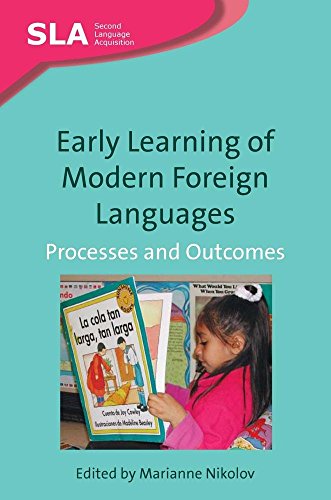
Inhaltsangabe
Modern languages are offered to young learners at an increasingly early age in many countries; yet few publications have focused on what is available to children in different contexts. This volume fills this gap by documenting the state-of-the-art in researching young language learners using a variety of research methods. It demonstrates how young children progress and benefit from an early exposure to modern languages in different educational contexts, and how affective, cognitive, social, linguistic and classroom-related factors interact in the processes. A special strength is the range of languages: although English is the most widely learnt language, chapters focus on various target languages: Croatian, French, English, German, Italian, Spanish and Ukrainian and the contexts include China, Croatia, Greece, Hungary, Ireland, Norway, Poland, the Ukraine, and the United Kingdom.
Die Inhaltsangabe kann sich auf eine andere Ausgabe dieses Titels beziehen.
Über die Autorin bzw. den Autor
Marianne Nikolov is a professor of English Applied Linguistics at the University of Pécs, Hungary. Her research interests include early learning and teaching of modern languages, assessment of processes and outcomes in language education, teacher education, individual differences, language policy and research methods. Her work has been published in journals (e.g., Language Learning, Language Teaching Research, Annual Review of Applied Linguistics, Magyar Pedagógia, Modern Nyelvoktatás) as well as books.
Auszug. © Genehmigter Nachdruck. Alle Rechte vorbehalten.
Early Learning of Modern Foreign Languages
Processes and Outcomes
By Marianne NikolovMultilingual Matters
Copyright © 2009 Marianne Nikolov and the authors of individual chapters
All rights reserved.
ISBN: 978-1-84769-146-0All rights reserved.
Contents
Contributors,
Introduction,
1 A Third Language at Primary Level in Ireland: An Independent Evaluation of the Modern Languages in Primary Schools Initiative John Harris and Denise O'Leary,
2 Can Today's Early Language Learners in England Become Tomorrow's Plurilingual European Citizens? Janet Enever,
3 Young Learners of Croatian as a Second Language: Minority Language Speakers and Their Croatian Competence Zrinka Jelaska and Lidija Cvikic,
4 Young Learners' Cognitive Skills and Their Role in Foreign Language Vocabulary Learning Thomai Alexiou,
5 An Investigation into the Relationship of L2 Motivation and Cross-cultural Contact Among Elementary School Students Kata Csizér and Judit Kormos,
6 Impact of Learning Conditions on Young FL Learners' Motivation Jelena Mihaljevic Djigunovic,
7 Early Modern Foreign Language Programmes and Outcomes: Factors Contributing to Hungarian Learners' Proficiency Marianne Nikolov,
8 Using the Early Years Literacy Programme in Primary EFL Norwegian Classrooms Ion Drew,
9 The Age Factor and L2 Reading Strategies Renata Šamo,
10 A Study of FL Composing Process and Writing Strategies Employed by Young Learners Eleni Griva, Helen Tsakiridou and Ioanna Nihoritou,
11 How do 9-11-Year-Old Croatians Perceive Sounds and Read Aloud in French? Vanda Marijanovic, Nathalie Panissal and Michel Billieres,
12 Differences Between the Processes and Outcomes in Third Graders' Learning of English and Ukrainian in Hungarian Schools in Beregszász Ilona Huszti, Márta Fábián and Erzsébet Bárányne Komári,
13 The Growth of Young Learners' English Vocabulary Size Andrea Orosz,
14 Factors Influencing Young Learners' Vocabulary Acquisition Magdalena Szpotowicz,
15 An Eye on Target Language Use in Elementary English Classrooms in China Jing Peng and Lili Zhang,
16 What Primary School Pupils Think About Learning English as a Foreign Language Krisztina Nagy,
Index,
CHAPTER 1
A Third Language at Primary Level in Ireland: An Independent Evaluation of the Modern Languages in Primary Schools Initiative
JOHN HARRIS and DENISE O'LEARY
Introducing modern languages at primary level in Ireland involves challenges and possibilities which differ from those of some other countries. Irish, a minority language is the first official language. All but a small proportion of pupils speak English at home but begin to learn Irish as a second language as soon as they begin school. Learning a modern foreign language at primary level is, therefore, an entirely new experience of diversity for most Irish pupils.
The Modern Languages in Primary Schools Initiative in Ireland began in 1998 with 270 schools and now has almost 400 (about 12% of primary schools). Pupils in the final two years in elementary school receive 1.5 hours of tuition within the normal school day in one of four languages: French, German, Spanish or Italian. Within the Initiative, there is also an emphasis on language diversity of a slightly different kind in that those European languages that traditionally were less commonly taught in Ireland (Spanish and Italian) are especially promoted. This chapter describes the experience of modern languages at primary level for pupils, parents and teachers. It draws on findings from Phases 1 (Harris & Conway, 2002) and Phase 2 (Harris & O'Leary, 2007) of an independent evaluation of the Project.
The Language Situation in Ireland
The early teaching of modern languages in Ireland takes place in a sociolinguistic context which differs in a number of respects from that obtaining in many other countries in Europe (Harris, 2007). Irish, an indigenous minority language, is also the first official language of the country. It has been taught to virtually all primary-school pupils since the foundation of the state about 85 years ago. In the vast majority of cases, it is taught as a second language to pupils whose home language is English – as a single school subject in 'ordinary' mainstream schools. It is also taught in immersion ('all-Irish') schools in the main English-speaking area. While these immersion schools are still relatively small in number, they have grown significantly over the last 20 years. Irish is also taught, of course, in the relatively small Gaeltacht heartland areas, mainly along the western seaboard. The teaching of Irish in these different contexts is central to the larger national goal of revitalising Irish as a general means of communication.
Parents and the public generally are in favour of the teaching of Irish. Harris et al. (2006), for example, report that 67.4% of the parents of pupils in ordinary mainstream primary schools are 'favourable' or 'very favourable' to Irish being taught at this level. Only 14.5% feel that less time should be spent on the language.
But parents in Ireland are in general also anxious that their children would learn other modern European languages. As part of a national consultation process called 'Your Education System', a representative sample (n = 1511) of the population aged 15+ years was surveyed in order to establish views nationally on a number of education issues (Kellaghan et al., 2004). Two key findings emerged in relation to foreign languages in primary school:
• 57.1% of respondents felt that 'too little emphasis' was placed on teaching foreign languages in primary schools (Kellaghan et al., 2004: 6, 26).
• 78.7% considered the teaching of a continental language in primary school to be 'very important/important' in achieving the objectives of schooling (Kellaghan et al., 2004: 35).
These percentages are notable given that statistics from 30 European countries show that Ireland is the only one where foreign-language learning at primary level is neither compulsory nor a core curriculum option (Eurydice, 2005: 24). The Irish Business and Employers Confederation (IBEC, 2004) identified a number of key priorities for the Irish education system, one of which was the development of a national coordinated system to make modern languages a compulsory subject in primary school. In addition, the Expert Group on Future Skills Needs (EGFSN) in its report Languages and Enterprise (EGFSN, 2005) called for the extension of the Modern Languages in Primary Schools Initiative to all primary schools nationwide and its full integration into the mainstream curriculum.
Yet another significant feature of the language situation in Ireland in recent years is the relatively sudden appearance of the languages of the 'New Irish' immigrant communities, such as Polish, Russian and Chinese. Until now, Ireland has not seen any immigration comparable to that experienced elsewhere in western Europe. The scale of this in-migration, largely as a result of the buoyant economy, is indicated by the fact that the population of non-nationals in Ireland grew from 7% to 10% between 2002 and 2006. By comparison, the non-national population of the UK grew by only two percentage points between 1960 and 1990 (Barrett & McCarthy, 2006).
The Modern Language Initiative and the Evaluation
In 1998, the national Pilot Project on the Teaching of Modern Languages...
„Über diesen Titel“ kann sich auf eine andere Ausgabe dieses Titels beziehen.
Suchergebnisse für Early Learning of Modern Foreign Languages: Processes...

Beispielbild für diese ISBN
Early Learning of Modern Foreign Languages
Anbieter: PBShop.store US, Wood Dale, IL, USA
Verkäuferbewertung 5 von 5 Sternen

HRD. Zustand: New. New Book. Shipped from UK. Established seller since 2000. Artikel-Nr. CX-9781847691460
Neu kaufen
EUR 123,20
Versand gratis
Versand innerhalb von USA
Versand innerhalb von USA
Anzahl: 15 verfügbar
Beispielbild für diese ISBN
Early Learning of Modern Foreign Languages
Anbieter: PBShop.store UK, Fairford, GLOS, Vereinigtes Königreich
Verkäuferbewertung 5 von 5 Sternen
HRD. Zustand: New. New Book. Shipped from UK. Established seller since 2000. Artikel-Nr. CX-9781847691460
Neu kaufen
EUR 118,22
EUR 5,86 Versand
Versand von Vereinigtes Königreich nach USA
Versand von Vereinigtes Königreich nach USA
Anzahl: 15 verfügbar
Beispielbild für diese ISBN
Early Learning of Modern Foreign Languages: Processes and Outcomes (Second Language Acquisition, 38)
Anbieter: Ria Christie Collections, Uxbridge, Vereinigtes Königreich
Verkäuferbewertung 5 von 5 Sternen
Zustand: New. In English. Artikel-Nr. ria9781847691460_new
Neu kaufen
EUR 134,84
EUR 13,17 Versand
Versand von Vereinigtes Königreich nach USA
Versand von Vereinigtes Königreich nach USA
Anzahl: Mehr als 20 verfügbar
Foto des Verkäufers
Early Learning of Modern Foreign Languages
Anbieter: moluna, Greven, Deutschland
Verkäuferbewertung 5 von 5 Sternen
Zustand: New. Artikel-Nr. 603321019
Neu kaufen
EUR 165,76
EUR 48,99 Versand
Versand von Deutschland nach USA
Versand von Deutschland nach USA
Anzahl: Mehr als 20 verfügbar
Beispielbild für diese ISBN
Early Learning of Modern Foreign Languages: Processes and Outcomes
Anbieter: Revaluation Books, Exeter, Vereinigtes Königreich
Verkäuferbewertung 5 von 5 Sternen
Hardcover. Zustand: Brand New. 242 pages. 9.25x6.25x0.75 inches. In Stock. Artikel-Nr. x-1847691463
Neu kaufen
EUR 235,41
EUR 14,58 Versand
Versand von Vereinigtes Königreich nach USA
Versand von Vereinigtes Königreich nach USA
Anzahl: 2 verfügbar