
Verwandte Artikel zu Motivation, Language Identity and the L2 Self (Second...
Motivation, Language Identity and the L2 Self (Second Language Acquisition) - Softcover
Buch 61 von 179: Second Language Acquisition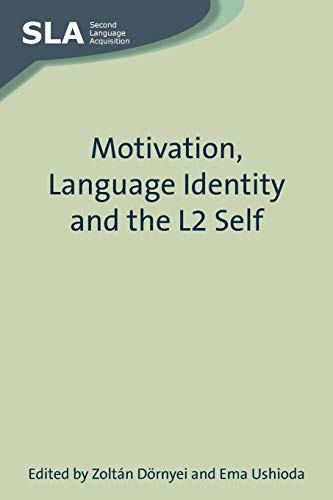
Inhaltsangabe
Due to its theoretical and educational significance within the language learning process, the study of L2 motivation has been an important area of second language acquisition research for several decades. Over the last few years L2 motivation research has taken an exciting new turn by focusing increasingly on the language learner's situated identity and various self-perceptions. As a result, the concept of L2 motivation is currently in the process of being radically reconceptualised and re-theorised in the context of contemporary notions of self and identity. With contributions by leading European, North American and Asian scholars, this volume brings together the first comprehensive anthology of key conceptual and empirical papers that mark this important paradigmatic shift.
Die Inhaltsangabe kann sich auf eine andere Ausgabe dieses Titels beziehen.
Über die Autorin bzw. den Autor
Zoltán Dörnyei is Professor of Psycholinguistics at the School of English, University of Nottingham. He has published widely on various aspects of second language acquisition and language learning motivation including Motivation, Language Identity and the L2 Self (2009, edited with Ema Ushioda).
Ema Ushioda is an Associate Professor in ELT and Applied Linguistics at the Centre for Applied Linguistics, University of Warwick where she teaches MA courses and coordinates the Doctorate in Education. Her research interests include language motivation, autonomy, sociocultural theory and teacher development. Her publications include Learner Autonomy 5: The Role of Motivation (1996, Authentik), Towards Greater Learner Autonomy in the Foreign Language Classroom (2002, Authentik, co-authored with David Little and Jennifer Ridley) and Learner Autonomy in the Foreign Language Classroom: Teacher, Learner, Curriculum and Assessment (2003, Authentik, co-edited with David Little and Jennifer Ridley).
Auszug. © Genehmigter Nachdruck. Alle Rechte vorbehalten.
Motivation, Language Identity and the L2 Self
By Zoltán Dörnyei, Ema UshiodaMultilingual Matters
Copyright © 2009 Zoltán Dörnyei, Ema Ushioda and the authors of individual chapters
All rights reserved.
ISBN: 978-1-84769-127-9All rights reserved.
Contents
Contributors,
1 Motivation, Language Identities and the L2 Self: A Theoretical Overview Ema Ushioda and Zoltán Dörnyei,
2 The L2 Motivational Self System Zoltán Dörnyei,
3 The Baby, the Bathwater, and the Future of Language Learning Motivation Research Peter D. MacIntyre, Sean P. Mackinnon and Richard Clément,
4 The L2 Motivational Self System among Japanese, Chinese and Iranian Learners of English: A Comparative Study Tatsuya Taguchi, Michael Magid and Mostafa Papi,
5 Learning Experiences, Selves and Motivated Learning Behaviour: A Comparative Analysis of Structural Models for Hungarian Secondary and University Learners of English Kata Csizér and Judit Kormos,
6 Self and Identity in L2 Motivation in Japan: The Ideal L2 Self and Japanese Learners of English Stephen Ryan,
7 International Posture and the Ideal L2 Self in the Japanese EFL Context Tomoko Yashima,
8 Motivation and Vision: The Relation Between the Ideal L2 Self, Imagination and Visual Style Abdullah S. Al-Shehri,
9 Links between Ethnolinguistic Affiliation, Self-related Motivation and Second Language Fluency: Are They Mediated by Psycholinguistic Variables? Norman Segalowitz, Elizabeth Gatbonton and Pavel Trofimovich,
10 Toward the Development of a Scale to Assess Possible Selves as a Source of Language Learning Motivation Richard Clément,
11 A Person-in-Context Relational View of Emergent Motivation, Self and Identity Ema Ushioda,
12 Situating the L2 Self: Two Indonesian School Learners of English Martin Lamb,
13 Imagined Identity and the L2 Self in the French Foreign Legion Zachary Lyons,
14 The Sociocultural Interface between Ideal Self and Ought-to Self: A Case Study of Two Korean Students' ESL Motivation Tae-Young Kim,
15 The Internalisation of Language Learning into the Self and Social Identity Kimberly A. Noels,
16 Possible Selves in Language Teacher Development Magdalena Kubanyiova,
17 Identity and Self in E-language Teaching Cynthia White and Alex Ding,
18 Motivation, Language Identities and the L2 Self: Future Research Directions Zoltán Dörnyei and Ema Ushioda,
Author Index,
Subject Index,
CHAPTER 1
Motivation, Language Identities and the L2 Self: A Theoretical Overview
EMA USHIODA and ZOLTÁN DÖRNYEI
Introduction: Why a New Book on L2 Motivation Now?
As Pit Corder famously put it some 40 years ago, 'given motivation, it is inevitable that a human being will learn a second language if he is exposed to the language data' [italics original] (Corder, 1967: 164). Since then, of course, we have witnessed a vast amount of theoretical discussion and research examining the complex nature of language learning motivation and its role in the process of SLA. At the same time, during the latter decades of the 20th century and the first decade of this century, we have also witnessed the phenomena of globalisation, the fall of communism and European reconfiguration, widespread political and economic migration, increased mobility with the rise of budget airlines, ever-developing media technologies and electronic discourse communities – all contributing in one way or another to the inexorable spread of 'global English', the growth of World English varieties, and repercussions for the loss or maintenance of various national, local or heritage languages. In short, over the past decades the world traversed by the L2 learner has changed dramatically – it is now increasingly characterised by linguistic and sociocultural diversity and fluidity, where language use, ethnicity, identity and hybridity have become complex topical issues and the subject of significant attention in sociolinguistic research. Yet, surprisingly perhaps, it is only within the last few years that those of us working in the L2 motivation field have really begun to examine what this changing global reality might mean for how we theorise the motivation to learn another language, and how we theorise the motivation to learn Global English as target language for people aspiring to acquire global identity in particular. Put simply, L2 motivation is currently in the process of being radically reconceptualised and retheorised in the context of contemporary notions of self and identity. This volume brings together the first comprehensive anthology of key conceptual and empirical papers that mark this important paradigmatic shift.
Re-theorising L2 Motivation in Relation to Self and Identity
Without the critical detachment of historical analysis, it is not easy to pinpoint the root causes of this paradigmatic shift in thinking. Instead, the aim of this introductory chapter is to sketch some of the contributing factors and developments which have brought questions of self and identity to the core of L2 motivation theorising.
Within the L2 motivation field, the theoretical concept that has garnered most attention to date is, of course, integrative orientation, defined by Gardner and Lambert (1972: 132) as 'reflecting a sincere and personal interest in the people and culture represented by the other group'. As Gardner and Lambert explain (Gardner & Lambert, 1972: 12), the integrative concept derived from a parallel they drew with processes of social identification underpinning first language acquisition, whereby the infant attempts to imitate the verbalisations of its caregivers for the reinforcing feedback which this imitation provides. They reason that a process similar to social identification 'extended to a whole ethnolinguistic community' may sustain the long-term motivation needed to master a second language. In short, notions of social identification and ethnolinguistic identity have always been implicit in the integrative concept. Moreover, such notions have been very much explicit in related social psychological research on second language communication and intergroup behaviour, and was used to explain motivation for developing and adopting particular linguistic codes and speech patterns among minority ethnic groups (Giles & Byrne, 1982). However, the basic premise underlying the integrative concept, namely that the L2 learner 'must be willing to identify with members of another ethnolinguistic group and take on very subtle aspects of their behaviour' (Gardner & Lambert, 1972: 135), has provoked considerable debate. Through the 1980s, there was much discussion about strong (social identification and integration) versus weak (sense of affiliation and interest) versions of the integrative concept. McDonough (1981: 152), for example, speculated that the strong form would be unrealistic for many language learners, while Clement and Kruidenier (1983) put the strong form to the empirical test and found little evidence that a truly integrative orientation of this kind was common among language learners.
In recent years, the debate about the integrative concept has intensified and taken on a new turn, prompted by the burgeoning discussions within applied linguistics and at large about the global spread of English. A basic question we have begun to ask is whether we can apply the concept of integrative orientation when there is no specific target reference group of speakers. Does it make sense to talk about integrative...
„Über diesen Titel“ kann sich auf eine andere Ausgabe dieses Titels beziehen.
Suchergebnisse für Motivation, Language Identity and the L2 Self (Second...

Beispielbild für diese ISBN
Motivation, Language Identity and the L2 Self
Verlag:
Multilingual Matters Limited, 2009
ISBN 10: 1847691277
ISBN 13: 9781847691279
Gebraucht
Paperback
Anbieter: ThriftBooks-Dallas, Dallas, TX, USA
Verkäuferbewertung 5 von 5 Sternen

Paperback. Zustand: Fair. No Jacket. Readable copy. Pages may have considerable notes/highlighting. ~ ThriftBooks: Read More, Spend Less. Artikel-Nr. G1847691277I5N00
Gebraucht kaufen
EUR 24,78
Versand gratis
Versand innerhalb von USA
Versand innerhalb von USA
Anzahl: 1 verfügbar
Beispielbild für diese ISBN
Motivation, Language Identity and the L2 Self
Verlag:
Channel View Publications Ltd, 2009
ISBN 10: 1847691277
ISBN 13: 9781847691279
Gebraucht
Paperback
Anbieter: World of Books (was SecondSale), Montgomery, IL, USA
Verkäuferbewertung 5 von 5 Sternen
Paperback. Zustand: Good. With contributions by leading European, North American and Asian scholars, this volume offers a comprehensive anthology of conceptual and empirical papers describing the latest developments in L2 motivation research that involves the reframing of motivation in the context of contemporary notions of self and identity. Artikel-Nr. 00091778099
Gebraucht kaufen
EUR 24,86
Versand gratis
Versand innerhalb von USA
Versand innerhalb von USA
Anzahl: 1 verfügbar
Beispielbild für diese ISBN
Motivation, Language Identity and the L2 Self
Anbieter: Better World Books, Mishawaka, IN, USA
Verkäuferbewertung 5 von 5 Sternen
Zustand: Good. Former library copy. Pages intact with minimal writing/highlighting. The binding may be loose and creased. Dust jackets/supplements are not included. Includes library markings. Stock photo provided. Product includes identifying sticker. Better World Books: Buy Books. Do Good. Artikel-Nr. 57880174-6
Gebraucht kaufen
EUR 29,11
Versand gratis
Versand innerhalb von USA
Versand innerhalb von USA
Anzahl: 1 verfügbar
Beispielbild für diese ISBN
Motivation, Language Identity and the L2 Self (Second Language Acquisition): 36
Verlag:
Channel View Publications Ltd, United Kingdom, Bristol, 2009
ISBN 10: 1847691277
ISBN 13: 9781847691279
Gebraucht
Paperback
Anbieter: WorldofBooks, Goring-By-Sea, WS, Vereinigtes Königreich
Verkäuferbewertung 5 von 5 Sternen
Paperback. Zustand: Very Good. Due to its theoretical and educational significance within the language learning process, the study of L2 motivation has been an important area of second language acquisition research for several decades. Over the last few years L2 motivation research has taken an exciting new turn by focusing increasingly on the language learners situated identity and various self-perceptions. As a result, the concept of L2 motivation is currently in the process of being radically reconceptualised and re-theorised in the context of contemporary notions of self and identity. With contributions by leading European, North American and Asian scholars, this volume brings together the first comprehensive anthology of key conceptual and empirical papers that mark this important paradigmatic shift. The book has been read, but is in excellent condition. Pages are intact and not marred by notes or highlighting. The spine remains undamaged. Artikel-Nr. GOR005787402
Gebraucht kaufen
EUR 25,86
EUR 6,61 Versand
Versand von Vereinigtes Königreich nach USA
Versand von Vereinigtes Königreich nach USA
Anzahl: 2 verfügbar
Beispielbild für diese ISBN
Motivation, Language Identity and the L2 Self (Second Language Acquisition): 36
Anbieter: WorldofBooks, Goring-By-Sea, WS, Vereinigtes Königreich
Verkäuferbewertung 5 von 5 Sternen
Paperback. Zustand: Fine. Artikel-Nr. GOR011774480
Gebraucht kaufen
EUR 25,86
EUR 6,61 Versand
Versand von Vereinigtes Königreich nach USA
Versand von Vereinigtes Königreich nach USA
Anzahl: 1 verfügbar
Beispielbild für diese ISBN
Motivation, Language Identity and the L2 Self
Anbieter: PBShop.store UK, Fairford, GLOS, Vereinigtes Königreich
Verkäuferbewertung 5 von 5 Sternen
PAP. Zustand: New. New Book. Shipped from UK. Established seller since 2000. Artikel-Nr. CX-9781847691279
Neu kaufen
EUR 43,36
EUR 5,92 Versand
Versand von Vereinigtes Königreich nach USA
Versand von Vereinigtes Königreich nach USA
Anzahl: 15 verfügbar
Beispielbild für diese ISBN
Motivation, Language Identity and the L2 Self (Second Language Acquisition, 36)
Anbieter: Ria Christie Collections, Uxbridge, Vereinigtes Königreich
Verkäuferbewertung 5 von 5 Sternen
Zustand: New. In English. Artikel-Nr. ria9781847691279_new
Neu kaufen
EUR 54,19
EUR 13,32 Versand
Versand von Vereinigtes Königreich nach USA
Versand von Vereinigtes Königreich nach USA
Anzahl: 2 verfügbar
Beispielbild für diese ISBN
Motivation, Language Identity and the L2 Self
Anbieter: Revaluation Books, Exeter, Vereinigtes Königreich
Verkäuferbewertung 5 von 5 Sternen
Paperback. Zustand: Brand New. 364 pages. 9.00x6.25x0.75 inches. In Stock. Artikel-Nr. x-1847691277
Neu kaufen
EUR 85,90
EUR 14,75 Versand
Versand von Vereinigtes Königreich nach USA
Versand von Vereinigtes Königreich nach USA
Anzahl: 2 verfügbar