
Verwandte Artikel zu Language Planning and Policy: Language Planning in...
Language Planning and Policy: Language Planning in Local Contexts - Hardcover
Buch 3 von 10: Language Planning and Policy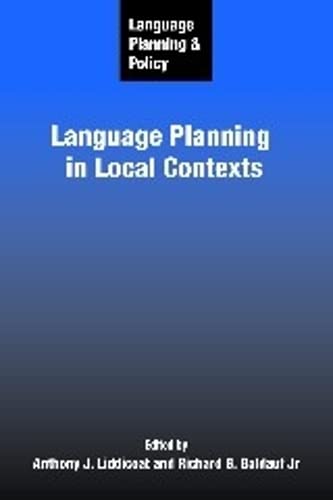
Inhaltsangabe
Most academic work in language planning has focused on national and governmental activities relating to language - macro language planning. Language problems potentially exist at all levels of human activity, including the local contexts of communities and institutions - micro language planning. Micro language planning occurs in both formal and informal contexts and is based in and around the everyday language needs and aspirations of communities and institutions. Micro language planning also articulates with macro language planning: local language problems can provide the impetus for national level action and national level planning needs to be implemented at the local level and local needs and conditions shape implementation. This volume examines the ways in which language planning works as a local activity in a wide variety of contexts around the world and dealing with a wide range of language planning issues: corpus planning, language in education planning prestige planning, and status planning.
Die Inhaltsangabe kann sich auf eine andere Ausgabe dieses Titels beziehen.
Über die Autorin bzw. den Autor
Anthony J. Liddicoat is Professor in Applied Linguistics at the Research Centre for Languages and Cultures in the School of International Studies at the University of South Australia. He is a former president of the Australian Federation of Modern language Teachers Associations. His research interests include: language and intercultural issues in education, conversation analysis, and language policy and planning. In recent years his research has focussed on ways on issues relating to the teaching and learning of culture through language study and his work has contributed to the development of Intercultural Language Teaching and Learning. He has published many books and papers in this area including Introduction to Conversation Analysis, Language Planning and Literacy, Australian Perspectives on Internationalisation, and Perspectives on Europe.
Richard B. Baldauf, Jr is Associate Professor of TESOL in the School of Education at the University of Queensland and a member of the Executive of the International Association of Applied Linguistics (AILA). He has published numerous articles in refereed journals and books. He is co-editor of Language Planning and Education in Australasia and the South Pacific (Multilingual Matters, 1990), principal researcher and editor for the Viability of Low Candidature LOTE Courses in Universities (DEET, 1995), co-author with Robert B. Kaplan of Language Planning from Practice to Theory (Multilingual Matters, 1997) and Language and Language-in-Education Planning in the Pacific Basin (Kluwer, 2003), and co-author with Zhao Shouhui of Planning Chinese Characters: Revolution, Evolution or Reaction (Springer, 2007).
Auszug. © Genehmigter Nachdruck. Alle Rechte vorbehalten.
Language Planning and Policy
Language Planning in Local Contexts
By Anthony J. Liddicoat, Richard B. Baldauf Jr.Multilingual Matters
Copyright © 2008 Anthony J. Liddicoat, Richard B. Baldauf Jr. and the authors of individual chapters
All rights reserved.
ISBN: 978-1-84769-063-0All rights reserved.
Contents
The Contributors, vii,
Introduction Language Planning in Local Contexts: Agents, Contexts and Interactions Anthony J. Liddicoat and Richard B. Baldauf Jr., 3,
Rearticulating the Case for Micro Language Planning in a Language Ecology Context Richard B. Baldauf Jr, 18,
Language Communities,
From Language to Ethnolect: Maltese to Maltaljan Roderick Bovingdon, 45,
Community-level Approaches in Language Planning: The Case of Hungarian in Australia Aniko Hatoss, 55,
Micro-level Language Planning in Ireland Diarmait Mac Giolla Chriost, 75,
Preserving Dialects of an Endangered Language Shelley Tulloch, 95,
The Ecological Impact of a Dictionary Anthony J. Liddicoat, 113,
Prestige From the Bottom Up: A Review of Language Planning in Guernsey Julia Sallabank, 120,
Language Planning in American Indian Pueblo Communities: Contemporary Challenges and Issues Christine P. Sims, 139,
Terminology Planning in Aboriginal Australia Jakelin Troy and Michael Walsh, 156,
Changing the Language Ecology of Kadazandusun: The Role of the Kadazandusun Language Foundation Rita Lasimbang and Ttixie Kinajil, 171,
Educational Contexts,
Singaporean Education Planning: Moving From the Macro to the Micro Catherine Siew Kheng Chua, 183,
'Trajectories of Agency' and Discursive Identities in Education: A Critical Site in Feminist Language Planning Jo Winter and Anne Pauwels, 199,
University Students' Attitudes Towards and Experiences of Bilingual Classrooms Christa van der Walt, 217,
Pacific Languages at the University of the South Pacific John Lynch and France Mugler, 234,
Micro Language Planning for Student Support in a Pharmacy Faculty Helen Marriott, 240,
Work Contexts,
Negotiable Acceptability: Reflections on the Interactions Between Language Professionals in Europe and NNS Scientists Wanting to Publish in English Joy Burrough-Boenisch, 255,
On Language Management in Multilingual Companies in the Czech Republic J. Nekvapil and M. Nekula, 268,
CHAPTER 1
Rearticulating the Case for Micro Language Planning in a Language Ecology Context
Richard B. Baldauf Jr School of Education, University of Queensland, Australia
Language planning is normally thought of in terms of large-scale, usually national planning, often undertaken by governments and meant to influence, if not change, ways of speaking or literacy practices within a society. It normally encompasses four aspects: status planning (about society), corpus planning (about language), language-in-education (or acquisition) planning (about learning), and (most recently) prestige planning (about image). When thinking about these aspects, both policy (i.e. form) and planning (i.e. function) components need to be considered as well as whether such policy and planning will be overt or covert in terms of the way it is put into action. Language policy and planning on this scale has dominated current work in the field. However, over the past decade language planning has taken on a more critical edge and its ecological context has been given greater emphasis, leading to an increasing acceptance that language planning can (and does) occur at different levels, i.e. the macro, meso and micro. This shift in focus has also led to a rethinking of agency – who has the power to influence change in these micro language policy and planning situations. Given this break with the dominant macro history, the question may be asked, is this developing notion of micro language planning and local agency actually language planning? If so, what are its parameters? Micro language planning studies are examined to illustrate trends in the literature.
Keywords: language planning, micro language policy, language ecology, agency
Introduction
Since an earlier review of micro language policy and planning (LPP) was completed in 2003 (Baldauf, 2005a), there have been a number of studies completed, creating the need to rearticulate this area of language planning study. Although there continues to be traditional 'modernist' LPP work done, a range of studies are now appearing that take a more critical position, that extends the notion of language policy (and planning) to local contexts. These studies also tend to use discursive methods and are concerned with issues of agency, harking back to recommendations found in the early work of Luke et al. (1990).
In a more recent overview volume on the field of language policy and planning, Kaplan and Baldauf (1997: 52) suggested that language planning occurred at several levels, the macro, the meso and the micro. Although they provided several examples in the volume of micro-level planning (e.g. a company requiring business translation in North America (Kaplan & Baldauf, 1997: 254ff)), this application of the principles of language policy and planning to micro situations was not a significant focus of the volume nor was it developed in any detail. As they indicated in their introductory chapter, when applied linguists think of language planning, they normally think of it in terms of large-scale, usually national, planning, often undertaken by governments and meant to influence, if not change, ways of speaking or literacy practices within a society. Nevertheless, Alan Davies, in a review of that volume, argued that the authors had been less convincing than they might have been about the centrality of applied linguistics to language planning and policy. He suggested that the authors tried to 'claim too much: language planning is best restricted to governmental activity, difficult as that may be to encompass' (Davies, 1999: 123).
Governmental activity is, of course, precisely where early language planning studies and practice had their roots, in macro sociolinguistics and related disciplines (see e.g. Fishman, 1974; Fox, 1975; Rubin & Jernudd, 1971) and it continues to be the site of the majority of language planning and policy related studies (and critiques). Furthermore, the notion of agency often lies with government officials, who are the prime actors in language planning activity (Baldauf & Kaplan, 2003). But, studies arising from this tradition raise the question of whether language policy and planning activity, almost by definition, is restricted to such large-scale (macro) governmental activity or can the frameworks that have been developed be applied differentially, but in an equally valid manner, to micro situations? Or, to put it another way, does language planning operate on a continuum from the macro to the micro? Is the resultant micro work still language policy and planning, or does it (should it) then fall into some other sub-field of applied linguistics or of some other discipline; e.g. sociolinguistics, education, critical discourse studies (CDA) or business studies?
More recently there has been some discussion of, and a number of specific studies reporting on language planning that has occurred at the micro level (i.e. language planning for businesses, educational bodies and other organisations). Although such studies often use different methodology – a focus on discourse, it might be argued that many of the same issues that can be found in the macro policy and planning frameworks and literature are...
„Über diesen Titel“ kann sich auf eine andere Ausgabe dieses Titels beziehen.
Suchergebnisse für Language Planning and Policy: Language Planning in...

Beispielbild für diese ISBN
Language Planning and Policy: Language Planning in Local Contexts
Anbieter: Majestic Books, Hounslow, Vereinigtes Königreich
Verkäuferbewertung 4 von 5 Sternen

Zustand: New. Artikel-Nr. 6529131
Neu kaufen
EUR 78,30
EUR 7,58 Versand
Versand von Vereinigtes Königreich nach USA
Versand von Vereinigtes Königreich nach USA
Anzahl: 1 verfügbar
Beispielbild für diese ISBN
Language Planning and Policy
Anbieter: PBShop.store US, Wood Dale, IL, USA
Verkäuferbewertung 5 von 5 Sternen

HRD. Zustand: New. New Book. Shipped from UK. Established seller since 2000. Artikel-Nr. CX-9781847690630
Neu kaufen
EUR 100,07
Versand gratis
Versand innerhalb von USA
Versand innerhalb von USA
Anzahl: 15 verfügbar
Beispielbild für diese ISBN
Language Planning and Policy
Anbieter: PBShop.store UK, Fairford, GLOS, Vereinigtes Königreich
Verkäuferbewertung 5 von 5 Sternen
HRD. Zustand: New. New Book. Shipped from UK. Established seller since 2000. Artikel-Nr. CX-9781847690630
Neu kaufen
EUR 94,63
EUR 5,85 Versand
Versand von Vereinigtes Königreich nach USA
Versand von Vereinigtes Königreich nach USA
Anzahl: 15 verfügbar
Beispielbild für diese ISBN
Language Planning and Policy: Language Planning in Local Contexts
Anbieter: Ria Christie Collections, Uxbridge, Vereinigtes Königreich
Verkäuferbewertung 5 von 5 Sternen
Zustand: New. In English. Artikel-Nr. ria9781847690630_new
Neu kaufen
EUR 118,82
EUR 13,17 Versand
Versand von Vereinigtes Königreich nach USA
Versand von Vereinigtes Königreich nach USA
Anzahl: Mehr als 20 verfügbar
Beispielbild für diese ISBN
Language Planning and Policy: Language Planning in Local Contexts
Anbieter: Revaluation Books, Exeter, Vereinigtes Königreich
Verkäuferbewertung 5 von 5 Sternen
Hardcover. Zustand: Brand New. 287 pages. 9.75x6.75x1.00 inches. In Stock. Artikel-Nr. x-1847690637
Neu kaufen
EUR 194,79
EUR 14,58 Versand
Versand von Vereinigtes Königreich nach USA
Versand von Vereinigtes Königreich nach USA
Anzahl: 2 verfügbar