
Verwandte Artikel zu Learning to be Literate: Multilingual Perspectives...
Inhaltsangabe
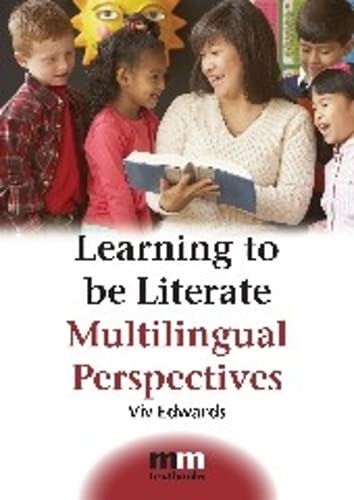
This textbook brings together research on literacy and multilingualism from a variety of settings: the learning of English in migrant destinations, immersion and bilingual education, and the maintenance of heritage languages. Designed to be accessible to students from a wide range of disciplines, the book explores multilingualism as a global phenomenon at both the individual and societal level, and literacy learning in a wide variety of contexts. It uses both these discussions to explore the theoretical and policy issues which are behind current educational practice, and points to possible ways forward. Students are introduced to examples of innovative and best practice from a range of international contexts, and discussion points and suggested activities encourage them to build on their own experiences as language learners. This is an ideal introductory text for students on courses where a critical understanding of language in education is necessary, as well as being a useful summary of the field and its future directions for researchers, practitioners and policy makers.
Die Inhaltsangabe kann sich auf eine andere Ausgabe dieses Titels beziehen.
Über die Autorin bzw. den Autor
Viv Edwards is Professor of Language in Education at the University of Reading where she is also Director of the National Centre for Language and Literacy. She is editor of the international journal Language and Education and has researched and published widely in the areas of multilingualism and education. Her book on Multilingualism in the English-speaking World received the 2005 British Association for Applied Linguistics book award. She is also a fellow of the Royal Society for Arts.
Auszug. © Genehmigter Nachdruck. Alle Rechte vorbehalten.
Learning to be Literate
Multilingual Perspectives
By Viv EdwardsMultilingual Matters
Copyright © 2009 Viv Edwards
All rights reserved.
ISBN: 978-1-84769-060-9All rights reserved.
Contents
Acknowledgements,
1: Reading the word, reading the world,
2: Multilingualism,
3: Education in multilingual societies,
4: Multiliteracies,
5: The politics and practice of literacy teaching,
6: Language, literacy and culture,
7: Resources for learning,
8: Making change in multilingual classrooms,
References,
Index,
CHAPTER 1
Reading the word, reading the world
* This brief introductory chapter describes some of the many different ways in which children learn to be literate in two or more languages and invites you to think of other examples from your own experience.
* It draws attention to the fragmented research on literacy in multilingual settings as disparate, for instance, as rural Zimbabwe and inner city England. While recognizing that the experiences of teachers and children can be very different, it makes a case for a more integrated approach that builds on commonalities between these various settings.
* It discusses the scope and organization of the book.
Many routes to literacy
The scope and organization of this book
Many routes to literacy
The title of this chapter comes from a book by Donaldo Macedo and Paulo Freire which makes links between literacy and politics: reading is not only about decoding the word from the page; it is also about the ways in which literacy can be used to empower and disempower people. This link is a recurring theme in the present book, too. The wordplay which underpins it is particularly appropriate in the context of the children in many different parts of the world who are learning read in more than one language. Let's look at some examples.
Redlands Primary School serves a highly diverse population in an inner city area of a town in southern England. Over 30 different languages are spoken. Many of the children have a parent who is studying at the university or working in the hospital nearby. The largest group, though, consists of children whose parents and grandparents arrived in the UK from Pakistan in the 1960s. The language of the home is Panjabi. Many of the children, however, are learning to read and write in Urdu, the language of literature and high culture in Pakistan, in a lunchtime club taught by one of the Redlands teachers. The introduction of an Urdu word-processing program was greeted with considerable enthusiasm by parents and children who use it for writing bilingual stories and captions for classroom displays (seeFigure 1.1). These activities also attracted the attention of non-Pakistani children, several of whom started to attend the Urdu club.
Ikastola Errobi is a small four-class school in Cambo-les-Bains in the foothills of the Pyrenees in the northern Basque country. The teachers' salaries are paid by the French government, but the buildings and other resources are funded by a cooperative of parents, some of whom speak only French but who are anxious for their children to reclaim their Basque heritage. As part of work on narrative, children were asked to produce their own bilingual, multimedia stories in Basque – introducing the characters, setting a problem, saying what happened, providing a resolution and giving the tale a twist. They read each other's stories, voted for the best draft – Zaunka ari zen gatua (The cat that barked) – and then worked together on improving it. Once the Basque version was complete, the story was sent to another class, where it was translated into French. The story was then read by a class of six-year-olds with less-developed Basque language skills who drew the illustrations (see Figure 1.2).
The Vulindlela Reading Club meets in Langa, a residential area established to segregate Black Africans from other racial groups in Cape Town during the apartheid era in South Africa. The club, launched in response to a request from a community organization, welcomes up to 200 children from Grades 2 to 6 from 10 to 12 on Saturday mornings. The sessions start with circle games and the singing of the Reading Club song, Education is fun, in English and isiXhosa. The children then divide into three different age groups to listen to stories and stretch out or cuddle up with a book. The sessions usually finish with a story telling session (See Figure 1.3). English and isiXhosa are used in the Reading Club on alternate weeks.
Play English (see Figure 1.4) in Monza, Italy, started as a playgroup for children aged three to five. The demand was such that soon there were two separate activities, a preschool day program and an after-school program. As the first Play English pupils approached elementary school age, parents, delighted with their children's progress, exerted pressure for provision to continue. The school now covers all the elementary grades and is beginning to extend to the Middle School years. Approximately equal amounts of time are given to literacy learning in English and Italian. The academic outcomes for the children, most of whom come from Italian-speaking homes, are comparable to those of their peers attending Italian schools. But, in addition, they are able to understand, speak, read and write in English at levels far superior to children in the Italian system.
The Chinese School in Reading in the south of England meets in a local primary school on Sunday mornings. It has two sections. One serves the predominantly Cantonese-speaking community that arrived in the UK in the 1950s and 1960s. The other teaches, through the medium of Mandarin or Putonghua, the official language of the People's Republic of China. Most of the children in this section are from sojourner families who stay in the UK for three or four years for study or work; they need to maintain high levels of literacy in Chinese for their return to China. Others are the children of longer-term residents from the People's Republic, whose parents are keen for them to either learn or maintain Chinese literacy skills. A smaller group consists of Cantonese speakers wishing to develop Mandarin in recognition of the importance of China on the world stage. A wall chart sets out the different stokes that make up Chinese characters. Great attention to detail is required: the strokes need to be written in a set order and the right proportions maintained (Figure 1.5).
Alexandra d'Onofrio is a citizen of the world. Born in London to a Greek mother and Italian father, she spent the first eight years of her life in England, attending first an Italian nursery and then the Greek Embassy School before transferring to an English primary school. The family moved briefly to Greece where Alexandra attended an Italian language-medium school before settling permanently in Italy. Throughout this time, her mother nurtured reading and writing in all three of her first languages, placing more emphasis, for instance, on Italian and English when they were in Greece, and more emphasis on English and Greek in Italy. In the early stages, she read stories and used post-its to label household objects – fridge, kettle, cupboard, table – in one language on one day, and another on the next. Alexandra returned to the UK for her higher education where she graduated with a degree in Social Anthropology and Hindi (see Figure 1.6). She later traveled to Cuba and Mexico where she learned Spanish, and spent six months in Brazil working on a...
„Über diesen Titel“ kann sich auf eine andere Ausgabe dieses Titels beziehen.
Suchergebnisse für Learning to be Literate: Multilingual Perspectives...

Beispielbild für diese ISBN
Learning to Be Literate: Multilingual Perspectives
Verlag:
Multilingual Matters Limited, 2009
ISBN 10: 1847690602
ISBN 13: 9781847690609
Gebraucht
Paperback
Anbieter: ThriftBooks-Dallas, Dallas, TX, USA
Verkäuferbewertung 5 von 5 Sternen

Paperback. Zustand: Fair. No Jacket. Readable copy. Pages may have considerable notes/highlighting. ~ ThriftBooks: Read More, Spend Less. Artikel-Nr. G1847690602I5N00
Gebraucht kaufen
EUR 12,10
Versand gratis
Versand innerhalb von USA
Versand innerhalb von USA
Anzahl: 1 verfügbar
Foto des Verkäufers
Learning to be Literate: Multilingual Perspectives (MM Texts): 3 (MM Textbooks)
Anbieter: WeBuyBooks, Rossendale, LANCS, Vereinigtes Königreich
Verkäuferbewertung 5 von 5 Sternen
Paperback. Zustand: Good. Most items will be dispatched the same or the next working day. A copy that has been read but remains in clean condition. All of the pages are intact and the cover is intact and the spine may show signs of wear. The book may have minor markings which are not specifically mentioned. . Annotations to page edges/pages, may include notes, highlighting or underlining. Artikel-Nr. rev3158093683
Gebraucht kaufen
EUR 6,35
EUR 6,42 Versand
Versand von Vereinigtes Königreich nach USA
Versand von Vereinigtes Königreich nach USA
Anzahl: 1 verfügbar
Beispielbild für diese ISBN
Learning to Be Literate: Multilingual Perspectives (MM Textbooks)
Anbieter: Anybook.com, Lincoln, Vereinigtes Königreich
Verkäuferbewertung 5 von 5 Sternen
Zustand: Good. This is an ex-library book and may have the usual library/used-book markings inside.This book has soft covers. In good all round condition. Please note the Image in this listing is a stock photo and may not match the covers of the actual item,400grams, ISBN:9781847690609. Artikel-Nr. 4317303
Gebraucht kaufen
EUR 3,00
EUR 15,81 Versand
Versand von Vereinigtes Königreich nach USA
Versand von Vereinigtes Königreich nach USA
Anzahl: 1 verfügbar
Beispielbild für diese ISBN
Learning to Be Literate: Multilingual Perspectives (Mm Texts)
Anbieter: Anybook.com, Lincoln, Vereinigtes Königreich
Verkäuferbewertung 5 von 5 Sternen
Zustand: Fair. This is an ex-library book and may have the usual library/used-book markings inside.This book has soft covers. In fair condition, suitable as a study copy. Please note the Image in this listing is a stock photo and may not match the covers of the actual item,350grams, ISBN:9781847690609. Artikel-Nr. 8606071
Gebraucht kaufen
EUR 6,16
EUR 15,81 Versand
Versand von Vereinigtes Königreich nach USA
Versand von Vereinigtes Königreich nach USA
Anzahl: 1 verfügbar
Beispielbild für diese ISBN
Learning to be Literate
Anbieter: PBShop.store UK, Fairford, GLOS, Vereinigtes Königreich
Verkäuferbewertung 5 von 5 Sternen
PAP. Zustand: New. New Book. Shipped from UK. Established seller since 2000. Artikel-Nr. CX-9781847690609
Neu kaufen
EUR 19,27
EUR 4,84 Versand
Versand von Vereinigtes Königreich nach USA
Versand von Vereinigtes Königreich nach USA
Anzahl: 15 verfügbar
Beispielbild für diese ISBN
Learning to be Literate
Anbieter: PBShop.store US, Wood Dale, IL, USA
Verkäuferbewertung 5 von 5 Sternen
PAP. Zustand: New. New Book. Shipped from UK. Established seller since 2000. Artikel-Nr. CX-9781847690609
Beispielbild für diese ISBN
Learning to be Literate: Multilingual Perspectives (MM Textbooks, 3)
Anbieter: Ria Christie Collections, Uxbridge, Vereinigtes Königreich
Verkäuferbewertung 5 von 5 Sternen
Zustand: New. In English. Artikel-Nr. ria9781847690609_new
Neu kaufen
EUR 23,91
EUR 10,90 Versand
Versand von Vereinigtes Königreich nach USA
Versand von Vereinigtes Königreich nach USA
Anzahl: Mehr als 20 verfügbar
Beispielbild für diese ISBN
Learning to Be Literate: Multilingual Perspectives
Anbieter: Revaluation Books, Exeter, Vereinigtes Königreich
Verkäuferbewertung 5 von 5 Sternen
Paperback. Zustand: Brand New. 128 pages. 9.00x6.75x0.75 inches. In Stock. Artikel-Nr. x-1847690602
Neu kaufen
EUR 39,03
EUR 11,63 Versand
Versand von Vereinigtes Königreich nach USA
Versand von Vereinigtes Königreich nach USA
Anzahl: 2 verfügbar