
Verwandte Artikel zu Colin Wilson's 'occult Trilogy': a Guide...
Inhaltsangabe
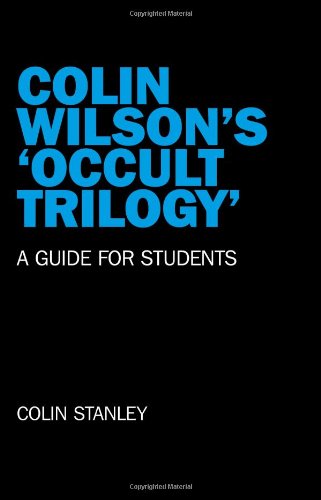
The 'Occult Trilogy' is the collective label applied to Colin Wilson's three major works on the occult: The Occult (1971); Mysteries: an Investigation into the Occult, the Paranormal and the Supernatural (1978) and Beyond the Occult (1988). They amounted to a monumental 1600 pages and have spawned many other lesser works.
Die Inhaltsangabe kann sich auf eine andere Ausgabe dieses Titels beziehen.
Über die Autorinnen und Autoren
Colin Stanley is a freelance writer and Managing Editor of Paupers' Press. He edits the series, Colin Wilson Studies, which features extended essays on Wilson's work by scholars worldwide. He lives in the UK.
,
Colin Stanley is a freelance writer and Managing Editor of Paupers' Press. He edits the series, Colin Wilson Studies, which features extended essays on Wilson's work by scholars worldwide. He lives in the UK.
,
Auszug. © Genehmigter Nachdruck. Alle Rechte vorbehalten.
Colin Wilson's 'Occult Trilogy'
A Guide for Students
By Colin StanleyJohn Hunt Publishing Ltd.
Copyright © 2012 Colin Stanley
All rights reserved.
ISBN: 978-1-84694-706-3All rights reserved.
Contents
| Preface.................................................................... | 1 |
| Notes...................................................................... | 3 |
| Book 1: The Occult......................................................... | 5 |
| Book 2: Mysteries: an Investigation into the Occult, the Paranormal, and the Supernatural........................................................... | 27 |
| Book 3: Beyond the Occult.................................................. | 47 |
| Colin Wilson on the occult: a checklist.................................... | 67 |
| Index...................................................................... | 79 |
| About the Author........................................................... | 89 |
Excerpt
CHAPTER 1
The Occult
* * *
The Occult was Colin Wilson's first commissioned book and hemade no secret of the fact that, at first, it was not a subject thatinterested him greatly. When he sought the advice of RobertGraves on whether he should write it, he was told very firmlythat he should not. However, with a young family to support,Wilson needed the money and fortunately went ahead with theproject. During the course of his research, he found his attitudeto the subject changing:
"Although I have always been curious about the 'occult' ... ithas never been one of my major interests, like philosophy, orscience, or even music.... It was not until two years ago, whenI began the systematic research for this book, that I realisedthe remarkable consistency of the evidence for such mattersas life after death, out-of-body experiences (astral projection),reincarnation. In a basic sense my attitude remainsunchanged; I still regard philosophy—the pursuit of realitythrough intuition aided by intellect—as being more relevantmore important, than questions of the 'occult'. But theweighing of the evidence ... has convinced me that the basicclaims of 'occultism' are true."
The completed book, dedicated to Graves, was published onOctober 4, 1971, by Hodder & Stoughton in the U.K. and RandomHouse in the U.S. In his new Introduction to a 2003 reprint,published by Watkins Publishing, he wrote, "The publication ofthis book had the effect of changing my life". Cyril Connolly andPhilip Toynbee who, as critics, were instrumental in turning hisThe Outsider into a bestseller in 1956, but had subsequentlychanged their minds and then ignored his work for fifteen years,relaxed their embargo and came out in support of him again.
"But for me, The Occult did a great deal more than make me'respectable', it also served as a kind of awakening. Before1970, I had been inclined to dismiss 'the occult' as superstitiousnonsense. Writing The Occult made me aware that theparanormal is as real as quantum physics (and, in fact, has agreat deal in common with it), and that anyone who refuses totake it into account is simply shutting his eyes to half theuniverse." (Wilson (1), xxii)
A huge book (over 600 pages), it became the first in a trilogy ofequally bulky volumes on the subject. Mysteries followed in 1978(London: Hodder and Stoughton) and Beyond the Occult (London,New York: Bantam Press) in 1988. The book also spawnednumerous popular, illustrated books on the subject which havebeen issued under his name since the 1970s and, indeed, continueto appear today [see following checklist].
The Occult is divided into three parts, preceded by a shortIntroduction. The first part, 'A Survey of the Subject', statesWilson's own preoccupations and convictions. The second, 'AHistory of Magic', concentrates on individual 'mages' andadepts. The third part, 'Man's Latent Powers', looks at witchcraft,spiritualism and ghosts with a final chapter that discusses themetaphysical questions that arise out of occultism.
"The thesis of this book is revolutionary ..." Wilson declares onthe first page of his Introduction. Primitive man believedthe world to be full of unseen forces whereas today our rationalminds tell us that these forces existed only in his imagination.The problem, says Wilson, is that we have become "thinkingpigmies" who have forgotten "the immense world of broadersignificance that stretches around [us]". It is his belief thatcivilisation cannot evolve until the occult is taken for granted "onthe same level as atomic energy" and he recommends thatwe re-learn the technique of expanding inwardly and relax ourhard-headed approach to subjects such as premonition, life afterdeath etc.
"Man has reached a point in his evolution where hemust ... turn increasingly inward. That is, he must turn to thehidden levels of his being, to the 'occult', to meanings andvibrations that have so far been too fine to grasp."
He claims that the science of cybernetics has suggested that thereis a certain order and meaning behind the universe and that:
"All this means that for the first time in Western history abook on the occult can be something more than a collection ofmarvels and absurdities. Religion, mysticism and magic allspring from the same basic 'feeling' about the universe: asudden feeling of meaning...."
In Part 1, Chapter 1, which has the seemingly paradoxical title'Magic—The Science of the Future', Wilson explains thatalthough he had read books on magic and mysticism in hisyouth, he did so "because they confirmed my intuition ofanother order of reality, an intenser and more powerful form ofconsciousness ...". But if, at that time, he had been askedwhether he literally believed in magic, he would have answered:No. "Magic, I felt, was no more than a first crude attempt atscience, and it had now been superseded by science". Hecontinues:
"If I still accepted that view, I would not be writing this book.It now seems to me that the exact reverse is true. Magic wasnot the 'science' of the past. It is the science of the future. Ibelieve that the human mind has reached a point in evolutionwhere it is about to develop new powers—powers that wouldonce have been considered magical."
In the animal kingdom 'magical' powers (such as the hominginstinct) are commonplace:
"Civilised man has forgotten about them because they are nolonger necessary to his survival ... In fact, his survival dependsupon 'forgetting' them. High development of the instinctivelevels is incompatible with the kind of concentration upondetail needed by civilised man."
Wilson then recounts some incidents of premonition andtelepathy in his personal life before outlining recorded cases ofastral projection by John Cowper Powys and August Strindberg.This encourages Wilson to produce his own basic theory of thepower of the human mind, introducing the important concept of'Faculty X': "that latent power that human beings possess to reachbeyond the present":
"Faculty X is a sense of reality of other places and other times,and it is the possession of it—fragmentary and uncertainthough it is—that distinguishes man from all other animals."
He quotes examples of 'Faculty X' from Marcel Proust's autobiographicalnovel À la Recherche du Temps Perdu and ArnoldToynbee's A Study of History. These...
„Über diesen Titel“ kann sich auf eine andere Ausgabe dieses Titels beziehen.
Suchergebnisse für Colin Wilson's 'occult Trilogy': a Guide...

Beispielbild für diese ISBN
Colin Wilson`s `Occult Trilogy` - a guide for students
Anbieter: PBShop.store US, Wood Dale, IL, USA
Verkäuferbewertung 5 von 5 Sternen

PAP. Zustand: New. New Book. Shipped from UK. Established seller since 2000. Artikel-Nr. GB-9781846947063
Beispielbild für diese ISBN
Colin Wilson`s `Occult Trilogy` - a guide for students
Anbieter: PBShop.store UK, Fairford, GLOS, Vereinigtes Königreich
Verkäuferbewertung 5 von 5 Sternen
PAP. Zustand: New. New Book. Shipped from UK. Established seller since 2000. Artikel-Nr. GB-9781846947063
Neu kaufen
EUR 14,72
EUR 3,88 Versand
Versand von Vereinigtes Königreich nach USA
Versand von Vereinigtes Königreich nach USA
Anzahl: 2 verfügbar
Beispielbild für diese ISBN
Colin Wilson's 'Occult Trilogy'
Anbieter: Majestic Books, Hounslow, Vereinigtes Königreich
Verkäuferbewertung 4 von 5 Sternen

Zustand: New. Artikel-Nr. 53949777
Neu kaufen
EUR 11,26
EUR 7,66 Versand
Versand von Vereinigtes Königreich nach USA
Versand von Vereinigtes Königreich nach USA
Anzahl: 1 verfügbar
Beispielbild für diese ISBN
Colin Wilson's 'Occult Trilogy': A Guide for Students
Anbieter: Ria Christie Collections, Uxbridge, Vereinigtes Königreich
Verkäuferbewertung 5 von 5 Sternen
Zustand: New. In English. Artikel-Nr. ria9781846947063_new
Neu kaufen
EUR 15,47
EUR 11,04 Versand
Versand von Vereinigtes Königreich nach USA
Versand von Vereinigtes Königreich nach USA
Anzahl: 4 verfügbar
Beispielbild für diese ISBN
Colin Wilson`s `Occult Trilogy` a guide for students
Anbieter: Revaluation Books, Exeter, Vereinigtes Königreich
Verkäuferbewertung 5 von 5 Sternen
Paperback. Zustand: Brand New. student edition. 97 pages. 8.30x5.40x0.30 inches. In Stock. Artikel-Nr. x-1846947065
Neu kaufen
EUR 16,12
EUR 11,78 Versand
Versand von Vereinigtes Königreich nach USA
Versand von Vereinigtes Königreich nach USA
Anzahl: 2 verfügbar
Beispielbild für diese ISBN
Colin Wilson's 'occult Trilogy'
Anbieter: Kennys Bookstore, Olney, MD, USA
Verkäuferbewertung 5 von 5 Sternen
Zustand: New. An essential guide to Colin Wilson's major writings on the occult. Num Pages: 97 pages. BIC Classification: VXW. Category: (G) General (US: Trade). Dimension: 215 x 141 x 7. Weight in Grams: 108. . 2013. Student. Paperback. . . . . Books ship from the US and Ireland. Artikel-Nr. V9781846947063
Neu kaufen
EUR 19,67
EUR 9,36 Versand
Versand innerhalb von USA
Versand innerhalb von USA
Anzahl: 1 verfügbar
Foto des Verkäufers
Colin Wilson`s `Occult Trilogy` - a guide for students
Verlag:
John Hunt Publishing Mai 2013, 2013
ISBN 10: 1846947065
ISBN 13: 9781846947063
Neu
Taschenbuch
Anbieter: AHA-BUCH GmbH, Einbeck, Deutschland
Verkäuferbewertung 5 von 5 Sternen
Taschenbuch. Zustand: Neu. Neuware - The 'Occult Trilogy' is the collective label applied to Colin Wilson's three major works on the occult: The Occult (1971); Mysteries: an Investigation into the Occult, the Paranormal and the Supernatural (1978) and Beyond the Occult (1988). They amounted to a monumental 1600 pages and have spawned many other lesser works. Artikel-Nr. 9781846947063
Neu kaufen
EUR 12,64
EUR 35,00 Versand
Versand von Deutschland nach USA
Versand von Deutschland nach USA
Anzahl: 1 verfügbar
Beispielbild für diese ISBN
COLIN WILSONS OCCULT TRILOGY
Anbieter: Speedyhen, Hertfordshire, Vereinigtes Königreich
Verkäuferbewertung 5 von 5 Sternen
Zustand: NEW. Artikel-Nr. NW9781846947063
Neu kaufen
EUR 12,26
EUR 48,32 Versand
Versand von Vereinigtes Königreich nach USA
Versand von Vereinigtes Königreich nach USA
Anzahl: 2 verfügbar
Foto des Verkäufers
Colin Wilson`s `Occult Trilogy` - a guide for students
Anbieter: moluna, Greven, Deutschland
Verkäuferbewertung 5 von 5 Sternen
Zustand: New. An essential guide to Colin Wilson s major writings on the occult.Über den AutorColin Stanley is a freelance writer and Managing Editor of Paupers Press. He edits the series, Colin Wilson Studies, which features extended essays. Artikel-Nr. 597080938
Neu kaufen
EUR 16,91
EUR 48,99 Versand
Versand von Deutschland nach USA
Versand von Deutschland nach USA
Anzahl: 2 verfügbar
Foto des Verkäufers
Colin Wilson`s `Occult Trilogy` - a guide for students
Anbieter: preigu, Osnabrück, Deutschland
Verkäuferbewertung 5 von 5 Sternen
Taschenbuch. Zustand: Neu. Colin Wilson`s `Occult Trilogy` - a guide for students | Colin Stanley | Taschenbuch | Einband - flex.(Paperback) | Englisch | 2013 | John Hunt Publishing | EAN 9781846947063 | Verantwortliche Person für die EU: Libri GmbH, Europaallee 1, 36244 Bad Hersfeld, gpsr[at]libri[dot]de | Anbieter: preigu. Artikel-Nr. 106085665
Neu kaufen
EUR 17,15
EUR 70,00 Versand
Versand von Deutschland nach USA
Versand von Deutschland nach USA
Anzahl: 1 verfügbar