
Verwandte Artikel zu The Economist Style Guide
Inhaltsangabe
The best-selling guide to English usage.
Die Inhaltsangabe kann sich auf eine andere Ausgabe dieses Titels beziehen.
Aus dem Klappentext
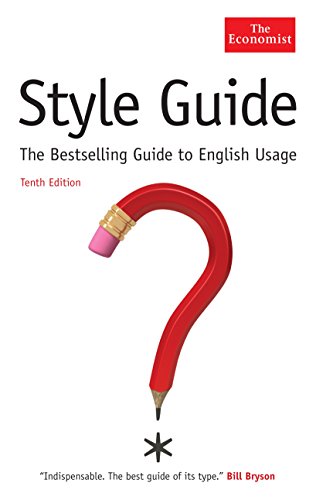
The tenth edition of this bestselling guide to style is based on the house style manual of The Economist newspaper. It is an invaluable companion for everyone who wants to communicate with the clarity, style and precision for which The Economist is famous. The first section, which has been revised and updated to reflect current usage (or misusage), gives general advice on writing, points out common errors and clichés, offers guidance on the proper use of punctuation and grammar, helps with spelling and hyphens, and much more.
The second section highlights the important differences between American and British English syntax and punctuation, spelling and usage and has been thoroughly revised and updated.
The third section contains a range of useful reference material, which has been checked and revised, covering everything from business ratios and stock market indices to chemical elements, US presidents and British prime ministers. Some new additions are the Greek alphabet, mathematical symbols, the winter Olympic games and the solar system.
An essential book for anyone who writes reports, articles, books, letters or memoranda? or even shopping lists?The Economist Style Guide will enlighten, educate and amuse.
- Aggravate means make worse not irritate or annoy.
- Alibi An alibi is the fact of being elsewhere, not a false explanation.
- Anticipate does not mean expect. Jack and Jill expected to marry; if they anticipated marriage, only Jill might find herself expectant.
- Born, borne are both past participles of the verb bear. Born is used in the sense of giving birth: She was born in April. Borne is used for supporting or putting up with (The victims has borne enough pain) and for giving birth in active constructions (She had already borne six children).
- Compare A is compared with B when you draw attention to the difference. A is compared to B only when you want to stress their similarity, as in Shall I compare thee to a summer's day?
- Continuous describes something uninterrupted. Continual admits of a break. If your neighbours play load music every night, it is a continual nuisance; it is not a continuous one unless the music is never turned off.
- Council, counsel A council is a body of people, elected or appointed, that advises, administers, organizes, legislates, etc. Counsel (noun) means advice or consultant, or lawyers who give legal advice and fight cases in court.
- Discreet, discrete Discreet means circumspect or prudent. Discrete means separate or distinct.
- Forgo, forego Forgo means do without; it forgoes the e. Forego means go before.
- Healthy If you think something is desirable or good, say so. Do not call it healthy.
- Jargon Avoid it.
- Journalese and slang Slang, like metaphors, should be used only occasionally of it is to have effect. Avoid expressions used only by journalists, such as giving people the thumbs up, the thumbs down or the green light.
- Political correctness Avoid, if you can, giving gratuitous offence: you risk losing your readers or at least their goodwill, and therefore your arguments. But pandering to every plea for politically correct terminology may make your prose unreadable, and therefore unread.
- Proactive Not a pretty word: try active or energetic.
- Ring, wring (verbs) bells are rung, hands are wrung. Both may be seen at weddings.
- Short words Use them.
„Über diesen Titel“ kann sich auf eine andere Ausgabe dieses Titels beziehen.
Suchergebnisse für The Economist Style Guide

Beispielbild für diese ISBN
The Economist Style Guide
Anbieter: World of Books (was SecondSale), Montgomery, IL, USA
Verkäuferbewertung 5 von 5 Sternen

Zustand: Very Good. Item in very good condition! Textbooks may not include supplemental items i.e. CDs, access codes etc. Artikel-Nr. 00109208605
Gebraucht kaufen
EUR 6,10
Versand gratis
Versand innerhalb von USA
Versand innerhalb von USA
Anzahl: 1 verfügbar
Beispielbild für diese ISBN
The Economist Style Guide
Anbieter: ThriftBooks-Dallas, Dallas, TX, USA
Verkäuferbewertung 5 von 5 Sternen
Hardcover. Zustand: Very Good. No Jacket. May have limited writing in cover pages. Pages are unmarked. ~ ThriftBooks: Read More, Spend Less. Artikel-Nr. G1846681758I4N00
Gebraucht kaufen
EUR 6,11
Versand gratis
Versand innerhalb von USA
Versand innerhalb von USA
Anzahl: 1 verfügbar
Beispielbild für diese ISBN
The Economist Style Guide
Verlag:
Wiley & Sons, Incorporated, John, 2010
ISBN 10: 1846681758
ISBN 13: 9781846681752
Gebraucht
Hardcover
Anbieter: Better World Books, Mishawaka, IN, USA
Verkäuferbewertung 5 von 5 Sternen
Zustand: Very Good. 10th Edition. Pages intact with possible writing/highlighting. Binding strong with minor wear. Dust jackets/supplements may not be included. Stock photo provided. Product includes identifying sticker. Better World Books: Buy Books. Do Good. Artikel-Nr. 8117700-20
Gebraucht kaufen
EUR 6,16
Versand gratis
Versand innerhalb von USA
Versand innerhalb von USA
Anzahl: 1 verfügbar
Beispielbild für diese ISBN
The Economist Style Guide
Verlag:
Wiley & Sons, Incorporated, John, 2010
ISBN 10: 1846681758
ISBN 13: 9781846681752
Gebraucht
Hardcover
Anbieter: Better World Books, Mishawaka, IN, USA
Verkäuferbewertung 5 von 5 Sternen
Zustand: Fine. 10th Edition. Used book that is in almost brand-new condition. May contain a remainder mark. Better World Books: Buy Books. Do Good. Artikel-Nr. 16573394-6
Gebraucht kaufen
EUR 6,16
Versand gratis
Versand innerhalb von USA
Versand innerhalb von USA
Anzahl: 1 verfügbar
Beispielbild für diese ISBN
The Economist Style Guide
Verlag:
Economist Books 18/03/2010, 2010
ISBN 10: 1846681758
ISBN 13: 9781846681752
Gebraucht
Hardcover
Anbieter: AwesomeBooks, Wallingford, Vereinigtes Königreich
Verkäuferbewertung 5 von 5 Sternen
Zustand: Very Good. This book is in very good condition and will be shipped within 24 hours of ordering. The cover may have some limited signs of wear but the pages are clean, intact and the spine remains undamaged. This book has clearly been well maintained and looked after thus far. Money back guarantee if you are not satisfied. See all our books here, order more than 1 book and get discounted shipping. . Artikel-Nr. 7719-9781846681752
Gebraucht kaufen
EUR 3,85
EUR 4,85 Versand
Versand von Vereinigtes Königreich nach USA
Versand von Vereinigtes Königreich nach USA
Anzahl: 3 verfügbar
Foto des Verkäufers
The Economist Style Guide
Anbieter: WeBuyBooks, Rossendale, LANCS, Vereinigtes Königreich
Verkäuferbewertung 5 von 5 Sternen
hardcover. Zustand: Good. Most items will be dispatched the same or the next working day. A copy that has been read but remains in clean condition. All of the pages are intact and the cover is intact and the spine may show signs of wear. The book may have minor markings which are not specifically mentioned. Artikel-Nr. rev9216221667
Gebraucht kaufen
EUR 1,33
EUR 7,46 Versand
Versand von Vereinigtes Königreich nach USA
Versand von Vereinigtes Königreich nach USA
Anzahl: 1 verfügbar
Beispielbild für diese ISBN
The Economist Style Guide
Anbieter: WorldofBooks, Goring-By-Sea, WS, Vereinigtes Königreich
Verkäuferbewertung 5 von 5 Sternen
Hardback. Zustand: Very Good. The book has been read, but is in excellent condition. Pages are intact and not marred by notes or highlighting. The spine remains undamaged. Artikel-Nr. GOR002229467
Gebraucht kaufen
EUR 2,31
EUR 6,59 Versand
Versand von Vereinigtes Königreich nach USA
Versand von Vereinigtes Königreich nach USA
Anzahl: 6 verfügbar
Beispielbild für diese ISBN
The Economist Style Guide
Verlag:
Wiley & Sons, Incorporated, John, 2010
ISBN 10: 1846681758
ISBN 13: 9781846681752
Gebraucht
Hardcover
Anbieter: Better World Books Ltd, Dunfermline, Vereinigtes Königreich
Verkäuferbewertung 5 von 5 Sternen
Zustand: Good. 10th Edition. Former library copy. Pages intact with minimal writing/highlighting. The binding may be loose and creased. Dust jackets/supplements are not included. Includes library markings. Stock photo provided. Product includes identifying sticker. Better World Books: Buy Books. Do Good. Artikel-Nr. GRP72048673
Gebraucht kaufen
EUR 5,70
EUR 5,88 Versand
Versand von Vereinigtes Königreich nach USA
Versand von Vereinigtes Königreich nach USA
Anzahl: 1 verfügbar
Beispielbild für diese ISBN
The Economist Style Guide
Verlag:
Wiley & Sons, Incorporated, John, 2010
ISBN 10: 1846681758
ISBN 13: 9781846681752
Gebraucht
Hardcover
Anbieter: Better World Books Ltd, Dunfermline, Vereinigtes Königreich
Verkäuferbewertung 5 von 5 Sternen
Zustand: Very Good. 10th Edition. Former library copy. Pages intact with possible writing/highlighting. Binding strong with minor wear. Dust jackets/supplements may not be included. Includes library markings. Stock photo provided. Product includes identifying sticker. Better World Books: Buy Books. Do Good. Artikel-Nr. GRP82198598
Gebraucht kaufen
EUR 5,70
EUR 5,88 Versand
Versand von Vereinigtes Königreich nach USA
Versand von Vereinigtes Königreich nach USA
Anzahl: 1 verfügbar
Beispielbild für diese ISBN
The Economist Style Guide
Anbieter: medimops, Berlin, Deutschland
Verkäuferbewertung 5 von 5 Sternen
Zustand: very good. Gut/Very good: Buch bzw. Schutzumschlag mit wenigen Gebrauchsspuren an Einband, Schutzumschlag oder Seiten. / Describes a book or dust jacket that does show some signs of wear on either the binding, dust jacket or pages. Artikel-Nr. M01846681758-V
Gebraucht kaufen
EUR 4,37
EUR 10,00 Versand
Versand von Deutschland nach USA
Versand von Deutschland nach USA
Anzahl: 1 verfügbar