
Verwandte Artikel zu Queer Events: Post-Deconstructive Subjectivities in...
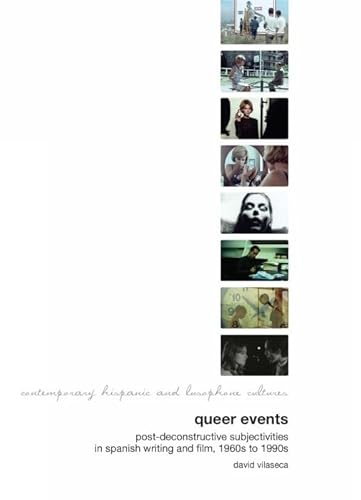
Queer Events: Post-Deconstructive Subjectivities in Spanish Writing and Film, 1960s to 1990s (Contemporary Hispanic and Lusophone Cultures, Band 4) - Hardcover
Inhaltsangabe
Queer Events offers radical new rereadings of crucial texts from the era of the Spanish transition to democracy. From Terenci Moix to Vicente Aranda, most of the major writers and filmmakers of the time are found here but David Vilaseca also addresses many who deserve to be better known, including Antonio Roig, controversial scholar Alberto Cardín, and the directors of the short-lived yet vital film movement known as the Barcelona School. Drawing on queer theory and the philosophies of Badiou, Agamben, and Deleuze, Queer Events reconceptualizes a complex period in Spanish history characterized by discomfort with the past and deep ideological conflict with the present.
Die Inhaltsangabe kann sich auf eine andere Ausgabe dieses Titels beziehen.
Über die Autorinnen und Autoren
David Vilaseca (1964–2010) was professor of Hispanic studies and critical theory at Royal Holloway, University of London.
David Vilaseca was Professor of Hispanic Studies and Critical Theory at Royal Holloway, University of London, and author of Hindsight and the Real: Subjectivity in Gay Hispanic Autobiography (Peter Lang, 2003) and L'aprenentatge de la soledat (Edicions 3i4, 2008; winner of the 2007 Octubre Prize for Catalan fiction). He was killed in a traffic accident in London on 9 February 2010.
Von der hinteren Coverseite
Queer Events studies for the first time crucial texts from the era of the Spanish Transition to democracy, taken here as the period lasting from the 1960s to the 1990s. It offers radically new readings of some major writers and filmmakers, such as Terenci Moix and Vicente Aranda, but also addresses some who deserve to be better known: defrocked priest and autobiographer Antonio Roig, controversial scholar and fiction-writer Alberto Cardín, and experimental film directors José Maria Nunes, Jacinto Esteva-Grewe and Joaquín Jordà, members of the short-lived, but vital, movement known as 'the Barcelona School'. David Vilaseca treats this group of texts, both literary and cinematic, in a wholly original way. Drawing on some of the most influential theorists and philosophers of our time never previously used in a Hispanic context (Deleuze, Agamben, Zizek and, above all, Badiou), Queer Events argues for a radical re-reading of a complex period in Spanish history, which is characterized by amnesia in relation to a painful past and ideological conflict within an unsettling present. The book argues that the Transition emerges as (in Badiou's terms) the great 'evental site' of modern Spain, from which radically new ways of thinking can still emerge.
„Über diesen Titel“ kann sich auf eine andere Ausgabe dieses Titels beziehen.
Suchergebnisse für Queer Events: Post-Deconstructive Subjectivities in...

Beispielbild für diese ISBN
Queer Events: Post-Deconstructive Subjectivities in Spanish Writing and Film, 1960s-1990s (Contemporary Hispanic and Lusophone Cultures) (Volume 4)
Verlag:
Liverpool University Press, 2010
ISBN 10: 1846314674
ISBN 13: 9781846314674
Gebraucht
Hardcover
Anbieter: Anybook.com, Lincoln, Vereinigtes Königreich
Verkäuferbewertung 5 von 5 Sternen

Zustand: Good. Volume 4. This is an ex-library book and may have the usual library/used-book markings inside.This book has hardback covers. In good all round condition. Dust jacket in fair condition. Please note the Image in this listing is a stock photo and may not match the covers of the actual item,600grams, ISBN:9781846314674. Artikel-Nr. 9791692
Gebraucht kaufen
EUR 26,25
EUR 15,86 Versand
Versand von Vereinigtes Königreich nach USA
Versand von Vereinigtes Königreich nach USA
Anzahl: 1 verfügbar
Beispielbild für diese ISBN
Queer Events: Post-deconstructive Subjectivities in Spanish Writing and Film 1960s-1990s (Contemporary Hispanic and Lusophone Cultures, 4)
Anbieter: Ria Christie Collections, Uxbridge, Vereinigtes Königreich
Verkäuferbewertung 5 von 5 Sternen
Zustand: New. In English. Artikel-Nr. ria9781846314674_new
Neu kaufen
EUR 152,66
EUR 13,17 Versand
Versand von Vereinigtes Königreich nach USA
Versand von Vereinigtes Königreich nach USA
Anzahl: Mehr als 20 verfügbar
Beispielbild für diese ISBN
Queer Events: Post-deconstructive Subjectivities in Spanish Writing and Film, 1960s to 1990s
Anbieter: Revaluation Books, Exeter, Vereinigtes Königreich
Verkäuferbewertung 5 von 5 Sternen
Hardcover. Zustand: Brand New. 1st edition. 256 pages. 6.00x9.25x0.50 inches. In Stock. Artikel-Nr. __1846314674
Neu kaufen
EUR 159,18
EUR 14,58 Versand
Versand von Vereinigtes Königreich nach USA
Versand von Vereinigtes Königreich nach USA
Anzahl: 2 verfügbar
Beispielbild für diese ISBN
Queer Events
Anbieter: Majestic Books, Hounslow, Vereinigtes Königreich
Verkäuferbewertung 4 von 5 Sternen

Zustand: New. pp. 256. Artikel-Nr. 5655273
Neu kaufen
EUR 166,67
EUR 7,58 Versand
Versand von Vereinigtes Königreich nach USA
Versand von Vereinigtes Königreich nach USA
Anzahl: 3 verfügbar
Beispielbild für diese ISBN
Queer Events
Anbieter: PBShop.store UK, Fairford, GLOS, Vereinigtes Königreich
Verkäuferbewertung 5 von 5 Sternen
HRD. Zustand: New. New Book. Shipped from UK. Established seller since 2000. Artikel-Nr. FW-9781846314674
Neu kaufen
EUR 171,77
EUR 5,85 Versand
Versand von Vereinigtes Königreich nach USA
Versand von Vereinigtes Königreich nach USA
Anzahl: 15 verfügbar
Beispielbild für diese ISBN
Queer Events
Anbieter: Kennys Bookstore, Olney, MD, USA
Verkäuferbewertung 5 von 5 Sternen
Zustand: New. Studies the representations of queer subjectivities during the Spanish Transition era (1960s to 1990s), drawing on some of the most influential critical theorists and philosophers. This book focuses on well-known Spanish authors and film-makers as well as on others who have merited far less critical attention. Series: Contemporary Hispanic and Lusophone Cultures. Num Pages: 256 pages, 18 black & white illustrations. BIC Classification: 2ADS; 5S; DSB. Category: (UP) Postgraduate, Research & Scholarly. Dimension: 240 x 161 x 21. Weight in Grams: 546. . 2011. 1st Edition. Hardcover. . . . . Books ship from the US and Ireland. Artikel-Nr. V9781846314674
Neu kaufen
EUR 203,40
EUR 9,14 Versand
Versand innerhalb von USA
Versand innerhalb von USA
Anzahl: Mehr als 20 verfügbar