
Verwandte Artikel zu Evolutionary Computer Music
Inhaltsangabe
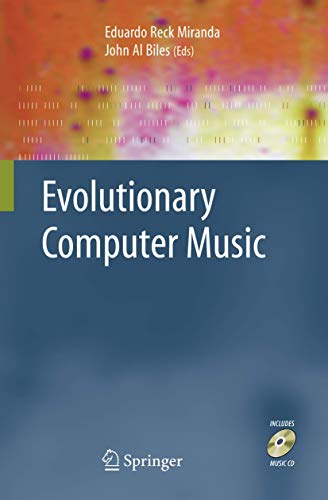
The evolutionary computation approach to music is an exciting new development for composers and musicologists alike. For composers, it provides an innovative and natural means for generating musical ideas from a specifiable set of primitive components and processes. For musicologists, these techniques are used to model the cultural transmission and change of a population's body of musical ideas over time. In both cases, musical evolution can be guided by a variety of constraints and tendencies built into the system, such as realistic psychological factors that influence the way music is expressed, experienced, learned, stored, modified, and passed on among individuals. This book discusses not only the applications of evolutionary computation to music, but also the tools needed to create and study such systems. These tools are drawn in part from research into the origins and evolution of biological organisms, ecologies, and cultural systems on the one hand, and from computer simulation methodologies on the other. They can be combined to create surrogate artificial worlds populated by interacting simulated organisms in which complex musical experiments can be performed that would otherwise be impossible. This authoritative book, with contributions from experts from around the globe, demonstrates that evolutionary systems can be used to create and to study musical compositions and cultures in ways that have never before been achieved. Eduardo Reck Miranda is a Professor in Computer Music at the University of Plymouth, UK, where he heads the Interdisciplinary Centre for Computer Music Research (ICCMR). He has recently been appointed the Edgard Varèse Guest Professor of Computer Music at the Technical University of Berlin. Al Biles is a Professor and the Undergraduate Program Coordinator in the Department of Information Technology at the Rochester Institute of Technology in Rochester, New York. Between
Die Inhaltsangabe kann sich auf eine andere Ausgabe dieses Titels beziehen.
Über die Autorin bzw. den Autor
Eduardo Reck Miranda is a Professor in Computer Music at the University of Plymouth, UK, where he heads the Interdisciplinary Centre for Computer Music Research (ICCMR). He has recently been appointed the Edgard Varèse Guest Professor of Computer Music at the Technical University of Berlin.
Al Biles has been applying evolutionary computation to music since 1993, when he built the first of many versions of GenJam, the Genetic Jammer. Since that time he and GenJam have performed around the world together, and Al has watched the field of evolutionary computer music emerge as a fascinating creative enterprise. Al is Professor and Undergraduate Program Coordinator in the Department of Information Technology at the Rochester Institute of Technology.
Von der hinteren Coverseite
The evolutionary computation approach to music is an exciting new development for composers and musicologists alike. For composers, it provides an innovative and natural means for generating musical ideas from a specifiable set of primitive components and processes. For musicologists, these techniques are used to model the cultural transmission and change of a population's body of musical ideas over time. In both cases, musical evolution can be guided by a variety of constraints and tendencies built into the system, such as realistic psychological factors that influence the way music is expressed, experienced, learned, stored, modified, and passed on among individuals.
This book discusses not only the applications of evolutionary computation to music, but also the tools needed to create and study such systems. These tools are drawn in part from research into the origins and evolution of biological organisms, ecologies, and cultural systems on the one hand, and from computer simulation methodologies on the other. They can be combined to create surrogate artificial worlds populated by interacting simulated organisms in which complex musical experiments can be performed that would otherwise be impossible.
This authoritative book, with contributions from experts from around the globe, demonstrates that evolutionary systems can be used to create and to study musical compositions and cultures in ways that have never before been achieved.
Eduardo Reck Miranda is a Professor in Computer Music at the University of Plymouth, UK, where he heads the Interdisciplinary Centre for Computer Music Research (ICCMR). He has recently been appointed the Edgard Varèse Guest Professor of Computer Music at the Technical University of Berlin.
Al Biles is a Professor and the Undergraduate Program Coordinator in the Department of Information Technology at the Rochester Institute of Technology in Rochester, New York. Between performances with GenJam over the last thirteen years, he has been active in helping establish information technology as a recognized academic discipline.
„Über diesen Titel“ kann sich auf eine andere Ausgabe dieses Titels beziehen.
Suchergebnisse für Evolutionary Computer Music

Beispielbild für diese ISBN
Evolutionary Computer Music
Anbieter: Anybook.com, Lincoln, Vereinigtes Königreich
Verkäuferbewertung 5 von 5 Sternen

Zustand: Fair. This is an ex-library book and may have the usual library/used-book markings inside.This book has soft covers. In fair condition, suitable as a study copy. Please note the Image in this listing is a stock photo and may not match the covers of the actual item,500grams, ISBN:9781846285998. Artikel-Nr. 8235363
Gebraucht kaufen
EUR 37,19
EUR 15,84 Versand
Versand von Vereinigtes Königreich nach USA
Versand von Vereinigtes Königreich nach USA
Anzahl: 1 verfügbar
Beispielbild für diese ISBN
Evolutionary Computer Music
Anbieter: Romtrade Corp., STERLING HEIGHTS, MI, USA
Verkäuferbewertung 5 von 5 Sternen
Zustand: New. This is a Brand-new US Edition. This Item may be shipped from US or any other country as we have multiple locations worldwide. Artikel-Nr. ABBB-155675
Beispielbild für diese ISBN
Evolutionary Computer Music
Anbieter: Majestic Books, Hounslow, Vereinigtes Königreich
Verkäuferbewertung 4 von 5 Sternen

Zustand: Used. pp. xiv + 259 Illus. Artikel-Nr. 7548229
Gebraucht kaufen
EUR 134,09
EUR 7,57 Versand
Versand von Vereinigtes Königreich nach USA
Versand von Vereinigtes Königreich nach USA
Anzahl: 1 verfügbar
Beispielbild für diese ISBN
Evolutionary Computer Music
Anbieter: Biblios, Frankfurt am main, HESSE, Deutschland
Verkäuferbewertung 4 von 5 Sternen
Zustand: Used. pp. xiv + 259. Artikel-Nr. 18299664
Gebraucht kaufen
EUR 137,78
EUR 9,95 Versand
Versand von Deutschland nach USA
Versand von Deutschland nach USA
Anzahl: 1 verfügbar