
Verwandte Artikel zu Resorts and Ports: European Seaside Towns since 1700...
Resorts and Ports: European Seaside Towns since 1700 (Tourism and Cultural Change, 29) - Hardcover
Buch 29 von 65: Tourism and Cultural Change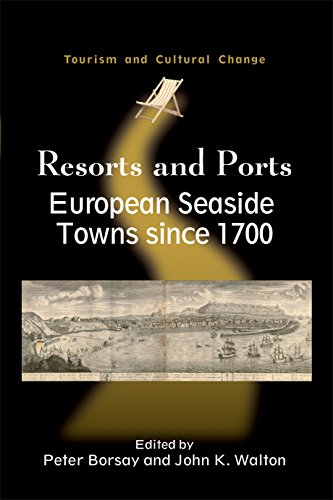
Inhaltsangabe
Histories of seaports and coastal resorts have usually been kept in separate compartments. This book brings them together and looks at how resort development affected historic ports during the rise and development of the seaside holiday in Europe from the 18th century to the 20th, and what the attributes of ports (fishing, harbour crafts, the whiff of the exotic, fishermen's homes and families) contributed to the attractions of resorts. Case-studies drawn from across Europe, from Wales and the Netherlands to Norway, Latvia and Spain, bring original perspectives to bear on these histories and relationships, and consider their influence on seaside heritage and regeneration at a time when coastal settlements are increasingly using their past to secure their future. The book will interest academics in tourism studies, history, geography and cultural studies, as well as provide essential information and analysis for policy-makers in coastal regeneration.
Die Inhaltsangabe kann sich auf eine andere Ausgabe dieses Titels beziehen.
Über die Autorin bzw. den Autor
Peter Borsay is a Professor in the Department of History and Welsh History at Aberystwyth University and has published widely in the areas of British urban and leisure history since the 18th century, including the history of spas and seaside resorts.
John K. Walton is an IKERBASQUE Research Professor in the Department of Contemporary History, University of the Basque Country UPV/ EHU, Bilbao. He has published extensively and internationally on tourism and identity, especially with regard to coastal towns, and edits the Journal of Tourism History.
Auszug. © Genehmigter Nachdruck. Alle Rechte vorbehalten.
Resorts and Ports
European Seaside Towns since 1700
By Peter Borsay, John K. WaltonMultilingual Matters
Copyright © 2011 Peter Borsay, John K. Walton and the authors of individual chapters
All rights reserved.
ISBN: 978-1-84541-198-5All rights reserved.
Contents
List of Figures,
Acknowledgements,
Contributors,
1 Introduction: The Resort–Port Relationship Peter Borsay and John K. Walton,
2 Towns of 'Health and Mirth': The First Seaside Resorts, 1730–1769 Allan Brodie,
3 A Dutch Idyll? Scheveningen as a Seaside Resort, Fishing Village and Port, c. 1700–1900 Jan Hein Furnée,
4 'From the Temple of Hygeia to the Sordid Devotees of Pluto'. The Hotwell and Bristol: Resort and Port in the Eighteenth Century David Hussey,
5 Three Views of Brighton as Port and Resort Fred Gray,
6 From Port to Resort: Tenby and Narratives of Transition, 1760–1914 Peter Borsay,
7 A Town Divided? Sea-Bathing, Dock-Building and Oyster-Fishing in Nineteenth-Century Swansea Louise Miskell,
8 Port and Resort: Symbiosis and Conflict in 'Old Whitby', England, since 1880 John K. Walton,
9 Recycled Maritime Culture and Landscape: VariousAspects of the Adaptation of Nineteenth-Century Shipping and Fishing Industries to Twentieth-Century Tourism in Southern Norway Berit Eide Johnsen,
10 Gijón: From Asturian Regional Port and Industrial City to Touristic and Cultural Centre for the European Atlantic Arc, from the Nineteenth Century to the Present Guy Saupin (Translated from the original French by John K. Walton),
11 From a Baltic Village to a Leading Soviet Health Resort: Reminiscences of the Social History of Jurmala, Latvia Simo Laakkonen and Karina Vasilevska,
12 From Port to Resort: Art, Heritage and Identity in the Regeneration of Margate Jason Wood,
CHAPTER 1
Introduction: The Resort–Port Relationship
PETER BORSAY and JOHN K. WALTON
The Specialisation Hypothesis
When, in 1943, John Betjeman compiled his volume on English Cities and Small Towns in the Collins Britain in Pictures series, he devoted separate sections to 'Ports' and 'Spas and Watering Places'. To reinforce the distinction, he declared,
After the visit of George III to Weymouth in the eighteenth century, watering places sprang up on the coast, and they must not be confused with the sea ports, where the sea is chastened by harbour bars and docks. In watering places, everything is a preparation for playing on the edge of the sea and for looking at it.
He was, excusably, wrong about both timing and causation, but historians have tended to embrace this separation of functions, with resorts and ports generating discrete historiographies. Underpinning such an approach has been the notion that industrialisation and rapid urbanisation brought about a greater specialisation of urban function, since towns were defined not so much by their position in a regionally defined hierarchy as by their economic role. As Penelope Corfield has argued of the eighteenth century,
A new and more specialized terminology began to be adopted. Towns were now talked of in terms of their leading economic functions. As well as traditional concepts of market towns and ports, other places became identified as dockyard towns, manufacturing towns, spas, holiday resorts ...
In practice, seaports and coastal resorts grew side by side from the eighteenth century onwards, responding to the same sets of processes, of consumption as well as production, of the spread of rising living standards and aspirations, of the fashion cycle, of globalisation and increasing mobility. The emergence of seaside resorts formed an integral part of the industrialisation process rather than constituting a subsequent consequence of this long and complex sequence of developments. This is worth emphasis because it has not always been understood, and it should also be stressed that these were not geographically isolated developments but often shared the same locations or adjacent ones. It is widely recognised that resorts were not necessarily, or even usually, built on virgin sites and that many had developed out of fishing settlements and ports, but such economic roles are usually described as 'decayed' and 'moribund'. Some historians have acknowledged that it was not necessarily so easy to distinguish a resort from a port, since both functions could continue to operate in tandem, and that the reality on the ground was far messier than the specialisation hypothesis would suggest. P. J. Waller, for example, has argued that 'seaside towns were not homogenous types ... they often combined holiday facilities with other pursuits, usually shipping and fishing', and that 'the history of pleasure resorts ... is more complicated than a story of property tycoons and corporations sniffing ozone and cashing in on an inevitable boom. One factor is evidently the potential for alternative business. A certain level of port traffic would not upset the holiday trade'. In fact, a large number of railway connections to emergent resorts were built with the primary intention of developing freight traffic to commercial harbours, and the resorts, with their fluctuating, unreliable and inconvenient seasonal traffic, were the secondary beneficiaries of such initiatives.
Contemporary guidebooks – which might be inclined to hide the presence of intrusive aspects of trade and commerce from potential visitors – could not conceal the obvious fact that conventional business activity mixed freely with the business of pleasure in some maritime settlements. Baedeker in 1894 pronounced Folkestone on the Kent coast 'a cheerful and thriving seaport and watering-place' and Dover, with its 'large outer tidal basin and two spacious docks' to accommodate the continental mail packets, 'a favourite bathing-place and winter-resort'; on the east coast, Lowestoft was 'a fashionable sea-bathing resort' and 'important fishing-station', and Yarmouth 'the most important town and port on the E. Anglian coast ... is also a very popular watering-place and in the summer is flooded almost daily with excursionists'. An annual guide to Seaside Watering Places for the season 1900–1901 was typical in including among its entries the major fishing or shipping ports of Southampton, Swansea, Brixham, Falmouth, Plymouth and Grimsby, as well as many minor ones. Clearly, resorts and ports were not mutually exclusive categories of settlement. This is not to say that in any particular location these functions were equally balanced or that, over time, one did not come to dominate and maybe drive out the other. Many small ports and fishing villages gradually completed a long-term transition, evolving into resorts during the eighteenth and nineteenth centuries but without necessarily losing older activities altogether. The two roles could co-exist over a considerable period of time so that any simple story of one automatically displacing the other, as the forces of specialisation kicked in, is difficult to sustain. Instead, a more nuanced and complicated account needs to be developed of how resort and port interacted with each other. The studies in this volume explore this relationship and the various transitions under way through a set of detailed case studies ranging across Britain and Europe. The term 'port' is defined broadly, embracing commercial, military, manufacturing and transport activity associated with maritime business, whereas coastal 'resorts' include a range of health and leisure functions, including...
„Über diesen Titel“ kann sich auf eine andere Ausgabe dieses Titels beziehen.
Suchergebnisse für Resorts and Ports: European Seaside Towns since 1700...

Beispielbild für diese ISBN
Resorts And Ports: European Seaside Towns Since 1700 (Tourism And Cultural Change)
Anbieter: Romtrade Corp., STERLING HEIGHTS, MI, USA
Verkäuferbewertung 5 von 5 Sternen

Zustand: New. This is a Brand-new US Edition. This Item may be shipped from US or any other country as we have multiple locations worldwide. Artikel-Nr. ABBB-175471
Beispielbild für diese ISBN
Resorts and Ports
Anbieter: Majestic Books, Hounslow, Vereinigtes Königreich
Verkäuferbewertung 4 von 5 Sternen

Zustand: New. pp. 240. Artikel-Nr. 3566145
Neu kaufen
EUR 112,08
EUR 7,71 Versand
Versand von Vereinigtes Königreich nach USA
Versand von Vereinigtes Königreich nach USA
Anzahl: 1 verfügbar
Beispielbild für diese ISBN
Resorts and Ports
Anbieter: PBShop.store US, Wood Dale, IL, USA
Verkäuferbewertung 5 von 5 Sternen
HRD. Zustand: New. New Book. Shipped from UK. Established seller since 2000. Artikel-Nr. CX-9781845411985
Neu kaufen
EUR 125,18
Versand gratis
Versand innerhalb von USA
Versand innerhalb von USA
Anzahl: 15 verfügbar
Beispielbild für diese ISBN
Resorts and Ports
Anbieter: PBShop.store UK, Fairford, GLOS, Vereinigtes Königreich
Verkäuferbewertung 5 von 5 Sternen
HRD. Zustand: New. New Book. Shipped from UK. Established seller since 2000. Artikel-Nr. CX-9781845411985
Neu kaufen
EUR 120,17
EUR 5,95 Versand
Versand von Vereinigtes Königreich nach USA
Versand von Vereinigtes Königreich nach USA
Anzahl: 15 verfügbar
Beispielbild für diese ISBN
Resorts and Ports: European Seaside Towns since 1700 (Tourism and Cultural Change, 29)
Anbieter: Ria Christie Collections, Uxbridge, Vereinigtes Königreich
Verkäuferbewertung 5 von 5 Sternen
Zustand: New. In English. Artikel-Nr. ria9781845411985_new
Neu kaufen
EUR 150,99
EUR 13,39 Versand
Versand von Vereinigtes Königreich nach USA
Versand von Vereinigtes Königreich nach USA
Anzahl: Mehr als 20 verfügbar
Beispielbild für diese ISBN
Resorts and Ports: European Seaside Towns Since 1700
Anbieter: Revaluation Books, Exeter, Vereinigtes Königreich
Verkäuferbewertung 5 von 5 Sternen
Hardcover. Zustand: Brand New. 218 pages. 9.25x6.25x0.75 inches. In Stock. Artikel-Nr. x-1845411986
Neu kaufen
EUR 245,38
EUR 14,82 Versand
Versand von Vereinigtes Königreich nach USA
Versand von Vereinigtes Königreich nach USA
Anzahl: 2 verfügbar