
Verwandte Artikel zu Edward III's Round Table at Windsor: The House...
Edward III's Round Table at Windsor: The House of the Round Table and the Windsor Festival of 1344 (Arthurian Studies, 68, Band 68) - Hardcover
Inhaltsangabe
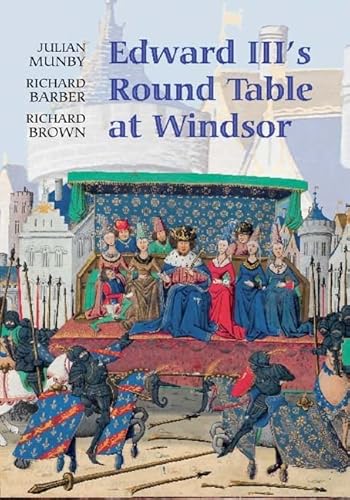
A dramatic archaeological find at Windsor Castle reveals Edward III's 'House of the Round Table', designed to show off Edward's power and prestige at a crucial moment in his attempts to lay claim to the throne of France.
NEW LOWER PRICE
The image of King Arthur's Round Table is well-known, both as Thomas Malory's portrayal of a fellowship of knights dedicated to the highest ideals of chivalry, and as the great wooden table at Winchester castle. Now a dramatic archaeological find at Windsor castle sheds new light on the idea of a round table as a gathering: the 'House of the Round Table' which Edward III ordered to be constructed at the conclusion of his Windsor festival of 1344.
The discovery of the foundation trench of a great building two hundred feet in diameter in the Upper Ward of Windsor castle, allows the reconstruction of that building's appearance and raises the question of itspurpose. Chronicles, building materials inventories from the royal accounts, medieval romances, and earlier descriptions of round table festivals all confirm the archaeological evidence: at a time when secular orders of knighthood were almost unknown, Edward declared his intention to found an Order of the Round Table with three hundred knights. This grand building, and the Arthurian entertainments he planned for it, would bind his nobles to his cause ata crucial point in his progress to claiming the throne of France.
His ambitious scheme, however, was overtaken by events. Victory at Crécy in 1346 confirmed Edward's reputation, and the order which he founded in 1348 was themuch more exclusive Order of the Garter, rewarding those commanders who had helped him to win the Crécy campaign. His reputation was assured, the omens for his reign were auspicious; he had the loyalty of his knights and magnates.The Round Table building was abandoned, and eventually pulled down in the 1360s. Thus a major plank in the strategic thinking of one of England's greatest kings almost became a footnote in history.
Time Team discovered .there [are] indeed foundations of a massive round building in Windsor Castle's upper ward. A splendidly produced volume, which gives full credit both to the history and to the archaeology: analysis of the chivalric background, archaeological analysis, discussion of the probable form of the building [and] the early history of Windsor Castle as well as the types of stone used by Edward III's masons. The book is attractively illustrated, and its appendicesprovide a full text in Latin, with translation, of the building accounts, as well as translations of many of the relevant chronicle extracts. MICHAEL PRESTWICH, THE TIMES LITERARY SUPPLEMENT
Die Inhaltsangabe kann sich auf eine andere Ausgabe dieses Titels beziehen.
Über die Autorinnen und Autoren
Head of Buildings Archaeology, Oxford Archaeology
RICHARD BARBER has had a huge influence on the study of medieval history and literature, as both a writer and a publisher. His first book on the Arthurian legend appeared in 1961, and his major works include The Knight and Chivalry (winner of the Somerset Maugham Award in 1971), Edward Prince of Wales and Aquitaine, The Penguin Guide to Medieval Europe and The Holy Grail: the History of a Legend which was widely praised and was translated into six languages.
DR. RICHARD BROWN was one of Canada's foremost experts on seagoing birds and worked for many years as a marine biologist with the Canadian Wildlife Service in Halifax.
„Über diesen Titel“ kann sich auf eine andere Ausgabe dieses Titels beziehen.
Suchergebnisse für Edward III's Round Table at Windsor: The House...

Beispielbild für diese ISBN
Edward III's Round Table at Windsor: The House of the Round Table and the Windsor Festival of 1344 (Arthurian Studies)
Anbieter: HALCYON BOOKS, LONDON, Vereinigtes Königreich
Verkäuferbewertung 5 von 5 Sternen

hardcover. Zustand: Very Good. Zustand des Schutzumschlags: Very Good. A clean, tight copy. NEW EU 3 EURO CHARGE FOR IMPORTS IS INCLUDED IN OUR SHIPPING PRICE. ALL ITEMS ARE DISPATCHED FROM THE UK, ALL OVERSEAS ORDERS SENT BY TRACKABLE AIR MAIL. IF YOU ARE LOCATED OUTSIDE THE UK PLEASE ASK US FOR A POSTAGE QUOTE FOR MULTI VOLUME SETS BEFORE ORDERING. Artikel-Nr. mon0000981417
Gebraucht kaufen
EUR 20,00
EUR 21,18 Versand
Versand von Vereinigtes Königreich nach USA
Versand von Vereinigtes Königreich nach USA
Anzahl: 1 verfügbar
Foto des Verkäufers
Edward III's Round Table at Windsor : the House of the Round Table and the Windsor Festival of 1344
Verlag:
Boydell Press, Woodbridge, Suffolk, 2007
ISBN 10: 1843833131
ISBN 13: 9781843833130
Gebraucht
Hardcover
Erstausgabe
Anbieter: MW Books, New York, NY, USA
Verkäuferbewertung 5 von 5 Sternen
1st edition. Fine cloth copy in an equally fine dust-wrapper. Particularly well-preserved overall; tight, bright, clean and especially sharp-cornered. Physical Description; xiv, 282 pages, 16 unnumbered pages of plates : illustrations (some color), maps ; 26 cm. Series; Arthurian studies, v. 68. Summary; The image of King Arthur's Round Table is well-known, both as Thomas Malory's portrayal of a fellowship of knights dedicated to the highest ideals of chivalry, and as the famous wooden table at Winchester Castle. Now a dramatic archaeological find at Windsor Castle sheds new light on the idea of a round table as a gathering: the 'House of the Round Table' which Edward III ordered to be constructed in 1344. Subjects; 1327-1377. Antiquities. Edward III, King of England, 1312-1377. England. England Windsor (Windsor and Maidenhead). Excavations (Archaeology). Excavations (Archaeology) England Windsor (Windsor and Maidenhead). Great Britain. Great Britain Antiquities. Great Britain History Edward III, 1327-1377. History. Knights and knighthood. Knights and knighthood England. Windsor Castle. 1 Kg. Artikel-Nr. 426582
Gebraucht kaufen
EUR 42,02
Versand gratis
Versand innerhalb von USA
Versand innerhalb von USA
Anzahl: 1 verfügbar
Beispielbild für diese ISBN
Edward III's Round Table at Windsor: The House of the Round Table and the Windsor Festival of 1344
Verlag:
Boydell Press, 2007
ISBN 10: 1843833131
ISBN 13: 9781843833130
Gebraucht
Soft cover
Erstausgabe
Anbieter: History Bookshop, Ascott under Wychwood, OXON, Vereinigtes Königreich
Verkäuferbewertung 5 von 5 Sternen
Soft cover. Zustand: As New. No Jacket. 1st Edition. Near mint copy. Artikel-Nr. HB8501E003
Gebraucht kaufen
EUR 16,97
EUR 25,24 Versand
Versand von Vereinigtes Königreich nach USA
Versand von Vereinigtes Königreich nach USA
Anzahl: 1 verfügbar
Beispielbild für diese ISBN
Edward III's Round Table at Windsor: The House of the Round Table and the Windsor Festival of 1344 (Arthurian Studies)
Anbieter: Anybook.com, Lincoln, Vereinigtes Königreich
Verkäuferbewertung 5 von 5 Sternen
Zustand: Good. This is an ex-library book and may have the usual library/used-book markings inside.This book has hardback covers. In good all round condition. No dust jacket. Please note the Image in this listing is a stock photo and may not match the covers of the actual item,1000grams, ISBN:9781843833130. Artikel-Nr. 5814795
Gebraucht kaufen
EUR 30,66
EUR 15,34 Versand
Versand von Vereinigtes Königreich nach USA
Versand von Vereinigtes Königreich nach USA
Anzahl: 1 verfügbar