
Verwandte Artikel zu A Short History of the Middle East: From Ancient Empires...
Inhaltsangabe
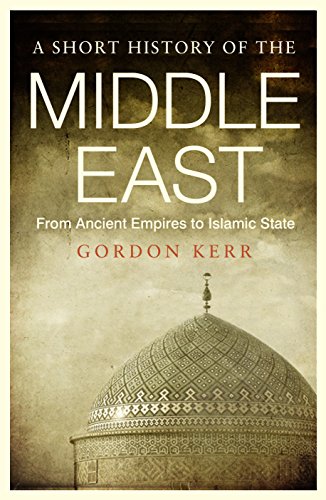
Situated at the crossroads of three continents, the Middle East has confounded the ambition of conquerors and peacemakers alike. Christianity, Judaism and Islam all had their genesis in the region but with them came not just civilization and religion, but also some of the great struggles of history. A Short History of the Middle East makes sense of the shifting sands of Middle Eastern History, beginning with the early cultures of the area and moving on to the modern world.
Die Inhaltsangabe kann sich auf eine andere Ausgabe dieses Titels beziehen.
Über die Autorin bzw. den Autor
Gordon Kerr is the author of several titles including A Short History of Europe, A Short History of Africa, A Short History of China, A Short History of Brazil, A Short History of the First World War and A Short History of the Vietnam War.
Auszug. © Genehmigter Nachdruck. Alle Rechte vorbehalten.
A Short History of the Middle East
By Gordon KerrOldcastle Books
Copyright © 2016 Gordon Kerr
All rights reserved.
ISBN: 978-1-84344-636-1All rights reserved.
CHAPTER 1
Ancient Civilisations
The Middle East occupies a unique position in the history of humankind. It was probably in that area that, around 8,000 years ago, we first began to cultivate food crops and domesticate certain animals after perhaps a million years of subsisting on wild vegetables and hunting. It was this development, the result of a great deal of trial and error, that led to the advancement of human civilisation. Soon, great civilisations were appearing that would wax and wane throughout history up to the present day. They overlapped and interacted, often going to war with one another, their peoples merging and interbreeding through the centuries.
The first evidence of people becoming sedentary and beginning to establish urban centres has been found in the Mesopotamian Basin. This area, the name of which means 'land between rivers' (the Tigris and Euphrates), is home to many of the world's oldest major societies and is often described as the 'cradle of civilisation'. The first cities in history developed here during the Chalcolithic period of the Bronze Age from round about 5300 BC.
The Sumer and the Akkadian Empire (c. 5300-1700 BC)
First signs of the Sumerian civilisation, one of earth's oldest, can be dated back to roughly 5000 BC. The Sumerians are believed to have migrated to Mesopotamia from the areas of modern-day Turkey and Iran although there is no real certainty about this. One and a half thousand years later they had built cities in the Fertile Crescent, the area between the Tigris and Euphrates that provided the means to live in what was essentially a desert. Sumer became divided into a dozen or so independent city states each of which surrounded a temple dedicated to a god or goddess. The earliest city in Mesopotamia and, therefore, the oldest city in the world, is said to be Eridu in southern Mesopotamia. Four other cities were built before, it is suggested, being wiped out by a great flood which may be no more than myth.
These first cities came under the control of the Akkadian Empire between the twenty-fourth and twenty-second centuries BC. This empire was founded by Sargon the Great (r. c. 2334 BC-2279 BC) who led his forces in the conquest of the Sumerian city-states. Sargon's empire grew to incorporate not just large parts of Mesopotamia, but also parts of present-day Iran, Asia Minor and Syria. It was amongst the first multi-ethnic, centrally ruled empires in history.
The Akkadian language became the lingua franca of the Middle East, used in government and administration while the Sumerian language remained in everyday use and in literature. Even when Sumer was no longer a great power, its language continued to be used in schools in the later civilisations of Babylonia and Assyria, in the same way Latin would later be used in mediaeval Europe. As well as being the inventors of bureaucracy, the Sumerians were amongst the first people to use the wheel. There is evidence that wheeled vehicles were being used from the second half of the fourth millennium BC in Mesopotamia.
Following a period of decline between around 2193 and 2154, the empire collapsed after an invasion by a nomadic people from the Zagros Mountains known as the Gutians. The Sumerian king, Ur-Nammu (r. 2112-2095 BC), finally drove out the Gutians and restored his own people's rule. This 'Sumerian Renaissance' was the last great period of Sumerian power. By this time, however, Akkadian-speaking Semites were beginning to increase their presence and power in the region. Competing local powers such as Isin, Larsa and Babylon started to dominate the southern part of Mesopotamia and Babylon would become increasingly powerful.
At this time there was also a shift in population to the north. In the south, agriculture was in decline due to poor soil resulting from the silting of the Mesopotamian Delta. This led to an almost 60 per cent population decline between 2100 BC and 1700 BC. Sumer eventually fell under the control of the Amorites, a Semitic-speaking people from ancient Syria. This 'Dynasty of Isin', as it is known in the list of Sumerian kings, ended with the rise to power of Babylonia around 1700 BC with the notable Hammurabi as its ruler.
The Babylonian Empire (1894-333 BC)
Babylon was a small and unimportant city when the Amorites came to power around 1894 BC but during the reign of the great king Hammurabi (r. c. 1792-1750 BC) it rose to prominence. It had been a minor city-state, dwarfed by other, older states but Hammurabi's father Sin-Muballit (r. c. 1812-1793 BC) began the expansion of Babylonian power with the conquest of Borsippa, Kish and Sippar.
When Hammurabi took the throne, the region was controlled by a number of local powers. Eshunna ruled the upper Tigris River; Larsa controlled the river delta; and Elam, in the east, regularly raided and took tribute from the weaker states in the southern part of Mesopotamia. In the north was the formidable Assyrian Empire with its colonies in Asia Minor. It had expanded into central Mesopotamia and the Levant.
Hammurabi reunited Mesopotamia, but his most important legacy was the code of laws known as the Code of Hammurabi. One of the first written sets of laws in history, it was carved upon a stele that was located in a public place in Babylon where everyone could see it. Later, it was discovered in 1901 in Iran and taken to the Louvre in Paris where it can now be viewed. The code consisted of 282 laws, inscribed in the Akkadian language on 12 tablets. Dealing with such things as theft, dishonest dealings, violence to others, financial transactions and relations between various social classes, it was invariably harsh in its punishments:
'8 – If any one steal cattle or sheep, or an ass, or a pig or a goat, if it belong to a god or to the court, the thief shall pay thirtyfold therefor; if they belonged to a freed man of the king he shall pay tenfold; if the thief has nothing with which to pay he shall be put to death ...'
The Code of Hammurabi, King of Babylon (1904), translated by Robert Francis Harper
Soon after the death of this great king his empire began to disintegrate. Nomadic people began to arrive – the Central Asian Hittites and Mitannians; the Elamites who settled in Chaldea to the east of the Mesopotamian Basin; the Aramaeans from the Syrian Desert and the Assyrians from northern Mesopotamia. The Amorites continued to rule a much-reduced Babylon for several hundred years more and a number of Neo-Babylonian empires and kingdoms emerged. The last Amorite ruler was overthrown by the Hittites following the 'sack of Babylon' in 1595 BC, although the Hittites soon moved on, leaving the Kassites to take control. The Kassites – Babylon's longest-lived dynasty – ruled until 1157 BC when Elam conquered it and then a few years later it was retaken by the native Akkadian-Babylonian, King Nebuchadnezzar I (r. c. 1125-1104 BC). Eventually, in 627 BC, after a period of chaos and three centuries of Assyrian rule, the Chaldeans seized the throne, ruling until 539 BC and conquering Assyria in the north of the region and Syria as far as the city of Tyre.
In 539, Babylon was conquered by Cyrus the Great (r. 559-530 BC), ruler of the Achaemenid Empire (also known as the First Persian Empire). Cyrus claimed to be the legitimate successor to the ancient Babylonian kings and he was ruler of almost the entire civilised world at that time. In 333 BC, the Macedonian ruler Alexander the...
„Über diesen Titel“ kann sich auf eine andere Ausgabe dieses Titels beziehen.
Suchergebnisse für A Short History of the Middle East: From Ancient Empires...

Beispielbild für diese ISBN
A Short History of the Middle East: From Ancient Empires to Islamic State
Anbieter: World of Books (was SecondSale), Montgomery, IL, USA
Verkäuferbewertung 5 von 5 Sternen

Zustand: Good. Item in good condition and has highlighting/writing on text. Used texts may not contain supplemental items such as CDs, info-trac etc. Artikel-Nr. 00097747975
Gebraucht kaufen
EUR 6,04
Versand gratis
Versand innerhalb von USA
Versand innerhalb von USA
Anzahl: 1 verfügbar
Beispielbild für diese ISBN
A Short History of the Middle East: From Ancient Empires to Islamic State
Anbieter: World of Books (was SecondSale), Montgomery, IL, USA
Verkäuferbewertung 5 von 5 Sternen
Zustand: Very Good. Item in very good condition! Textbooks may not include supplemental items i.e. CDs, access codes etc. Artikel-Nr. 00102788606
Gebraucht kaufen
EUR 6,04
Versand gratis
Versand innerhalb von USA
Versand innerhalb von USA
Anzahl: 1 verfügbar
Beispielbild für diese ISBN
A Short History of the Middle East: From Ancient Empires to Islamic State
Anbieter: World of Books (was SecondSale), Montgomery, IL, USA
Verkäuferbewertung 5 von 5 Sternen
Zustand: Acceptable. Item in acceptable condition! Textbooks may not include supplemental items i.e. CDs, access codes etc. Artikel-Nr. 00104364155
Gebraucht kaufen
EUR 6,04
Versand gratis
Versand innerhalb von USA
Versand innerhalb von USA
Anzahl: 1 verfügbar
Beispielbild für diese ISBN
A Short History of the Middle East : From Ancient Empires to Islamic State
Verlag:
Oldcastle Books, Limited, 2016
ISBN 10: 1843446367
ISBN 13: 9781843446361
Gebraucht
Softcover
Anbieter: Better World Books, Mishawaka, IN, USA
Verkäuferbewertung 5 von 5 Sternen
Zustand: Good. Pages intact with minimal writing/highlighting. The binding may be loose and creased. Dust jackets/supplements are not included. Stock photo provided. Product includes identifying sticker. Better World Books: Buy Books. Do Good. Artikel-Nr. 9602322-20
Gebraucht kaufen
EUR 6,05
Versand gratis
Versand innerhalb von USA
Versand innerhalb von USA
Anzahl: 3 verfügbar
Beispielbild für diese ISBN
A Short History of the Middle East: From Ancient Empires to Islamic State
Anbieter: ThriftBooks-Phoenix, Phoenix, AZ, USA
Verkäuferbewertung 5 von 5 Sternen
Paperback. Zustand: Very Good. No Jacket. May have limited writing in cover pages. Pages are unmarked. ~ ThriftBooks: Read More, Spend Less. Artikel-Nr. G1843446367I4N00
Gebraucht kaufen
EUR 6,32
Versand gratis
Versand innerhalb von USA
Versand innerhalb von USA
Anzahl: 1 verfügbar
Beispielbild für diese ISBN
A Short History of the Middle East: From Ancient Empires to Islamic State
Anbieter: ThriftBooks-Reno, Reno, NV, USA
Verkäuferbewertung 5 von 5 Sternen
Paperback. Zustand: Very Good. No Jacket. May have limited writing in cover pages. Pages are unmarked. ~ ThriftBooks: Read More, Spend Less. Artikel-Nr. G1843446367I4N00
Gebraucht kaufen
EUR 6,32
Versand gratis
Versand innerhalb von USA
Versand innerhalb von USA
Anzahl: 1 verfügbar
Beispielbild für diese ISBN
A Short History of the Middle East: From Ancient Empires to Islamic State
Anbieter: ThriftBooks-Dallas, Dallas, TX, USA
Verkäuferbewertung 5 von 5 Sternen
Paperback. Zustand: As New. No Jacket. Pages are clean and are not marred by notes or folds of any kind. ~ ThriftBooks: Read More, Spend Less. Artikel-Nr. G1843446367I2N00
Gebraucht kaufen
EUR 6,34
Versand gratis
Versand innerhalb von USA
Versand innerhalb von USA
Anzahl: 1 verfügbar
Beispielbild für diese ISBN
A Short History of the Middle East: From Ancient Empires to Islamic State
Anbieter: ThriftBooks-Atlanta, AUSTELL, GA, USA
Verkäuferbewertung 5 von 5 Sternen
Paperback. Zustand: Very Good. No Jacket. May have limited writing in cover pages. Pages are unmarked. ~ ThriftBooks: Read More, Spend Less. Artikel-Nr. G1843446367I4N00
Gebraucht kaufen
EUR 6,34
Versand gratis
Versand innerhalb von USA
Versand innerhalb von USA
Anzahl: 1 verfügbar
Beispielbild für diese ISBN
A Short History of the Middle East: From Ancient Empires to Islamic State
Anbieter: ThriftBooks-Atlanta, AUSTELL, GA, USA
Verkäuferbewertung 5 von 5 Sternen
Paperback. Zustand: Fair. No Jacket. Readable copy. Pages may have considerable notes/highlighting. ~ ThriftBooks: Read More, Spend Less. Artikel-Nr. G1843446367I5N00
Gebraucht kaufen
EUR 6,34
Versand gratis
Versand innerhalb von USA
Versand innerhalb von USA
Anzahl: 1 verfügbar
Beispielbild für diese ISBN
A Short History of the Middle East: From Ancient Empires to Islamic State
Anbieter: ThriftBooks-Dallas, Dallas, TX, USA
Verkäuferbewertung 5 von 5 Sternen
Paperback. Zustand: Very Good. No Jacket. May have limited writing in cover pages. Pages are unmarked. ~ ThriftBooks: Read More, Spend Less. Artikel-Nr. G1843446367I4N00
Gebraucht kaufen
EUR 6,34
Versand gratis
Versand innerhalb von USA
Versand innerhalb von USA
Anzahl: 1 verfügbar