
Verwandte Artikel zu When The Devil Holds The Candle
Inhaltsangabe
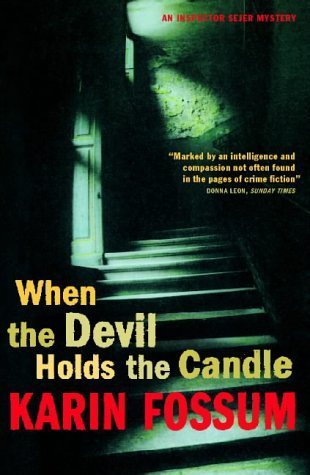
Pulling a handbag from a pushchair handle, two teenage trouble-makers, Zipp and Andreas, unwittingly commit murder when the baby inside is thrown to the ground. Unaware of what has happened, the pair move on to their next target. Having followed home Irma, an elderly lady who lives nearby, Andreas enters her house armed, with his trusty flick-knife. Zipp waits nervously outside, but his friend never reappears. He will never see him alive again. Fossum toys with the roles of victim and killer and pens the inner monologue of her characters to chilling effect. There are no red herrings in this narrative as the crime is played out on the page, but it is the mental processes behind the murderer's sinister act that are the real pieces of this puzzle. Gradually, they fall into place as Irma and Andreas talk to each other. We are forced to question the familiar stereotypes: people are not always what they seem and it is not always bad people who do bad things. While the reader knows the truth of this crime, the police remain flummoxed. There is no reason for Sejer and his colleague Skarre to see a connection between the infant's death and the reported disappearance of a town trouble-maker. With Zipp too frightened to come forward, the police must wait for the evidence to present itself before they can begin to comprehend the unsettling nature of the case on their hands.
Die Inhaltsangabe kann sich auf eine andere Ausgabe dieses Titels beziehen.
Über die Autorin bzw. den Autor
KARIN FOSSUM made her literary debut in Norway in 1974. The author of poetry, short stories and one non-crime novel, it is with her Inspector Sejer Mysteries that Fossum has found greatest acclaim. Winner of the Glass Key Award for best Nordic crime novel, Don't Look Back was the first to be translated into English, followed by He Who Fears the Wolf (both Harvill). The Sejer Mysteries are currently published in sixteen languages.
Auszug. © Genehmigter Nachdruck. Alle Rechte vorbehalten.
CHAPTER 1
The courthouse. September 4, 4 p.m.
Jacob Skarre glanced at his watch. His shift was over. He slipped a book out of his inside jacket pocket and read the poem on the first page. It's like playing Virtual Reality, he thought. Poof ! - and you're in a different landscape. The door to the corridor stood open, and suddenly he was aware that someone was watching him. Whoever it was was just beyond what he could see with his excellent peripheral vision. A vibration, light as a feather, barely perceptible, finally reached him. He closed his book.
"Can I help you?"
This woman didn't move, just stood there staring at him with an odd expression. Skarre looked at her tense face and thought that she seemed familiar. She was no longer young, maybe about 60, wearing a coat and dark boots. A scarf around her neck. Enough of the pattern was discernible under her chin. The design seemed a sharp contrast to what she most likely possessed in the way of speed and elegance: racehorses with jockeys in colourful silks against a dark blue background. She had a wide, heavy face that was elongated by a prominent chin. Her eyebrows were dark and had grown almost together. She was clutching a handbag against her stomach. But most noticeable of all was her gaze. In that pale face her eyes were blazing. They fixed him with a tremendous force and he could not escape them. Then he remembered who she was. What an odd coincidence, he thought, and waited in suspense. He sat there as if riveted by the probing silence. Any moment now she was going to say something momentous.
"It has to do with a missing person," was what she said.
Her voice was rough. A rusty tool creaking into motion after a long repose. Behind her white forehead burned a fire. Skarre could see the flickering glow in her irises. He was trying not to make assumptions, but obviously she was in some way possessed. Gradually it came to him what sort of person he was dealing with. In his mind he rehearsed the day's reports, but he could not recall whether any patients had been listed as missing from the psychiatric institutes in the district. She was breathing hard, as if it had cost her immeasurable effort to come here. But she had made up her mind, and at last had been driven by something. Skarre wondered how she had made it past the reception area and Mrs Brenningen's eagle eye, coming straight to his office without anyone stopping her.
"Who is it that's missing?" he asked in a friendly voice.
She kept staring at him. He met her gaze with the same force to see if she would flinch. Her expression turned to one of confusion.
"I know where he is."
Skarre was startled. "So you know where he is? He's not missing, then?"
"He probably won't live much longer," she said. Her thin lips began to quiver.
"Who are we talking about?" Skarre said. And then, because he guessed who it might be. "Do you mean your husband?"
"Yes. My husband."
She nodded resolutely. Stood there, straightbacked and unmoving, her handbag still pressed to her stomach. Skarre leaned back in his chair.
"Your husband is sick, and you're worried about him. Is he old?"
It was an inappropriate question. Life is life, as long as a person is alive and means something, maybe everything, to another being. He regretted the question and picked up his pen from the desk, twirling it between his fingers.
"He's almost like a child," she said sadly.
He was surprised at her response. What was she really talking about? The man was sick, possibly dying. And senile, it occurred to him. Regressing to his childhood. At the same time Skarre had a strange feeling that she was trying to tell him something else. Her coat was threadbare at the lapels, and the middle button had been sewn on rather badly, creating a fold in the fabric. Why am I noticing these things? he thought.
"Do you live far from here?" He glanced at his watch. Perhaps she could afford a taxi.
She straightened her shoulders. "Prins Oscars gate 17." She enunciated the street name with crisp consonants. "I didn't mean to bother you," she said.
Skarre stood up. "Do you need help getting home?"
She was still staring into his eyes. As if there was in them something that she wanted to take away with her. A glow, a memory of something very much alive, which the young officer was. Skarre had a weird sensation, the sort of thing that happens only rarely, when the body reacts on impulse. He lowered his gaze and saw that the short blond hairs on his arms were standing on end. At the same moment the woman turned slowly around and walked to the door. She took short, awkward steps, as if she were trying to hide something. He went back to his chair. It was 4.03 p.m. For his amusement, he scribbled a few notes on his pad.
"A woman of about 60 arrives at the office at 4 p.m. She seems confused. Says her husband is missing, that he doesn't have long to live. Wearing a brown coat with a blue scarf at her neck. Brown handbag, black boots. Possibly mentally disturbed. Left after a few minutes. Refused offer of help to get home."
He sat there, turning her visit over in his mind. Probably she was just a lost soul; there were so many of them nowadays. After a while he folded the piece of paper and stuck it into his shirt pocket. The incident didn't belong in his daily report.
*
HAS ANYONE SEEN ANDREAS? That was the headline in the town's largest newspaper, set in bold type. That's the way newspapers express themselves, using an informal tone to address us directly, as if we were on first-name terms and have known each other a long time. We're supposed to break down the barriers of formality and use a straightforward, youthful tone, in this fresh, onward-storming society. So even though very few people actually knew him or used his first name, let's just cut right to the chase and ask: Has anyone seen Andreas?
And the picture of him. A nice-looking boy of 18, with a thin face and unruly hair. I say "nicelooking", I'm generous enough to admit that. So handsome that things came easily to him. He strutted around with that handsome face of his and took things for granted. It's a familiar pattern, but it does no-one any good to look like that. Handsome in a timeless, classic sense. A charming boy. It costs me a bit to use that word, but all the same . . . charming.
On the afternoon of September 1, he left his house on Cappelens gate. He said nothing about where he was off to. Where are you going? Out. That's the kind of answer you give at that age. A sort of infinite guardedness. You think you're somebody so exceptional. And his mother didn't have the sense to press him. Maybe she used his obstinacy as food for her martyrdom. Her son was in the process of leaving her, and she hated that fact. But it's really a matter of respect. She ought to have raised the boy so that it would be unthinkable for him not to reply in a polite and precise manner. I'm going out, well, with someone. We're thinking of going into town. I'll be home before midnight. Surely that's not too much to ask, is it? But she had failed, as have so many others. That's what happens when you invest all of your energy in yourself, your own life, your own sorrow. I know what I'm talking about. And the sorrow was going to get worse. He never came home.
Yes, I've seen Andreas. I can see him whenever I like. A lot of people are going to be surprised when he's finally found. And of course they'll speculate, they'll guess, and write up reports, and carry on discussions and fill numerous files. Everyone with his own theory. And all wrong, of course. People howl with many voices. In the midst of that din I've lived in silence for almost 60 years. My name is Irma. At last I'm the one who's...
„Über diesen Titel“ kann sich auf eine andere Ausgabe dieses Titels beziehen.
Suchergebnisse für When The Devil Holds The Candle

Beispielbild für diese ISBN
When The Devil Holds The Candl
Anbieter: World of Books (was SecondSale), Montgomery, IL, USA
Verkäuferbewertung 5 von 5 Sternen

Zustand: Good. Item in good condition. Textbooks may not include supplemental items i.e. CDs, access codes etc. Artikel-Nr. 00103621839
Gebraucht kaufen
EUR 6,10
Versand gratis
Versand innerhalb von USA
Versand innerhalb von USA
Anzahl: 1 verfügbar
Beispielbild für diese ISBN
When the Devil Holds the Candle: An Inspector Sejer Mystery
Anbieter: ThriftBooks-Dallas, Dallas, TX, USA
Verkäuferbewertung 5 von 5 Sternen
Paperback. Zustand: Very Good. No Jacket. May have limited writing in cover pages. Pages are unmarked. ~ ThriftBooks: Read More, Spend Less. Artikel-Nr. G1843430916I4N00
Gebraucht kaufen
EUR 6,10
Versand gratis
Versand innerhalb von USA
Versand innerhalb von USA
Anzahl: 1 verfügbar
Beispielbild für diese ISBN
When the Devil Holds the Candle
Anbieter: Better World Books, Mishawaka, IN, USA
Verkäuferbewertung 5 von 5 Sternen
Zustand: Very Good. paperback / softback. Pages intact with possible writing/highlighting. Binding strong with minor wear. Dust jackets/supplements may not be included. Stock photo provided. Product includes identifying sticker. Better World Books: Buy Books. Do Good. Artikel-Nr. 16572146-6
Gebraucht kaufen
EUR 6,54
Versand gratis
Versand innerhalb von USA
Versand innerhalb von USA
Anzahl: 1 verfügbar
Beispielbild für diese ISBN
When the Devil Holds the Candle
Anbieter: Better World Books Ltd, Dunfermline, Vereinigtes Königreich
Verkäuferbewertung 5 von 5 Sternen
Zustand: Good. paperback / softback. Former library copy. Pages intact with minimal writing/highlighting. The binding may be loose and creased. Dust jackets/supplements are not included. Includes library markings. Stock photo provided. Product includes identifying sticker. Better World Books: Buy Books. Do Good. Artikel-Nr. 48398879-20
Gebraucht kaufen
EUR 5,70
EUR 5,88 Versand
Versand von Vereinigtes Königreich nach USA
Versand von Vereinigtes Königreich nach USA
Anzahl: 1 verfügbar
Beispielbild für diese ISBN
When the Devil Holds the Candle
Anbieter: Better World Books Ltd, Dunfermline, Vereinigtes Königreich
Verkäuferbewertung 5 von 5 Sternen
Zustand: Very Good. paperback / softback. Former library copy. Pages intact with possible writing/highlighting. Binding strong with minor wear. Dust jackets/supplements may not be included. Includes library markings. Stock photo provided. Product includes identifying sticker. Better World Books: Buy Books. Do Good. Artikel-Nr. 48397979-75
Gebraucht kaufen
EUR 5,70
EUR 5,88 Versand
Versand von Vereinigtes Königreich nach USA
Versand von Vereinigtes Königreich nach USA
Anzahl: 1 verfügbar
Beispielbild für diese ISBN
When The Devil Holds The Candle
Verlag:
The Harvill Press, 2004
ISBN 10: 1843430916
ISBN 13: 9781843430919
Gebraucht
Softcover
Erstausgabe
Anbieter: The Book Scouts, Hamilton, ON, Kanada
Verkäuferbewertung 5 von 5 Sternen
Softcover. Zustand: Fine. First Edition. We're always buying collectible book collections. Contact us for details. We're happy to provide pictures of any book priced at $10 or more, please just ask! British SOFT COVERED first edition, first printing. Contains numberline 1 2 3 4 5 6 7 8 9 10. Covers are in Near Fine condition. Front corners have a little curl to them. . Covers are clean and bright. Edges are sharp. The book itself is in Near Fine condition. The binding is straight and tight. Previous owners sticker on front end page. NO remainder mark. Artikel-Nr. sku520004132
Gebraucht kaufen
EUR 3,95
EUR 8,88 Versand
Versand von Kanada nach USA
Versand von Kanada nach USA
Anzahl: 1 verfügbar
Beispielbild für diese ISBN
When The Devil Holds The Candle
Verlag:
Vintage Publishing, United Kingdom, London, 2004
ISBN 10: 1843430916
ISBN 13: 9781843430919
Gebraucht
Paperback
Anbieter: WorldofBooks, Goring-By-Sea, WS, Vereinigtes Königreich
Verkäuferbewertung 5 von 5 Sternen
Paperback. Zustand: Very Good. Pulling a handbag from a pushchair handle, two teenage trouble-makers, Zipp and Andreas, unwittingly commit murder when the baby inside is thrown to the ground. Unaware of what has happened, the pair move on to their next target. Having followed home Irma, an elderly lady who lives nearby, Andreas enters her house armed, with his trusty flick-knife. Zipp waits nervously outside, but his friend never reappears. He will never see him alive again. Fossum toys with the roles of victim and killer and pens the inner monologue of her characters to chilling effect. There are no red herrings in this narrative as the crime is played out on the page, but it is the mental processes behind the murderer's sinister act that are the real pieces of this puzzle. Gradually, they fall into place as Irma and Andreas talk to each other. We are forced to question the familiar stereotypes: people are not always what they seem and it is not always bad people who do bad things. While the reader knows the truth of this crime, the police remain flummoxed. There is no reason for Sejer and his colleague Skarre to see a connection between the infant's death and the reported disappearance of a town trouble-maker. With Zipp too frightened to come forward, the police must wait for the evidence to present itself before they can begin to comprehend the unsettling nature of the case on their hands. The book has been read, but is in excellent condition. Pages are intact and not marred by notes or highlighting. The spine remains undamaged. Artikel-Nr. GOR001632627
Gebraucht kaufen
EUR 8,99
EUR 6,59 Versand
Versand von Vereinigtes Königreich nach USA
Versand von Vereinigtes Königreich nach USA
Anzahl: 2 verfügbar