
Verwandte Artikel zu Confronting the Body: The Politics of Physicality in...
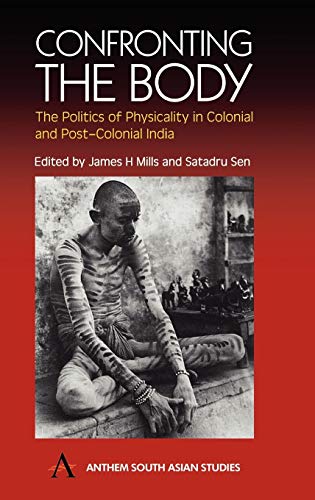
Confronting the Body: The Politics of Physicality in Colonial and Post-Colonial India (Anthem South Asian Studies) - Hardcover
Inhaltsangabe
The editors bring together some of the best new scholarship on physicality in modern India in a single volume and provide a balance of materials from colonial and post-colonial India. Included are new writings by established and upcoming writers in the social sciences and humanities, all based on original research.
Die Inhaltsangabe kann sich auf eine andere Ausgabe dieses Titels beziehen.
Über die Autorin bzw. den Autor
Edited by James H. Mills and Satadru Sen
Von der hinteren Coverseite
The human body in modern South Asia is a continuous political enterprise. The body was central to the project of British colonialism, as well as to the Indian response to colonial rule. By constructing British bodies as normative and disciplined, and Indian bodies as deviant and undisciplined, the British could construct an ideology of their own fitness for political power and defence of colonialism itself. The politics of physicality then manifested in reverse in many ways, not least through Gandhi's use of his body as public experiment in discipline, as well as becoming a living rejection of British rule and norms of physicality. In the post-colonial period, the politics of physicality became more public. Bodies and their symbolic meanings were deployed not only against the European ‘other’ but, increasingly, against other Indian bodies – be it the representation of political aspiration, beauty pageants and the representation of nationalism on the world stage, the furtherance of feminist issues or the moral issues of sexual images of women in the media. In this challenging and wide-ranging new collection, the editors have assembled some of the best new writing on physicality in modern India. Providing a balance of materials from colonial and post-colonial India, Confronting the Body includes new research by established and up-and-coming writers in the social sciences and humanities.
Auszug. © Genehmigter Nachdruck. Alle Rechte vorbehalten.
Confronting The Body
The Politics of Physicality in Colonial and Post-Colonial India
By James H Mills, Satadru SenWimbledon Publishing Company
Copyright © 2004 Anthem Press
All rights reserved.
ISBN: 978-1-84331-032-7All rights reserved.
Contents
ACKNOWLEDGEMENTS, vii,
Notes on Contributors, viii,
Introduction: James H Mills and Satadru Sen, 1,
1. Body, Text, Nation: Writing the Physically Fit Body in Post-Colonial India, Joseph S Alter, 16,
2. 'A Parcel of Dummies'? Sport and the Body in Indian History, Paul Dimeo, 39,
3. Schools, Athletes and Confrontation: The Student Body in Colonial India, Satadru Sen, 58,
4. Body as Target, Violence as Treatment: Psychiatric Regimes in Colonial and Post-Colonial India, James H Mills, 80,
5. The Lotah Emeutes of 1855: Caste, Religion and Prisons in North India in the Early Nineteenth Century, Anand A Yang, 102,
6. The Body at Work: Colonial Art Education and the Figure of the 'Native Craftsman', Deepali Dewan, 118,
7. Making a Dravidian Hero: The Body and Identity Politics in the Dravidian Movement, Nimmi Rangaswamy, 135,
8. Describing the Body: The Writing of Sex and Gender Identity for the Contemporary Bengali Woman, Srimati Basu, 146,
9. A Perfect 10 – 'Modern and Indian': Representations of the Body in Beauty Pageants and the Visual Media in Contemporary India, Shoma Munshi, 162,
10. Demographic Rhetoric and Sexual Surveillance: Indian Middle-Class Advocates of Birth Control, 1902–1940s, Sanjam Ahluwalia, 183,
CHAPTER 1
Body, Text, Nation: Writing the Physically Fit Body in Post-Colonial India
Joseph S Alter
Indeed I wonder whether, before one poses the question of ideology, it wouldn't be more materialist to study first the question of the body and the effects of power on it. Because what troubles me with these analyses which prioritize ideology is that there is always presupposed a human subject on the lines of the model provided by classical philosophy, endowed with consciousness which power is then thought to seize on.
You notice that the metaphor of surface begins to break down. The metaphor of surface becomes the surface of metaphor; the relation among signifiers, posited as a material historical relation, nevertheless continues to be haunted by the deferred ontology that is its point of origin. What has been suppressed is the alterity that will erupt as nature and death – the alterity of the Real.
There will be in this [expressive] view of the world, a day in the indefinite future when word and object will be perfectly articulated in the OM, when event and description will be perfectly attuned. But herein lies the danger: in the seduction, the hope, the illusion that someday there will be a perfect closure.
Introduction: bodies and bodies of knowledge
In most parts of the world, but certainly in modern India, there is a great deal of concern among various groups with the relationship between health, identity and the moral integrity of both the nation as a whole and the citizenry who constitute that whole through individual embodied acts and collective social action. Often body discipline is regarded as both the means and the ends of nationalism. Based on ethnographic research conducted among wrestlers in North India who advocate the embodiment of nationalism and among a yoga society with a similar nationalistic agenda, this chapter is concerned with popular publications in which communities that define themselves in terms of physical fitness and physiological health seek to 'write the body' into popular consciousness.
The nationalism associated with wrestling, known as Bharatiya kushti or Pahalwani, takes shape in the context of gymnasiums where young men gather to engage in a complex regimen of physical fitness training. Each gymnasium is a social world in itself, but there is an important sense in which the institutional structure of gymnasiums collectively defines an 'imagined community' of men intent on building their bodies so as to rebuild the nation. Although wrestling is a 'popular' sport, as a way of life it is thought to have been marginalized by modernity. Relatively speaking, there are not many wrestlers in India, and popular publications are in part designed to counteract this trend by inspiring young men to join gymnasiums and embody a wrestling lifestyle.
Yoga in India has a long association with nationalism. The particular form with which I am concerned is a yoga society, the Bharatiya Yog Sansthan (BYS), that advocates the public performance of secularized mass-drill yoga as a regimen of fitness designed to counteract the harmful effects of modernity on public health. The BYS is unique in as far as it is explicitly nationalistic. It is a registered society, based in Delhi but extending into a number of other North Indian cities, and it has an official, dues-paying membership of several thousand. Its publications are meant to define the relationship among yoga, social reform, physiological health and national fitness.
Of particular interest to this chapter are the two magazines Bharatiya Kushti (Indian Wrestling) and Yog Manjari (Yoga in Bloom). In the age of the World Wide Web, Bharatiya Kushti and Yog Manjari are decidedly anachronistic in their continued format as ink-on-paper publications distributed by mail. The former, measuring 20 by 15 centimetres, contains some black-and-white photographs and is typically about 50 pages in length. The latter measures 28 by 18 centimetres, with colour photographs on the front and back pages, and is typically 35 pages in length. Bharatiya Kushti is published by Ratan Patodi, who founded Bharatiya Kushti Prakashan (The Indian Wrestling Press) explicitly to define Indian wrestling as a nationalistic way of life and to communicate ideas about this way of life to wrestlers and would-be wrestlers. Yog Manjari is the organ of the BYS and is designed to communicate the ideals associated with a nationalist way of life defined in terms of yoga practice. In many ways the two magazines are quite similar as regards topics and structure. Nevertheless they are different in important ways that are germane to the key issue under discussion here. The community of wrestlers and would-be wrestlers constituted through the medium of Bharatiya Kushti do not belong to an organization as such. They are simply imagined, by themselves and by those who subscribe to their views, to be out there as a potent and powerful force. The BYS, on the other hand, is an organization similar to the Rashtriya Swayamsevak Samaj or Boy Scouts, where membership is paramount and the social performance of community through meetings, administrative structure, rank hierarchy of membership and parades is a significant part of what counts as nationalistic. In other words, while both are concerned with embodied reform, Yog Manjari addresses itself to a body of members and Bharatiya Kushti addresses itself to 'everyone' but to no institutionalized body as such. In any case, the key problematic in these magazines has to do with the way in which ideas that take shape as words, sentences and whole texts relate to the materiality of the body as meaningful and powerful in itself and the problematic presumption of the body's 'unmediated' relationship to nationalism.
In many respects nationalism is a form of ideology. As recent scholarship has shown, however, thinking analytically about nationalism as simply ideological is problematic since nationalism involves social acts...
„Über diesen Titel“ kann sich auf eine andere Ausgabe dieses Titels beziehen.
Suchergebnisse für Confronting the Body: The Politics of Physicality in...

Beispielbild für diese ISBN
Confronting the Body: The Politics of Physicality in Colonial and Post-Colonial India (Anthem South Asian Studies)
Anbieter: Books From California, Simi Valley, CA, USA
Verkäuferbewertung 4 von 5 Sternen

Hardcover. Zustand: Very Good. Artikel-Nr. mon0003150266
Gebraucht kaufen
EUR 66,93
EUR 4,47 Versand
Versand innerhalb von USA
Versand innerhalb von USA
Anzahl: 1 verfügbar
Beispielbild für diese ISBN
Confronting the Body
Anbieter: PBShop.store UK, Fairford, GLOS, Vereinigtes Königreich
Verkäuferbewertung 5 von 5 Sternen

HRD. Zustand: New. New Book. Shipped from UK. Established seller since 2000. Artikel-Nr. CX-9781843310327
Neu kaufen
EUR 78,49
EUR 6,02 Versand
Versand von Vereinigtes Königreich nach USA
Versand von Vereinigtes Königreich nach USA
Anzahl: 15 verfügbar
Beispielbild für diese ISBN
Confronting the Body
Anbieter: PBShop.store US, Wood Dale, IL, USA
Verkäuferbewertung 5 von 5 Sternen
HRD. Zustand: New. New Book. Shipped from UK. Established seller since 2000. Artikel-Nr. CX-9781843310327
Beispielbild für diese ISBN
Confronting the Body: The Politics of Physicality in Colonial and Post-Colonial India
Anbieter: Revaluation Books, Exeter, Vereinigtes Königreich
Verkäuferbewertung 5 von 5 Sternen
Hardcover. Zustand: Brand New. 212 pages. 9.25x6.00x0.75 inches. In Stock. Artikel-Nr. x-1843310325
Neu kaufen
EUR 175,45
EUR 12,00 Versand
Versand von Vereinigtes Königreich nach USA
Versand von Vereinigtes Königreich nach USA
Anzahl: 2 verfügbar
Foto des Verkäufers
Confronting the Body : The Politics of Physicality in Colonial and Post-Colonial India
Anbieter: GreatBookPricesUK, Woodford Green, Vereinigtes Königreich
Verkäuferbewertung 5 von 5 Sternen
Zustand: As New. Unread book in perfect condition. Artikel-Nr. 954312
Gebraucht kaufen
EUR 241,00
EUR 18,00 Versand
Versand von Vereinigtes Königreich nach USA
Versand von Vereinigtes Königreich nach USA
Anzahl: 3 verfügbar