
Verwandte Artikel zu Can NGOs Make a Difference?: The Challenge of Development...
Inhaltsangabe
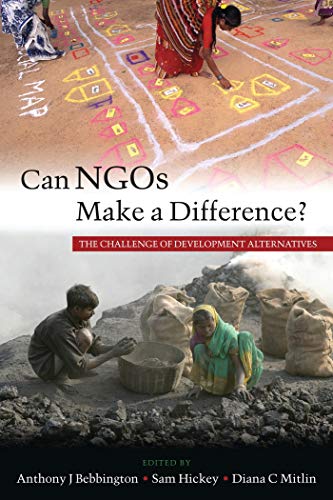
Can non-governmental organisations contribute to more socially just, alternative forms of development? Or are they destined to work at the margins of dominant development models determined by others? Addressing this question, this book brings together leading international voices from academia, NGOs and the social movements. It provides a comprehensive update to the NGO literature and a range of critical new directions to thinking and acting around the challenge of development alternatives. The book's originality comes from the wide-range of new case-study material it presents, the conceptual approaches it offers for thinking about development alternatives, and the practical suggestions for NGOs.
At the heart of this book is the argument that NGOs can and must re-engage with the project of seeking alternative development futures for the world's poorest and more marginal. This will require clearer analysis of the contemporary problems of uneven development, and a clear understanding of the types of alliances NGOs need to construct with other actors in civil society if they are to mount a credible challenge to disempowering processes of economic, social and political development.
Die Inhaltsangabe kann sich auf eine andere Ausgabe dieses Titels beziehen.
Über die Autorin bzw. den Autor
Anthony Bebbington is Professor of Nature, Society and Development in the Institute of Development Policy and Management at the University of Manchester, an ESRC Professorial Fellow, and also a member and research affiliate of the Centro Peruano de Estudios Sociales, Lima, Peru. He has previously held positions at the University of Colorado at Boulder, the University of Cambridge, the International Institute for Environment and Development, the Overseas Development Institute and the World Bank.
Sam Hickey is lecturer in International Development in the Institute of Development Policy and Management at the University of Manchester.
Diana Mitlin is an economist and social development specialist with staff posts at both the International Institute for Environment and Development and the Institute for Development Policy and Management at the University of Manchester.
Auszug. © Genehmigter Nachdruck. Alle Rechte vorbehalten.
Can NGOs Make a Difference?
The Challenge of Development Alternatives
By Anthony J. Bebbington, Samuel Hickey, Diana C. MitlinZed Books Ltd
Copyright © 2008 Anthony J. Bebbington, Samuel Hickey and Diana C. Mitlin
All rights reserved.
ISBN: 978-1-84277-893-7All rights reserved.
Contents
List of Figures and Tables, viii,
Acknowledgements, ix,
PART I Critical Challenges,
1 Introduction: Can NGOs Make a Difference? The Challenge of Development Alternatives Anthony J. Bebbington, Samuel Hickey and Diana C. Mitlin, 3,
2 Have NGOs 'Made a Difference?' From Manchester to Birmingham with an Elephant in the Room Michael Edwards, 38,
PART II NGO Alternatives under Pressure,
3 Challenges to Participation, Citizenship and Democracy: Perverse Confluence and Displacement of Meanings Evelina Dagnino, 55,
4 Learning from Latin America: Recent Trends in European NGO Policymaking Kees Biekart, 71,
5 Whatever Happened to Reciprocity? Implications of Donor Emphasis on 'Voice' and 'Impact' as Rationales for Working with NGOs in Development Alan Thomas, 90,
6 Development and the New Security Agenda: W(h)ither(ing) NGO Alternatives? Alan Fowler, 111,
PART III Pursuing Alternatives: NGO Strategies in Practice,
7 How Civil Society Organizations Use Evidence to Influence Policy Processes Amy Pollard and Julius Court, 133,
8 Civil Society Participation as the Focus of Northern NGO Support: The Case of Dutch Co-financing Agencies Irene Guijt, 153,
9 Producing Knowledge, Generating Alternatives? Challenges to Research-oriented NGOs in Central America and Mexico Cynthia Bazán, Nelson Cuellar, Ileana Gómez, Cati Illsley, Adrian López, Iliana Monterroso, Joaliné Pardo, Jose Luis Rocha, Pedro Torres and Anthony J. Bebbington, 175,
10 Anxieties and Affirmations: NGO-Donor Partnerships for Social Transformation Mary Racelis, 196,
PART IV Being Alternative,
11 Reinventing International NGOs: A View from the Dutch Co-financing System Harry Derksen and Pim Verhallen, 221,
12 Transforming or Conforming? NGOs Training Health Promoters and the Dominant Paradigm of the Development Industry in Bolivia Katie S. Bristow, 240,
13 Political Entrepreneurs or Development Agents: An NGO's Tale of Resistance and Acquiescence in Madhya Pradesh, India Vasudha Chhotray, 261,
14 Is This Really the End of the Road for Gender Mainstreaming? Getting to Grips with Gender and Institutional Change Nicholas Pialek, 279,
15 The Ambivalent Cosmopolitanism of International NGOs Helen Yanacopulos and Matt Baillie Smith, 298,
16 Development as Reform and Counter-reform: Paths Travelled by Slum/Shack Dwellers International Joel Bolnick, 316,
PART V Taking Stock and Thinking Forward,
17 Reflections on NGOs and Development: The Elephant, the Dinosaur, Several Tigers but No Owl David Hulme, 337,
Contributors, 346,
Index, 351,
CHAPTER 1
Introduction: Can NGOs Make a Difference? The Challenge of Development Alternatives
Anthony J. Bebbington, Samuel Hickey and Diana C. Mitlin
'Not another Manchester book on NGOs!' some bookstore browsers will comment on spotting this text. The short response, of course, is 'Yes, another one.' The longer response is this introductory chapter. In it we argue why this is once again a good moment to take the pulse of the NGO world. This time, though, we take the pulse not merely as a health check, which was the spirit of the three Manchester conferences: in 1992 to check their fitness to go to scale (Edwards and Hulme, 1992); in 1994 to check their fitness in the face of increased societal scrutiny (Edwards and Hulme, 1995; Hulme and Edwards, 1997); and in 1999 to check their fitness in the face of globalization (e.g. Eade and Ligteringen, 2001; Edwards and Gaventa, 2001; Lewis and Wallace, 2000). Instead, participants in a conference in 2005 took the pulse of NGOs to see whether the patient was still alive. The conviction underlying the book is that NGOs are only NGOs in any politically meaningful sense of the term if they are offering alternatives to dominant models, practices and ideas about development. The question that the book addresses is whether – in the face of neoliberalism, the poverty agenda in aid, the new security agenda, institutional maturation (if not senescence), and the simple imperatives of organizational survival – NGOs continue to constitute alternatives.
As the reader will see, the authors are far from certain about the health of the patient, though none of them is yet ready to write the certificate declaring the death of alternatives and the irrelevance of NGOs (an irrelevance that would somewhat invert the scales of Edwards's polemic in 1989 that declared development studies irrelevant to NGOs, the place where real development was being done: Edwards, 1989). There are serious doubts regarding how far NGOs in the North are able to do anything that is especially alternative to their host countries' bilateral aid programmes. There is a sense that their room for manoeuvre has been seriously constrained by the security agenda, increasing political disenchantment with NGOs, the constraints of a poverty impact agenda that will only fund activities with measurable impacts on some material dimension of poverty, and also a sense in which 'alternatives' have been swallowed whole within the newly 'inclusive' mainstream. And there are just as serious questions about NGOs in the South, who, in addition to facing these constraints, transmitted to them through funding decisions and the ever more constraining conditionalities linked to them, have to operate in political-economic environments defined by both the ravages and the domesticating hands of neoliberalism as well as the never-ending struggle to secure the financial bases of organizational survival.
That said, these doubts do not lead the majority of the authors to conclude that 'there is no alternative' and that therefore there is no reason for NGOs to exist. Indeed, the strength of all the chapters – and, we hope, the primary contribution of this collection – is that each takes a hard-headed and theoretically informed look at the constraints on NGOs' ability to exist, speak and act as development alternatives, but then also explores the ways in which NGOs have either found points where the stitching of these straitjackets is coming unpicked, or found ways simply to reframe the debate, to say that the game they were previously playing is no longer interesting, and it is time to design a new one.
In this chapter we flesh out some of the themes that the book elaborates. We begin by elaborating the idea of 'alternatives' that runs through the book, and the ways in which it might relate to NGOs. We then use this framework to give a brief, historical discussion of NGOs and the differing ways in which they have sought to be alternative (both sections rely heavily on Mitlin, Hickey and Bebbington 2007). The third section introduces the middle three sections of the book: a section focusing on the different ways in which NGO-led alternatives have come under increasing pressure in the last decade; a section exploring ways in which NGOs have continued to seek ways of fostering alternative forms of development; and a section that explores how far NGOs have sought ways to simply be alternative, and, in so being, to suggest that there are different ways in which the broader development enterprise might be thought about and engaged in. The closing section of this chapter then charts...
„Über diesen Titel“ kann sich auf eine andere Ausgabe dieses Titels beziehen.
Suchergebnisse für Can NGOs Make a Difference?: The Challenge of Development...

Beispielbild für diese ISBN
Can NGOs Make a Difference?: The Challenge of Development Alternatives
Verlag:
Bloomsbury Publishing PLC, 2007
ISBN 10: 1842778935
ISBN 13: 9781842778937
Gebraucht
Paperback
Anbieter: World of Books (was SecondSale), Montgomery, IL, USA
Verkäuferbewertung 5 von 5 Sternen

Paperback. Zustand: Good. An important volume that asks whether non-governmental organisations can contribute to more socially just, alternative forms of development or if they destined to work at the margins of dominant development models determined by others. Artikel-Nr. CIN1842778935G
Gebraucht kaufen
EUR 5,41
Versand gratis
Versand innerhalb von USA
Versand innerhalb von USA
Anzahl: 1 verfügbar
Beispielbild für diese ISBN
Can NGOs Make a Difference?: The Challenge of Development Alternatives
Anbieter: BooksRun, Philadelphia, PA, USA
Verkäuferbewertung 5 von 5 Sternen
Paperback. Zustand: Very Good. It's a well-cared-for item that has seen limited use. The item may show minor signs of wear. All the text is legible, with all pages included. It may have slight markings and/or highlighting. Artikel-Nr. 1842778935-11-1
Gebraucht kaufen
EUR 7,03
Versand gratis
Versand innerhalb von USA
Versand innerhalb von USA
Anzahl: 1 verfügbar
Beispielbild für diese ISBN
Can NGOs Make a Difference?
Verlag:
Bloomsbury Publishing PLC, 2007
ISBN 10: 1842778935
ISBN 13: 9781842778937
Gebraucht
Paperback
Anbieter: ThriftBooks-Atlanta, AUSTELL, GA, USA
Verkäuferbewertung 5 von 5 Sternen
Paperback. Zustand: Very Good. No Jacket. May have limited writing in cover pages. Pages are unmarked. ~ ThriftBooks: Read More, Spend Less. Artikel-Nr. G1842778935I4N00
Gebraucht kaufen
EUR 9,09
Versand gratis
Versand innerhalb von USA
Versand innerhalb von USA
Anzahl: 1 verfügbar
Beispielbild für diese ISBN
Can NGOs Make a Difference? : The Challenge of Development Alternatives
Anbieter: Better World Books, Mishawaka, IN, USA
Verkäuferbewertung 5 von 5 Sternen
Zustand: Good. Pages intact with minimal writing/highlighting. The binding may be loose and creased. Dust jackets/supplements are not included. Stock photo provided. Product includes identifying sticker. Better World Books: Buy Books. Do Good. Artikel-Nr. 48712417-6
Gebraucht kaufen
EUR 9,55
Versand gratis
Versand innerhalb von USA
Versand innerhalb von USA
Anzahl: 1 verfügbar
Beispielbild für diese ISBN
Can NGOs Make a Difference? : The Challenge of Development Alternatives
Anbieter: Better World Books, Mishawaka, IN, USA
Verkäuferbewertung 5 von 5 Sternen
Zustand: Good. Former library copy. Pages intact with minimal writing/highlighting. The binding may be loose and creased. Dust jackets/supplements are not included. Includes library markings. Stock photo provided. Product includes identifying sticker. Better World Books: Buy Books. Do Good. Artikel-Nr. 47284321-20
Gebraucht kaufen
EUR 9,55
Versand gratis
Versand innerhalb von USA
Versand innerhalb von USA
Anzahl: 1 verfügbar
Beispielbild für diese ISBN
Can NGOs Make a Difference?: The Challenge of Development Alternatives
Anbieter: Ammareal, Morangis, Frankreich
Verkäuferbewertung 5 von 5 Sternen
Softcover. Zustand: Bon. Ancien livre de bibliothèque. Petite(s) trace(s) de pliure sur la couverture. Légères traces d'usure sur la couverture. Edition 2007. Ammareal reverse jusqu'à 15% du prix net de cet article à des organisations caritatives. ENGLISH DESCRIPTION Book Condition: Used, Good. Former library book. Slightly creased cover. Slight signs of wear on the cover. Edition 2007. Ammareal gives back up to 15% of this item's net price to charity organizations. Artikel-Nr. E-325-306
Gebraucht kaufen
EUR 3,50
EUR 6,29 Versand
Versand von Frankreich nach USA
Versand von Frankreich nach USA
Anzahl: 1 verfügbar
Beispielbild für diese ISBN
Can NGOs Make a Difference? : The Challenge of Development Alternatives
Anbieter: AwesomeBooks, Wallingford, Vereinigtes Königreich
Verkäuferbewertung 5 von 5 Sternen
Paperback. Zustand: Very Good. Can NGOs Make a Difference? : The Challenge of Development Alternatives This book is in very good condition and will be shipped within 24 hours of ordering. The cover may have some limited signs of wear but the pages are clean, intact and the spine remains undamaged. This book has clearly been well maintained and looked after thus far. Money back guarantee if you are not satisfied. See all our books here, order more than 1 book and get discounted shipping. Artikel-Nr. 7719-9781842778937
Gebraucht kaufen
EUR 4,89
EUR 4,91 Versand
Versand von Vereinigtes Königreich nach USA
Versand von Vereinigtes Königreich nach USA
Anzahl: 2 verfügbar
Beispielbild für diese ISBN
Can NGOs Make a Difference?: The Challenge of Development Alternatives
Anbieter: WorldofBooks, Goring-By-Sea, WS, Vereinigtes Königreich
Verkäuferbewertung 5 von 5 Sternen
Paperback. Zustand: Good. The book has been read but remains in clean condition. All pages are intact and the cover is intact. Some minor wear to the spine. Artikel-Nr. GOR007024261
Gebraucht kaufen
EUR 3,94
EUR 6,68 Versand
Versand von Vereinigtes Königreich nach USA
Versand von Vereinigtes Königreich nach USA
Anzahl: 1 verfügbar
Beispielbild für diese ISBN
Can NGOs Make a Difference?: The Challenge of Development Alternatives
Anbieter: WorldofBooks, Goring-By-Sea, WS, Vereinigtes Königreich
Verkäuferbewertung 5 von 5 Sternen
Paperback. Zustand: Very Good. The book has been read, but is in excellent condition. Pages are intact and not marred by notes or highlighting. The spine remains undamaged. Artikel-Nr. GOR002290149
Gebraucht kaufen
EUR 3,94
EUR 6,68 Versand
Versand von Vereinigtes Königreich nach USA
Versand von Vereinigtes Königreich nach USA
Anzahl: 1 verfügbar
Beispielbild für diese ISBN
Can NGOs Make a Difference? : The Challenge of Development Alternatives
Anbieter: Better World Books Ltd, Dunfermline, Vereinigtes Königreich
Verkäuferbewertung 5 von 5 Sternen
Zustand: Very Good. Former library copy. Pages intact with possible writing/highlighting. Binding strong with minor wear. Dust jackets/supplements may not be included. Includes library markings. Stock photo provided. Product includes identifying sticker. Better World Books: Buy Books. Do Good. Artikel-Nr. GRP97038315
Gebraucht kaufen
EUR 5,75
EUR 5,96 Versand
Versand von Vereinigtes Königreich nach USA
Versand von Vereinigtes Königreich nach USA
Anzahl: 1 verfügbar