
Verwandte Artikel zu Directors: From Stage to Screen and Back Again
Inhaltsangabe
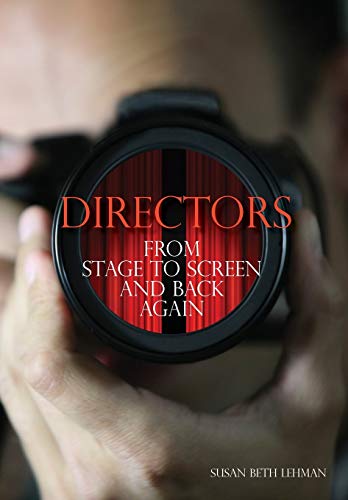
Some of America's most exciting film directors have emerged from the theater world. Directors: From Stage to Screen and Back Again features a series of interviews with directors who did just that. Each conversation traces its subject's personal artistic journey and explores how he or she handled the challenge of moving from stage to screen.
Die Inhaltsangabe kann sich auf eine andere Ausgabe dieses Titels beziehen.
Über die Autorin bzw. den Autor
Susan Beth Lehman, a former actor, director, and screenwriter, is assistant professor of TV and film at DeSales University in Pennsylvania.
Auszug. © Genehmigter Nachdruck. Alle Rechte vorbehalten.
Directors
From Stage to Screen and Back Again
By Susan Beth LehmanIntellect Ltd
Copyright © 2013 Intellect Ltd
All rights reserved.
ISBN: 978-1-84150-490-2All rights reserved.
Contents
Acknowledgements,
Foreword,
Preface,
Good Story, Well Told,
Brief History of the Modern Director,
Chapter 1: Paul Aaron, August 2010,
Chapter 2: Gilbert Cates, October 2010,
Chapter 3: Judy Chaikin, October 2011,
Chapter 4: Lenore Dekoven, August 2010,
Chapter 5: Gordon Hunt, June 2010,
Chapter 6: Neil LaBute, August 2011,
Chapter 7: Rob Marshall, June 2011,
Chapter 8: Jiri Menzel, July 2011,
Chapter 9: Oz Scott, May 2010,
Chapter 10: Matt Shakman, September 2010,
Chapter 11: Jerry Zaks, April 2011,
Chapter 12: Joel Zwick, July 2010,
Conclusion,
CHAPTER 1
Paul Aaron, August 2010
Paul Aaron believes that creating a great ensemble is the key to being a successful director.
Aaron grew up in Hoosick Falls in the 1950s, the prototype setting for Thornton Wilder's classic American play Our Town. Aaron graduated as a Drama Fellow from Bennington College in the mid- 1960s. Shortly thereafter, he was the Casting and New Programs Director at the Mark Taper Forum in Los Angeles. There, he founded an actor's workshop and directed several plays, including a critically acclaimed production of The Threepenny Opera.
Upon returning to New York, his directing career was firmly established with his production of the national tour of The Prime of Miss Jean Brodie, starring Academy Award winner Kim Hunter. Off Broadway, he directed the rock musical Salvation in 1969, starring then-unknown actors Barry Bostwick, Joe Morton and Bette Midler. In 1974 Variety called his direction of Ugo Betti's drama The Burnt Flower Bed" ... nothing less than masterful." His directorial debut on Broadway was Paris is Out in 1970.
In 1977 he was awarded the Los Angeles Drama Critic's Award as Best Director for Paddy Chayefsky's play The Tenth Man, starring Richard Dreyfuss. His film career followed with A Different Story in 1978, the first Hollywood film to depict gay people as positive protagonists.
His follow-up feature was the action film A Force of One in 1979, staring Chuck Norris and Jennifer O'Neill, with a screenplay by Academy Award winner, Ernest Tidyman.
Aaron entered television in 1979, helming the Emmy Award- winning NBC Special Event of William Gibson's classic The Miracle Worker. His work has garnered the Christopher Award, Director's Guild and Golden Globe award nominations and the Director's prize from the Monte Carlo Film Festival.
Aaron continues to direct on both film and stage with some of the most esteemed actors of the past half-century, including Lillian Gish, Claudette Colbert, Jane Alexander, Fritz Weaver, Glenn Close, Mandy Patinkin, James Earl Jones and James Woods.
In the 1980s, he created Elsboy Entertainment, where he manages artists and develops projects as a writer, producer and director. He guest lectures at many universities, including UCLA and the University of Washington.
Paul started our conversation asking me what led me to this project.
SL: Since switching from teaching theater to film, I've noticed that a greater percentage of my theater students had much more intellectual curiosity about history, and the world, including all aspects of their own art than many of my film students. And though my film students are extremely bright, a majority of them didn't do theater in high school and just want to play with the toys of filmmaking. Because video has become so accessible, students easily come into our program with wonderful technical skills, but lack an interest and understanding of the importance of character and story that results from studying literature and theater.
PA: The academics insist on separating themselves: theory, or technology, or aesthetics. Film is a constantly evolving technical medium, as you said, "They want to play with the toys." But it's very important to know the evolution of those toys, and what the artists in directing, writing, cinematography and so on, have done in the past that pave the way to the future.
One of the great weaknesses of film programs is that they do not study the language of acting. The language, the very core of the communication, is one of the very few things that are similar in terms of theater and film. Most other ways they are very different.
SL: Where are you from?
PA: Brought up in a little village in upstate New York called Hoosick Falls known mostly because it is the home of Grandma Moses. If you pick any Grandma Moses paintings you'll know my childhood.
SL: And you went to Bennington College?
PA: I went to Brandeis University first and then got a fellowship to Bennington.
SL: When did you start in theater?
PA: I was directing in my little town in the community theater when I was 16. I was still in high school but directing adults.
SL: Okay, so to the manor born?
PA: I didn't grow up in the alleys of New York. You know, I mean in Shubert Alley, going to plays when I was seven or eight or nine. I don't think I saw a play in New York until I was probably 16, 17. The Diary of Anne Frank [1955] was the first play I ever saw. But it didn't matter what play it was, because somehow that's always what I wanted to do. That's always how I saw myself. Before I knew what directors did, I was directing.
When I did my first Broadway show, on the opening night there are always lots of flowers and gifts. There was also a special delivery envelope from Dorothy Niles who was my second grade teacher back in Hoosick Falls. Inside was a yellowed mimeograph program, from the days when purple mimeo was the way of copying. It was a program from second grade: "The Adventures of Ichabod Crane, adapted, produced and directed by Paul Aaron." So who knows? As you said, "to the manor born."
SL: You went to Brandeis University?
PA: I went to Brandeis after high school. Actually, I spent a year in Israel, and then I went to Brandeis for two years. Bennington College was not yet coed, but they had Drama Fellows in dance and drama. And there were, I think, 12 of us. The school mandated that you couldn't matriculate from high school. You had to have gone two years elsewhere before they would invite you to finish with them. It couldn't be a very serious program of drama or dance if you didn't have men and women. A year or two years after I graduated, the school became coed. So, I was one of the last of the Drama Fellows. [The all-female college became coed in 1969] Alan Arkin was Drama Fellow. Oh yeah, lots of great people.
SL: And why did you pick theater over film?
PA: Because I could do it. Because it didn't involve technology. There was no video at the time. I mean the idea to be able to work with film, and your parents going out to buy you equipment was impossible. Now you can have a MAC computer, and for a few grand you can make a feature-length motion picture. But what I could do was get five kids together and do Ichabod Crane. I did it because I could do it. I have never been technically interested or gifted. I'm a storyteller, and I could do that best in theater. And it was not until later that I went to do film.
SL: What brought you to film?
PA: What brought me to film was that I was casting for Seventy Girls Seventy [1971], the Kandor/Ebb musical I was directing. There were several girls in...
„Über diesen Titel“ kann sich auf eine andere Ausgabe dieses Titels beziehen.
Suchergebnisse für Directors: From Stage to Screen and Back Again

Beispielbild für diese ISBN
Directors
Anbieter: PBShop.store US, Wood Dale, IL, USA
Verkäuferbewertung 5 von 5 Sternen

PAP. Zustand: New. New Book. Shipped from UK. Established seller since 2000. Artikel-Nr. C3-9781841504902
Beispielbild für diese ISBN
Directors
Anbieter: PBShop.store UK, Fairford, GLOS, Vereinigtes Königreich
Verkäuferbewertung 5 von 5 Sternen
PAP. Zustand: New. New Book. Shipped from UK. Established seller since 2000. Artikel-Nr. C3-9781841504902
Neu kaufen
EUR 18,05
EUR 4,85 Versand
Versand von Vereinigtes Königreich nach USA
Versand von Vereinigtes Königreich nach USA
Anzahl: 9 verfügbar
Beispielbild für diese ISBN
Directors
Anbieter: Majestic Books, Hounslow, Vereinigtes Königreich
Verkäuferbewertung 4 von 5 Sternen

Zustand: New. pp. 189. Artikel-Nr. 57944137
Neu kaufen
EUR 16,27
EUR 7,58 Versand
Versand von Vereinigtes Königreich nach USA
Versand von Vereinigtes Königreich nach USA
Anzahl: 3 verfügbar
Beispielbild für diese ISBN
Directors From Stage to Screen and Back Again
Anbieter: Revaluation Books, Exeter, Vereinigtes Königreich
Verkäuferbewertung 5 von 5 Sternen
Paperback. Zustand: Brand New. 189 pages. 9.25x6.25x0.50 inches. In Stock. Artikel-Nr. __1841504904
Neu kaufen
EUR 14,02
EUR 11,66 Versand
Versand von Vereinigtes Königreich nach USA
Versand von Vereinigtes Königreich nach USA
Anzahl: 2 verfügbar
Beispielbild für diese ISBN
Directors from Stage to Screen and Back Again
Verlag:
University Of Chicago Press, 2013
ISBN 10: 1841504904
ISBN 13: 9781841504902
Gebraucht
Softcover
Anbieter: Anybook.com, Lincoln, Vereinigtes Königreich
Verkäuferbewertung 5 von 5 Sternen
Zustand: Good. This is an ex-library book and may have the usual library/used-book markings inside.This book has soft covers. In good all round condition. Please note the Image in this listing is a stock photo and may not match the covers of the actual item,450grams, ISBN:9781841504902. Artikel-Nr. 7850246
Gebraucht kaufen
EUR 14,86
EUR 15,86 Versand
Versand von Vereinigtes Königreich nach USA
Versand von Vereinigtes Königreich nach USA
Anzahl: 1 verfügbar
Beispielbild für diese ISBN
Directors
Anbieter: Kennys Bookstore, Olney, MD, USA
Verkäuferbewertung 5 von 5 Sternen
Zustand: New. Num Pages: 150 pages, Illustrations, ports. BIC Classification: ANB; APFB. Category: (P) Professional & Vocational. Dimension: 231 x 171 x 11. Weight in Grams: 354. . 2013. Paperback. . . . . Books ship from the US and Ireland. Artikel-Nr. V9781841504902
Neu kaufen
EUR 22,37
EUR 9,14 Versand
Versand innerhalb von USA
Versand innerhalb von USA
Anzahl: 2 verfügbar
Beispielbild für diese ISBN
Directors: From Stage to Screen and Back Again
Anbieter: Ria Christie Collections, Uxbridge, Vereinigtes Königreich
Verkäuferbewertung 5 von 5 Sternen
Zustand: New. In English. Artikel-Nr. ria9781841504902_new
Neu kaufen
EUR 35,14
EUR 10,93 Versand
Versand von Vereinigtes Königreich nach USA
Versand von Vereinigtes Königreich nach USA
Anzahl: Mehr als 20 verfügbar