
Verwandte Artikel zu Dancing Across the Page: Narrative and Embodied Ways...
Inhaltsangabe
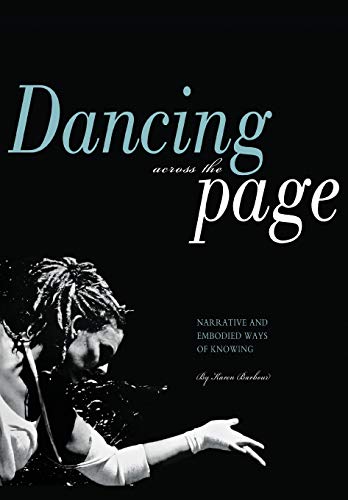
An innovative exploration of understanding through dance, Dancing across the Page draws on the frameworks of phenomenology, feminism, and postmodernism to offer readers an understanding of performance studies that is grounded in personal narrative and lived experience. Through accounts of contemporary dance making, improvisation, and dance education, Karen Barbour explores a diversity of themes, including power; activism; and cultural, gendered, and personal identity. An intimate yet rigorous investigation of creativity in dance, Dancing across the Page emphasizes embodied knowledge and imagination as a basis for creative action in the world.
Die Inhaltsangabe kann sich auf eine andere Ausgabe dieses Titels beziehen.
Über die Autorin bzw. den Autor
Karen Barbour is a senior lecturer in the Faculty of Education at the University of Waikato in New Zealand. She is a member of the World Dance Alliance and the Congress on Research in Dance.
Auszug. © Genehmigter Nachdruck. Alle Rechte vorbehalten.
Dancing Across the Page
Narrative and Embodied Ways of Knowing
By Karen Nicole BarbourIntellect Ltd
Copyright © 2011 Intellect Ltd
All rights reserved.
ISBN: 978-1-84150-421-6All rights reserved.
Contents
List of Photographs and Figures, 7,
Mihi, 9,
Acknowledgements, 11,
Chapter 1: Being: Introductions, 13,
Chapter 2: Becoming: Feminist Choreography and Dance Research, 25,
Chapter 3: Dancing Across the Page: Representing Research Through Narrative, 45,
Chapter 4: Dreaming Yourself Anew: Choreographic Strategies in Women's Solo Contemporary Dance, 61,
Chapter 5: Knowing Differently, Living Creatively: Embodied Ways of Knowing, 83,
Chapter 6: Standing Strong: Pedagogical Approaches to Affirming Identity, 107,
Chapter 7: Improvising: Dance and Everyday Life, 131,
Chapter 8: Performing Identity: Tattoos, Dreadlocks and Feminism in Everyday Life, 149,
Chapter 9: Imaginings: Reaching for a Vision, 163,
References, 175,
CHAPTER 1
Being: Introductions
Writing at my computer now as a dancer and writer, a feminist researcher, teacher in tertiary dance education and mother, I wonder how you will connect with me, with my different experiences, ways of knowing, cultures and environment. I share my experiences with you in this book – a narrative exploration of embodied ways of knowing as a means of living creatively in the world. I feel deeply in my bones that the specifics of my embodiment as a woman and a contemporary dancer living in Aotearoa are integral to my engagement in qualitative research. My embodiment is crucial to the ways in which I understand my personal experiences in relation to the social and political world around me. My contention as a feminist is that the specifics of my embodiment are pivotal to epistemology too, just as the specifics of my cultural, social, discursive and geographical context are also integral to what I can know. Consequently, this book contains a collection of specifically located, personally embodied narratives and autoethnographies based on lived experiences.
Recollections
A remote rural area of Te Ika a Maui, Aotearoa (the North Island of New Zealand) was my first home. Surrounded by native bush, rugged farmland and cool fresh rivers, my days were clear blue and full of adventure, and my nights alight with family discussion and the imaginary worlds of books. My sisters and I ran barefoot, playing in the rivers, exploring caves, climbing hills and building tree huts, watched casually by our parents. We knew the deep, quiet pools and the secret space behind the waterfall, the route up the limestone cliffs to where we could see over the whole valley, the best spots for gathering watercress and picking wild plums, the places glow-worms lit and the calls of the Ruru (Morepork owl) in the night. School was a long drive away, our bus crawling along familiar dusty roads and picking up neighbours every few kilometres before reaching the little town. Some summers our spring would run dry and winter storms could leave our valley isolated and without electricity for days. We learned to live with the seasons and we made our own fun.
As a naive but precocious young girl, my parents took me to see popular Limbs Dance Company perform in the local community theatre. I remember sitting near the stage, my eyes wide as dancers transformed into reptiles, moths and all the fancies of my young imagination. Enraptured with the strength, fluidity and charisma of the dancers, I knew then that contemporary dance was what I wanted to do. After pestering my parents for months, I had my first real contemporary dance experience in the big city of Auckland.
My 11-year-old body was filled with nervous anticipation as I set out for my first morning of the ten-day Limbs dance workshop. After catching buses from my aunt's house to the central city, I walked through the tumbledown houses and boarded-up buildings of the early 1980s inner-city suburb of Ponsonby. Climbing eagerly up the creaky wooden stairs to the third floor of the old Limbs Dance Company building, I arrived at last. Dressed in my new black footless tights, leotard and T-shirt under my street clothes, I was ready to become a dancer. To my elation, I was greeted by one of the marvellous dancers I remembered seeing perform, and from then on I imagined myself one of them. I remember distinct things from that first workshop, like the smell of one woman's perfume and the absolute thrill of moving in new ways. Though always in awe of those around me, somehow I also felt at home too.
That first dance workshop and those clear blue days of adventure are some of my fondest childhood memories. Or at least, these are what remain in my memory anyway, because after this, the realities of being a young woman began to sink in. The days seemed to get shorter and there was not enough time for wandering and adventuring. Saddened, I noticed the hillsides scar with landslides in the winter storms after the farmers began logging more forest. Our rivers changed too as the water was contaminated with silt and with animal effluent from increased livestock. As time went on, my outside play reduced to running and swimming for competition rather than for pleasure. Study for exams also meant that I did not get to attend many dance workshops and I had to make do with leaping around my bedroom and imagining I was dancing in Limbs Dance Company.
The books in front of me morphed from novels to textbooks and study ate steadily into our family discussion time. I suppose that I was well prepared for my tertiary education, but I still reflect sadly on this inescapable change from childhood to adulthood. Inevitably I left my remote home environment and family for the city and university, choosing to study philosophy and psychology because dance was not offered in tertiary education in those days. By the time the tertiary dance programme in Auckland city became established, I had completed my Master's degree in philosophy. Enrolling in dance training at long last, I immersed myself in the dance world, my childhood dream of professional training and performance coming to fruition, albeit briefly. It was not long though, before I traded in the struggle of professional dance and returned to the academic environment in search of a more sustainable career and lifestyle.
My nostalgia for both the seemingly uncomplicated rural life of my childhood and my naive dream of a career as a dancer are balanced now with a much greater awareness of the political, social and artistic context of Aotearoa, and by my experiences travelling internationally.
Dance in my footsteps
As the short vignette above illustrates, I share my own lived experiences in this book, beginning by providing some context through the autobiographical vignette above and extending my writing style throughout the book to more substantial narratives. Within these pages I develop richly descriptive, visceral and kinaesthetic methods of writing to deliberately draw attention to the constructed, contextual and embodied nature of my experience and research. I believe that, as a member of the dance community and social context of Aotearoa that I study, my own dance-making experiences and research with others should be represented to convey lived experience as fully as possible within written forms. Thus, I consult my own embodiment for understandings and I search for evocative words to articulate my understandings. My hope is that I can inspire you to engage kinaesthetically and empathetically with my...
„Über diesen Titel“ kann sich auf eine andere Ausgabe dieses Titels beziehen.
Suchergebnisse für Dancing Across the Page: Narrative and Embodied Ways...

Beispielbild für diese ISBN
Dancing Across the Page - Narr
Anbieter: World of Books (was SecondSale), Montgomery, IL, USA
Verkäuferbewertung 5 von 5 Sternen

Zustand: Good. Item in good condition. Textbooks may not include supplemental items i.e. CDs, access codes etc. Artikel-Nr. 00093727664
Gebraucht kaufen
EUR 7,08
Versand gratis
Versand innerhalb von USA
Versand innerhalb von USA
Anzahl: 2 verfügbar
Beispielbild für diese ISBN
Dancing Across the Page â" Narrative and Embodied Ways of Knowing
Anbieter: WorldofBooks, Goring-By-Sea, WS, Vereinigtes Königreich
Verkäuferbewertung 5 von 5 Sternen
Paperback. Zustand: Very Good. The book has been read, but is in excellent condition. Pages are intact and not marred by notes or highlighting. The spine remains undamaged. Artikel-Nr. GOR003092507
Gebraucht kaufen
EUR 3,90
EUR 6,53 Versand
Versand von Vereinigtes Königreich nach USA
Versand von Vereinigtes Königreich nach USA
Anzahl: 1 verfügbar
Beispielbild für diese ISBN
Dancing Across the Page : Narrative and Embodied Ways of Knowing
Anbieter: Better World Books Ltd, Dunfermline, Vereinigtes Königreich
Verkäuferbewertung 5 von 5 Sternen
Zustand: Good. Pages intact with minimal writing/highlighting. The binding may be loose and creased. Dust jackets/supplements are not included. Stock photo provided. Product includes identifying sticker. Better World Books: Buy Books. Do Good. Artikel-Nr. 42267267-75
Gebraucht kaufen
EUR 5,89
EUR 5,83 Versand
Versand von Vereinigtes Königreich nach USA
Versand von Vereinigtes Königreich nach USA
Anzahl: 1 verfügbar
Beispielbild für diese ISBN
Dancing Across the Page : Narrative and Embodied Ways of Knowing
Anbieter: Better World Books Ltd, Dunfermline, Vereinigtes Königreich
Verkäuferbewertung 5 von 5 Sternen
Zustand: Good. Former library copy. Pages intact with minimal writing/highlighting. The binding may be loose and creased. Dust jackets/supplements are not included. Includes library markings. Stock photo provided. Product includes identifying sticker. Better World Books: Buy Books. Do Good. Artikel-Nr. 42269610-20
Gebraucht kaufen
EUR 5,89
EUR 5,83 Versand
Versand von Vereinigtes Königreich nach USA
Versand von Vereinigtes Königreich nach USA
Anzahl: 3 verfügbar
Beispielbild für diese ISBN
Dancing across the Page: Narrative and Embodied Ways of Knowing
Anbieter: Phatpocket Limited, Waltham Abbey, HERTS, Vereinigtes Königreich
Verkäuferbewertung 5 von 5 Sternen
Zustand: Good. Your purchase helps support Sri Lankan Children's Charity 'The Rainbow Centre'. Ex-library, so some stamps and wear, but in good overall condition. Our donations to The Rainbow Centre have helped provide an education and a safe haven to hundreds of children who live in appalling conditions. Artikel-Nr. Z1-T-006-02058
Gebraucht kaufen
EUR 2,50
EUR 12,42 Versand
Versand von Vereinigtes Königreich nach USA
Versand von Vereinigtes Königreich nach USA
Anzahl: 1 verfügbar
Beispielbild für diese ISBN
Dancing Across the Page
Anbieter: PBShop.store UK, Fairford, GLOS, Vereinigtes Königreich
Verkäuferbewertung 5 von 5 Sternen
PAP. Zustand: New. New Book. Shipped from UK. Established seller since 2000. Artikel-Nr. CX-9781841504216
Neu kaufen
EUR 30,35
EUR 4,85 Versand
Versand von Vereinigtes Königreich nach USA
Versand von Vereinigtes Königreich nach USA
Anzahl: 15 verfügbar
Beispielbild für diese ISBN
Dancing Across the Page
Anbieter: PBShop.store US, Wood Dale, IL, USA
Verkäuferbewertung 5 von 5 Sternen
PAP. Zustand: New. New Book. Shipped from UK. Established seller since 2000. Artikel-Nr. CX-9781841504216
Beispielbild für diese ISBN
Dancing across the Page: Narrative and Embodied Ways of Knowing
Anbieter: Ria Christie Collections, Uxbridge, Vereinigtes Königreich
Verkäuferbewertung 5 von 5 Sternen
Zustand: New. In English. Artikel-Nr. ria9781841504216_new
Neu kaufen
EUR 35,16
EUR 10,93 Versand
Versand von Vereinigtes Königreich nach USA
Versand von Vereinigtes Königreich nach USA
Anzahl: Mehr als 20 verfügbar