
Verwandte Artikel zu Readings in Primary Art Education (Readings in Art...
Inhaltsangabe
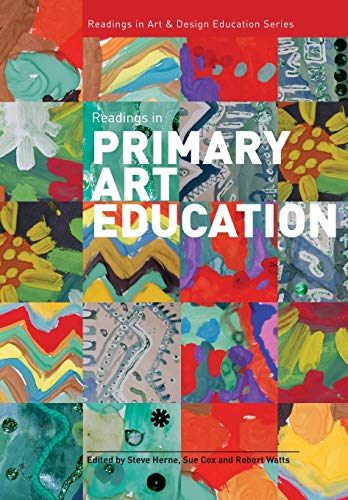
With approximately 16,000 students beginning primary teacher education in the UK each year, and each of those being expected to teach art and design, this pioneering volume provides a renewed emphasis on ideas, issues and research in art and design education in the primary and early years phases. It gathers together work from internationally recognised authors, providing a critical framework to underpin current and developing practice in primary art and design education in the UK and worldwide.Through in-depth exploration of debates that have taken place worldwide amongst art educators, it provides a critical framework to underpin current and developing practice. Herne's edited collection is a welcome addition to art and design education and will be of interest to all those involved in primary art and design education, whether teachers, trainees, post-graduate students or academics.
Die Inhaltsangabe kann sich auf eine andere Ausgabe dieses Titels beziehen.
Über die Autorin bzw. den Autor
Steve Herne is a senior lecturer in art in education at Goldsmiths, University of London. Sue Cox is a senior lecturer in the School of Education and Life-Long Learning at the University of East Anglia in the United Kingdom. Robert Watts is a senior lecturer in art and design education at Roehampton University.
Auszug. © Genehmigter Nachdruck. Alle Rechte vorbehalten.
Readings in Primary Art Education
By Steve Herne, Sue Cox, Robert WattsIntellect Ltd
Copyright © 2009 NSEAD
All rights reserved.
ISBN: 978-1-84150-242-7All rights reserved.
Contents
Acknowledgements,
Preface,
Introduction: Research in Primary Art Education Steve Herne, Sue Cox and Robert Watts,
Chapter 1 Art in the Primary School: Towards First Principles Geoffrey Southworth,
Chapter 2 Art and the Pre-Adolescent Child – Applying Witkin's Theory of Subject-Reflexive Action Frank Dobson and David Jackson,
Chapter 3 Marion Richardson Bruce Holdsworth,
Chapter 4 An Analysis of the Presentation of Art in the British Primary School Curriculum and its Implications for Teaching Jenny Hallam, Helen Lee and Mani Das Gupta,
Chapter 5 In Search of a Curriculum Model for the Primary Schools Gillian Figg,
Chapter 6 Compatibility; Incompatibility? Froebelian Principles and the Art Curriculum Margaret Payne,
Chapter 7 Breadth and Balance? The Impact of the National Literacy and Numeracy Strategies on Art in the Primary School Steve Herne,
Chapter 8 Changing Views of Childhood and their Effects on Continuity in the Teaching of Drawing Sheila Paine,
Chapter 9 How Children Use Drawing Dennis Atkinson,
Chapter 10 Teaching Children to Draw in The Infants School Maureen Cox, Grant Cooke and Deirdre Griffin,
Chapter 11 Conversations around Young Children's Drawing: The Impact of the Beliefs of Significant Others at Home and School Angela Anning,
Chapter 12 Intention and Meaning in Young Children's Drawing Sue Cox,
Chapter 13 Originalities and Originals, Copies and Reproductions: Reflections on a Primary School Project Anthony Dyson,
Chapter 14 Art Learning in Developmental Perspective Norman Freeman,
Chapter 15 Teaching Now with the Living: A Dialogue with Teachers Investigating Contemporary Art Practices Tara Page, Steve Herne, Paul Dash, Helen Charman, Dennis Atkinson and Jeff Adams,
Chapter 16 5 x 5 x 5 = Creativity in the Early Years Mary Fawcett and Penny Hay,
Chapter 17 Tuition or Intuition? Making Sketchbooks with a Group of Ten-Year-Old Children Gillian Robinson,
Chapter 18 An Art Enrichment Project for Eight to Ten-Year-Olds in the Ordinary Classroom Angela Martin,
Chapter 19 Electronic Paint: Understanding Children's Representation through their Interactions with Digital Paint John Matthews and Peter Seow,
Chapter 20 Attitudes to Making Art in the Primary School Robert Watts,
Chapter 21 Room 13: One Artist, 11 years, One School Anna Harding,
Notes on Contributors,
Index,
CHAPTER 1
Art in the Primary School: Towards First Principles
Geoffrey W. Southworth
Vol 1, No 2, 1982
Art in the curriculum
The English primary school curriculum is made up of a variety of subjects and activities. The range of the curriculum is diverse, but not all the subjects are equal since the tradition of the three Rs creates an elite core of the so-called 'basic subjects'–reading, writing and number. One can appreciate the reasons for emphasizing these skills but one has less enthusiasm for the damage which this hierarchy tends to inflict on the other activities. Maths and English, generally speaking, have become the titans of the primary curriculum, towering over all other subjects. Moreover, they dominate the attitudes and assumptions of primary curriculum development.
Art is usually one of the activities associated with primary schooling. In one sense it is true to say that it is no longer necessary to fight for art's inclusion in the curriculum. In another sense, though, this is not true. Because of the pre-eminence of maths and basic language skills, art, along with certain other subjects, has tended to suffer. For one thing it is the misfortune of primary art to be considered as simply a decorative frill to the other so-called more important areas of the curriculum. Art is regarded as an occupation which interests children, keeps them busy and is sometimes mildly therapeutic. However, compared to the main purpose of primary schooling, which is the transmission of basic skills, art is 'non serious'. Art, it is thought, has nothing whatsoever to do with mathematical and linguistic understanding. Indeed, art is often considered to have only one main function, namely, to provide opportunities for children to express themselves. Thus, once art is pigeonholed as 'expression' it becomes typical of such compartmentalizing to regard art as having no intellectual function at all. Art may be 'in' the curriculum but primary art is not given much respect when placed alongside certain 'more important' activities. Art is under-emphasized and it is under-estimated.
The 1978 HMI primary survey said that the general progress of children and their competence in the basic skills appear to benefit where they are involved in a programme of activities that include art, crafts, music, P.E., science, history and geography as well as language, mathematics and religious and moral education (DES 1978: 114, para. 8.29). Insofar as art is concerned we still have to demonstrate the validity of this claim. Primary art specialists need to challenge the attitudes of many of our colleagues in order to reverse the prevailing prejudices which result in art's low standing and diminish and restrict its purpose. Those concerned about primary art need to become more active and convince more teachers of art's real contribution to the child's development. To do this we need to have a fairly clear conception as to the nature of the activity we call art. Only then can we begin to justify the role and scope of art education.
Art's contribution to the child's development
In attempting to identify the nature of the activity we call art it is necessary to ask: what is art's unique contribution to the education of children? Eisner's response is to say that:
The prime value of the arts in education lies in the unique contributions it makes to the individual's experience with and understanding of the world. The visual arts deal with an aspect of human consciousness that no other field touches on; the aesthetic contemplation of visual form. (Eisner 1972: 9)
Eisner demonstrates that the fundamental nature of the activity is concerned with visual form and this is widely accepted by the common use of art's alternative title, namely visual education. However, Eisner's statement also suggests certain other aspects of art education. For one thing it is noted that art involves the individual's experience with the world. Art education is implicitly concerned with individuals and a regard for individuality. Another thing which is embodied in Eisner's thinking is the notion that the visual arts deal with an aspect of human consciousness. This suggests that consciousness is comprised of a number of aspects that consciousness is not singular or monolithic but, rather, that it is broad and made up of a variety of areas of awareness. Such a view is supported by Hirst's idea of forms of knowledge (Hirst 1974).
It is therefore possible to say that Eisner raises three areas of attention: (1) the visual aspect of art education; (2) individuality; (3) human consciousness. Each makes significant contributions to the nature and role of art education and each needs to be examined.
The visual aspect
As human beings we have a variety of symbol systems at our disposal and in some way or another each of these systems is a mode of understanding. Art is primarily a visual mode, although this...
„Über diesen Titel“ kann sich auf eine andere Ausgabe dieses Titels beziehen.
Suchergebnisse für Readings in Primary Art Education (Readings in Art...

Beispielbild für diese ISBN
Readings in Primary Art Education (Readings in Art and Design Education)
Anbieter: AwesomeBooks, Wallingford, Vereinigtes Königreich
Verkäuferbewertung 5 von 5 Sternen

Paperback. Zustand: Very Good. Readings in Primary Art Education (Readings in Art and Design Education) This book is in very good condition and will be shipped within 24 hours of ordering. The cover may have some limited signs of wear but the pages are clean, intact and the spine remains undamaged. This book has clearly been well maintained and looked after thus far. Money back guarantee if you are not satisfied. See all our books here, order more than 1 book and get discounted shipping. Artikel-Nr. 7719-9781841502427
Gebraucht kaufen
EUR 3,94
EUR 4,89 Versand
Versand von Vereinigtes Königreich nach USA
Versand von Vereinigtes Königreich nach USA
Anzahl: 2 verfügbar
Beispielbild für diese ISBN
Readings in Primary Art Education (Readings in Art and Design Education)
Anbieter: WorldofBooks, Goring-By-Sea, WS, Vereinigtes Königreich
Verkäuferbewertung 5 von 5 Sternen
Paperback. Zustand: Very Good. The book has been read, but is in excellent condition. Pages are intact and not marred by notes or highlighting. The spine remains undamaged. Artikel-Nr. GOR005511810
Gebraucht kaufen
EUR 3,71
EUR 6,65 Versand
Versand von Vereinigtes Königreich nach USA
Versand von Vereinigtes Königreich nach USA
Anzahl: 3 verfügbar
Beispielbild für diese ISBN
Readings in Primary Art Education (Readings in Art and Design Education)
Verlag:
University of Chicago Press, 2010
ISBN 10: 1841502421
ISBN 13: 9781841502427
Gebraucht
paperback
Anbieter: Sell Books, Elland, YORKS, Vereinigtes Königreich
Verkäuferbewertung 5 von 5 Sternen
paperback. Zustand: Good. Our good condition books are generally good for reading but not for gifting or collecting. They could have imperfections such as creasing, fanning, inscriptions, margin notes, yellowing, staining on edge or cover or pages, bumps, scuffs, etc etc (sometimes multiple of these). It's a wide category that encompasses anything that isn't almost-new down to anything that is slightly better than poor. We would NOT recommend gifting Good books - these should be considered reading copies. Our books are dispatched from a Yorkshire former cotton mill. We list via barcode/ISBN so please note that the images are stock images and may not be the exact copy you receive, furthermore the details about edition and year might not be accurate as many publishers reuse the same ISBN for multiple editions and as we simply scan a barcode or enter an ISBN we do not check the validity of the edition data when listing. If you're looking for an exact edition please don't order (at least not without checking with us first, although we don't always have time to check). We aim to dispatch prompty, the service used will depend on order value and book size. We can ship to most countries, see our shipping policies. Payment is via Abe only. Artikel-Nr. SBAB-mon0000115275
Gebraucht kaufen
EUR 1,95
EUR 9,21 Versand
Versand von Vereinigtes Königreich nach USA
Versand von Vereinigtes Königreich nach USA
Anzahl: 1 verfügbar
Beispielbild für diese ISBN
Readings in Primary Art Education
Anbieter: Better World Books Ltd, Dunfermline, Vereinigtes Königreich
Verkäuferbewertung 5 von 5 Sternen
Zustand: Good. Pages intact with minimal writing/highlighting. The binding may be loose and creased. Dust jackets/supplements are not included. Stock photo provided. Product includes identifying sticker. Better World Books: Buy Books. Do Good. Artikel-Nr. 55964145-20
Gebraucht kaufen
EUR 5,72
EUR 5,93 Versand
Versand von Vereinigtes Königreich nach USA
Versand von Vereinigtes Königreich nach USA
Anzahl: 1 verfügbar
Beispielbild für diese ISBN
Readings in Primary Art Education (Readings in Art and Design Education)
Anbieter: Bahamut Media, Reading, Vereinigtes Königreich
Verkäuferbewertung 4 von 5 Sternen

Paperback. Zustand: Very Good. This book is in very good condition and will be shipped within 24 hours of ordering. The cover may have some limited signs of wear but the pages are clean, intact and the spine remains undamaged. This book has clearly been well maintained and looked after thus far. Money back guarantee if you are not satisfied. See all our books here, order more than 1 book and get discounted shipping. Artikel-Nr. 6545-9781841502427
Gebraucht kaufen
EUR 4,21
EUR 8,28 Versand
Versand von Vereinigtes Königreich nach USA
Versand von Vereinigtes Königreich nach USA
Anzahl: 2 verfügbar
Beispielbild für diese ISBN
Readings in Primary Art Education (Readings in Art and Design Education)
Anbieter: Anybook.com, Lincoln, Vereinigtes Königreich
Verkäuferbewertung 5 von 5 Sternen
Zustand: Good. This is an ex-library book and may have the usual library/used-book markings inside.This book has soft covers. In good all round condition. Please note the Image in this listing is a stock photo and may not match the covers of the actual item,650grams, ISBN:9781841502427. Artikel-Nr. 8494890
Gebraucht kaufen
EUR 5,55
EUR 15,48 Versand
Versand von Vereinigtes Königreich nach USA
Versand von Vereinigtes Königreich nach USA
Anzahl: 1 verfügbar
Beispielbild für diese ISBN
Readings in Primary Art Education (Readings in Art and Design Education)
Anbieter: Anybook.com, Lincoln, Vereinigtes Königreich
Verkäuferbewertung 5 von 5 Sternen
Zustand: Good. This is an ex-library book and may have the usual library/used-book markings inside.This book has soft covers. In good all round condition. Please note the Image in this listing is a stock photo and may not match the covers of the actual item,650grams, ISBN:9781841502427. Artikel-Nr. 8494877
Gebraucht kaufen
EUR 5,55
EUR 15,48 Versand
Versand von Vereinigtes Königreich nach USA
Versand von Vereinigtes Königreich nach USA
Anzahl: 1 verfügbar
Beispielbild für diese ISBN
Readings in Primary Art Education
Anbieter: Anybook.com, Lincoln, Vereinigtes Königreich
Verkäuferbewertung 5 von 5 Sternen
Zustand: Good. This is an ex-library book and may have the usual library/used-book markings inside.This book has soft covers. Clean from markings. In good all round condition. Please note the Image in this listing is a stock photo and may not match the covers of the actual item,650grams, ISBN:9781841502427. Artikel-Nr. 9865601
Gebraucht kaufen
EUR 11,57
EUR 15,48 Versand
Versand von Vereinigtes Königreich nach USA
Versand von Vereinigtes Königreich nach USA
Anzahl: 1 verfügbar
Beispielbild für diese ISBN
Readings in Primary Art Education
Anbieter: PBShop.store UK, Fairford, GLOS, Vereinigtes Königreich
Verkäuferbewertung 5 von 5 Sternen
PAP. Zustand: New. New Book. Shipped from UK. Established seller since 2000. Artikel-Nr. CX-9781841502427
Neu kaufen
EUR 36,22
EUR 5,96 Versand
Versand von Vereinigtes Königreich nach USA
Versand von Vereinigtes Königreich nach USA
Anzahl: 15 verfügbar
Beispielbild für diese ISBN
Readings in Primary Art Education
Anbieter: PBShop.store US, Wood Dale, IL, USA
Verkäuferbewertung 5 von 5 Sternen
PAP. Zustand: New. New Book. Shipped from UK. Established seller since 2000. Artikel-Nr. CX-9781841502427