Reaching Audiences: Distribution and Promotion of Alternative Moving Image - Softcover
Buch 9 von 9: Readings in Art and Design Education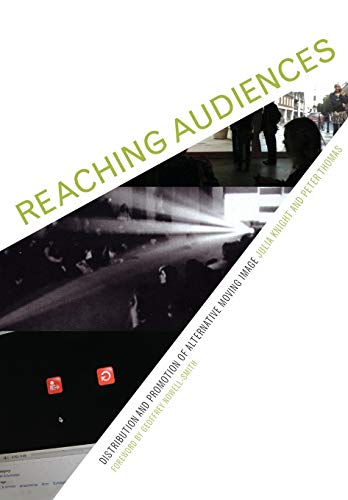
Inhaltsangabe
From Hollywood blockbusters to art films, distributors play an important role in getting films in front of audiences and thus in shaping the nature of film culture. Of central concern to Reaching Audiences are the distribution practices developed to counter Hollywood’s dominance of the marketplace, designed to ensure audiences have access to a more diverse moving image culture. Through a series of case studies, the book tracks the inventive distribution and exhibition initiatives developed over the last forty years by small companies on the periphery of the United Kingdom’s film industry—practices now being replicated by a new generation of digital distributors. Although largely invisible to outsiders, the importance of distribution networks is widely recognized in the industry, and this book is a key contribution to our understanding of the role they play.
Die Inhaltsangabe kann sich auf eine andere Ausgabe dieses Titels beziehen.
Über die Autorin bzw. den Autor
Julia Knight is a reader in media and cultural studies at the University of Sunderland. Peter Thomas is an independent scholar, visiting lecturer at the University of Bedfordshire, and a member of the Exploding Cinema collective.
Auszug. © Genehmigter Nachdruck. Alle Rechte vorbehalten.
Reaching Audiences
Distribution and Promotion of Alternative Moving Image
By Julia Knight, Peter ThomasIntellect Ltd
Copyright © 2011 Intellect Ltd
All rights reserved.
ISBN: 978-1-84150-157-4All rights reserved.
Contents
Acknowledgements,
Foreword by Geoffrey Nowell-Smith,
List of Abbreviations,
Introduction: So Much More than Meets the Eye,
Chapter 1: DIY, Counterculture and State Funding: The London Film-Makers' Co-op,
Chapter 2: Exhibition, Political Agendas and Access to Audiences: The Other Cinema and Cinema of Women,
Chapter 3: Technology, Television and Seeking Wider Audiences: London Video Access/London Electronic Arts and Albany Video Distribution,
Chapter 4: Promotion, Selection and Engaging Audiences: Circles, Film and Video Umbrella, London Video Access and London Film-Makers' Co-op,
Chapter 5: Changing Conditions, Under-Resourcing and Self-Sustainability: Cinenova,
Chapter 6: Questions of Strategy, Policy and Agency: The Lux Saga,
Chapter 7: Understanding Distribution,
Appendix: Research Sources,
Select Bibliography,
Index,
CHAPTER 1
DIY, Counterculture and State Funding: London Film-Makers' Co-op
The London Film-Makers' Co-op, The Other Cinema, London Video Arts, Cinema of Women and Circles were all set up by or with the close involvement of the artists and filmmakers themselves. In each case the enthusiasm, commitment and energy of a small group of individuals was absolutely central to the activity being initiated, and they provided an essential base of volunteer labour that sustained the activity in its formative years. While distribution generated some income, this was deeply variable and most of the organisations remained heavily dependent on volunteer labour to cover the full costs of the distribution operations. However, because it is difficult to grow an area of cultural activity on a voluntary workforce and trade earnings alone, state funding was sought fairly early to support or develop particular aspects of their work - print acquisition, catalogue production, equipment purchase and exhibition. Most groups also later accessed revenue funding to pay for what were then transformed into staff positions. Since it changed their nature and the way they operated, this transition from volunteer-activist origins to grant-aid dependence is a crucial stage in the histories of these organisations. While the specifics vary from organisation to organisation, this chapter uses a case study of the London Film-Maker's Co-op (LFMC), between its founding date of 1966 and the early 1980s, to explore the kinds of changes that occur and their ramifications for a distributor. It is during this period that the LFMC shifted from a wholly independent, volunteer supported organisation to one substantially if not wholly dependent on grant aid for its continued existence. At the same time, a number of funders - including the Arts Council of Great Britain, the British Film Institute and Channel 4 - also made their own interventions directly into the realms of distribution and exhibition, with varying outcomes for the independent distributors. Although further examples will be explored in later chapters, this chapter's focus on the LFMC enables an examination of the impact of the Arts Council's promotional initiatives during the 1970s, alongside the British Film Institute's annual funding of the Co-op from 1975 onwards.
Underground Origins and the Co-operative DIY Ethos
In the 'swinging' London underground of 1966, October was a significant month: on the 11th, an underground newspaper called The International Times (IT) was founded by, amongst others, John 'Hoppy' Hopkins and Jim Haynes. It had an editor but no editorial policy - whatever was sent in was printed. As the paper was not expected to pay for itself, a bootstrapping operation was devised whereby a series of benefit raves supported the paper and publicised its existence, while the paper publicised the raves. At the first of these, the IT launch party held on the 15th at the Roundhouse in North London, a band called Pink Floyd received its first public notice. This is where the London Film-Makers' Co-op (LFMC), officially formed two days earlier, held its first film show.
The LFMC had been set up at Better Books, a bookshop on New Compton Street, where manager and poet Bob Cobbing had already been screening underground films among the performances, readings and other events he regularly staged at the shop. Founding members included Cobbing, Simon Hartog, Ray Durgnat, Steve Dwoskin, Andy Meyer and Harvey Matusow. Although an early draft constitution included 'encouraging the making of independent non-commercial films', and IT announced the Co-op would aid filmmakers 'by making available equipment and technical advice', both Dwoskin and frequent Better Books visitor David Curtis have observed that there were in fact very few British underground filmmakers or films around. While there was a hope to stimulate specifically English production - and over 20 people attended two planning meetings earlier in the year - the impetus for setting up the Co-op came mostly from those interested in seeing, showing and writing about experimental film. Indeed, the initial constitution included distinct membership levels for filmmakers and non-filmmakers. An important third party to the prehistory of the LFMC was The (New York) Film-Makers' Cooperative (FMC). In a letter to FMC filmmakers in May 1966, Jonas Mekas wrote that
we have a huge pile of letters from various corners of Europe asking to send them programmes of Avantgarde (Underground) cinema. We couldn't do anything about it because of the costs & time involved. London is our solution.
He suggested producing $2000 worth of prints to send to London, where FMC filmmaker and provocateur Barbara Rubin was involved with local activists and expatriate Americans (such as Dwoskin, Meyer and Matusow) in setting up a new Co-op. Thus the LFMC could begin life as more of an open access distributor and freewheeling exhibitor, whose primary function was to promote such work and guarantee its availability, prior to the onset of substantial local production.
In the following month, November, the LFMC staged its first major film series, the 'Spontaneous Festival of Underground Film', which received four pages of coverage in IT (written, of course, by LFMC members). The six-day festival screened 'just about every piece of experimental film that was available in London' and was followed by a further six nights of open screenings at Better Books - screenings where anything that turned up on the night was projected. Towards the end of the month, Matusow wrote to Mekas, celebrating their achievements so far:
In the past three weeks we have had an 'opening festival' of films, and have screened over seventy (70) new films. Over half of them had never been seen before here in London. ... Within six to eight weeks we should have our catalogue out. ... We have over one hundred requests for film programs from all over England.
Open and programmed screenings at Better Books filled the rest of the year and, according to Dwoskin, were attended by increasingly large audiences. At Christmas the IT raves shifted to a fixed venue, the UFO Club in nearby Tottenham Court Road. Dwoskin describes the UFO as part of an attempt to turn London into an all-night city like New York, and alongside its lightshows, bands, jugglers, performance artists and food stalls, Curtis regularly provided projections of avant-garde film...
„Über diesen Titel“ kann sich auf eine andere Ausgabe dieses Titels beziehen.
Suchergebnisse für Reaching Audiences: Distribution and Promotion of Alternativ...

Foto des Verkäufers
Reaching Audiences â" Distribution and Promotion of Alternative Moving Image
Verlag:
University of Chicago Press, 2012
ISBN 10: 1841501573
ISBN 13: 9781841501574
Gebraucht
Softcover
Anbieter: WeBuyBooks, Rossendale, LANCS, Vereinigtes Königreich
Verkäuferbewertung 5 von 5 Sternen

Zustand: Like New. Most items will be dispatched the same or the next working day. An apparently unread copy in perfect condition. Dust cover is intact with no nicks or tears. Spine has no signs of creasing. Pages are clean and not marred by notes or folds of any kind. Artikel-Nr. wbs5583303491
Gebraucht kaufen
EUR 18,90
EUR 7,70 Versand
Versand von Vereinigtes Königreich nach USA
Versand von Vereinigtes Königreich nach USA
Anzahl: 1 verfügbar