
Verwandte Artikel zu Back to Black: Retelling Black Radicalism for the 21st...
Back to Black: Retelling Black Radicalism for the 21st Century (Bloomsbury Global Black Studies) - Hardcover
Buch 1 von 6: Blackness in Britain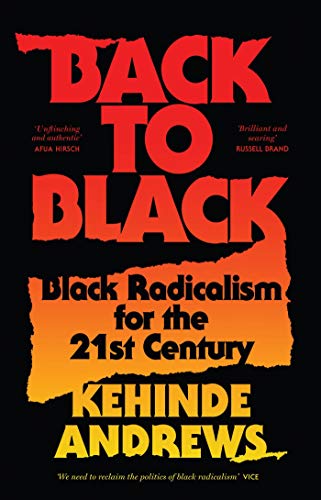
Inhaltsangabe
One of Britain's most highly acclaimed Black educators presents the history of Black radicalism, reclaiming it for the twenty-first century.
Die Inhaltsangabe kann sich auf eine andere Ausgabe dieses Titels beziehen.
Über die Autorin bzw. den Autor
Kehinde Andrews is Professor of Black Studies at Birmingham City University, UK. He is author of Back to Black: Retelling Black Radicalism for the 21st Century (2018), Resisting Racism: Race, Inequality and the Black Supplementary School Movement (2013) and The New Age of Empire (2021).
Auszug. © Genehmigter Nachdruck. Alle Rechte vorbehalten.
Back to Black
Retelling Black Radicalism for the 21st Century
By Kehinde AndrewsZed Books Ltd
Copyright © 2018 Kehinde Andrews
All rights reserved.
ISBN: 978-1-78699-278-9All rights reserved.
Contents
Acknowledgements, ix,
Prologue: Reclaiming Radicalism, xi,
1. Narrow Nationalism, 1,
2. Pan-Africanism, 35,
3. Black is a Country, 67,
4. Cultural Nationalism, 101,
5. Blackness, 139,
6. Black Marxism, 177,
7. Liberal Radicalism, 213,
8. Black Survival, 247,
Epilogue: It's Already Too Late, 279,
Notes, 299,
Index, 327,
CHAPTER 1
Narrow Nationalism
A veteran campaigner against police abuse in Black communities, Stafford Scott was in many ways the ideal person to keynote the first major Black Lives Matter (BLM) conference held in Britain, in October 2015. He battled through the notorious Broadwater Farm rebellion in Tottenham in 1985, which were sparked by the police killing Joy Gardner; and, as he explained in his keynote speech, he has been 'supporting the people who are receiving the hard face of racism' for decades. After a day of listening to speeches in solidarity with the movement that started in America it was jarring to hear some of his scepticism about how BLM had been mobilised in Britain. In comments before the conference he explained that:
When I have to talk to the parents of Jermaine Baker (shot dead by police in December 2015), and Pam Duggan, the mother of Mark Duggan and explain to them why they can't get justice and why our young people are more interested in what is happening in America, than England, it irks me.
These words highlight the dwindling community support that movements for justice for Black people killed by the police in Britain have been receiving. The police in Britain do not routinely carry guns, so in comparison to America there are very few police killings. But the problem with the police is exactly the same and I have never met anyone who doubts that if all police were armed then the streets and social media feeds in Britain would be equally stained with Black blood. But aside from the killing of Mark Duggan, which sparked protests in 2011, there has not been the same reaction as to police brutality in America in recent years.
The Black Lives Matter protest in Birmingham, which I referred to in the introduction, drew thousands people onto the streets in solidarity with America. It was planned on the same day as a march to put pressure on the authorities over the death of a local man, Kingsley Burrell, in custody. But the Kingsley Burrell march drew a fraction of the numbers of the BLM protest, and though the two eventually connected, it was not until a large proportion of the BLM protesters had gone home. It is easy to understand the frustrations of campaigners who have been fighting for justice for families, sometimes for decades, and do not feel the support of the community. Scott is also right when he argues that 'when you cannot get justice for people that look like you in your own country, you ain't got no chance for people that might look like you somewhere else'. In fairness to him, he has also been positive about the numbers on the street and has supported BLM demonstrations. However, the comments raise an important limitation on much of Black political thought in that it gets trapped within the boundaries of the nation state.
Political movements that focus their attention solely on local or national problems, accepting the enforced separation of American, British or other issues, fall outside a radical analysis. The vicious system of racial oppression causes impacts at the ground level that must be addressed. Poverty, unemployment, police brutality, mass incarceration, and the list goes on. But we cannot be so focused on the symptoms of racism that we ignore the systemic problem. The issues that we see on the streets on a daily basis are caused by the same system of racism wherever we are located in the Diaspora. There is no 'British' problem that is not an American, Caribbean or African one. BLM protesters in Britain are not being seduced by the romanticism of America, they are responding to the same racism that impacts their lives here. Perhaps the majority of Black politics have not been driven by this global concern and any discussion of Black radicalism has to begin with a separation of the concept from various Black Nationalist traditions.
Black Nationalism has become wrongly conflated with Black radicalism, and Black Nationalism itself is mostly misunderstood. The collective memory has created a set of 'Black nationalist tropes of violence and ultra-sexuality' to represent the tradition, rather than focusing on the revolutionary and liberatory forms of nationalism. In these tropes Black nationalists are portrayed as 'divisive, fanatical, dangerous, unprincipled, racist, delusional and even mad'; or 'demonized as the civil rights movement's "evil twin" and stereotyped as a politics of rage practiced by gun toting' and 'men'. The tropes are then used to discredit not only Black Nationalism but also the distinct yet conflated forms of Black radicalism.
Complicating the effort to decouple the two concepts is that Black radicals have often embraced the rhetoric of nationalism. Malcolm X declared he was a 'Black nationalist freedom fighter' and the call for Black nationhood is essential to the radical tradition. However, revolutionary forms of nationalism must be distinguished from a variety of narrow calls for nationhood that do not seek to radically transform the system.
The nation within a nation
It is wrong to speak of Black Nationalism as singular political philosophy. The label Black Nationalism has been applied to so many different contexts that Hill Collins argues we should now see it as a 'system of meaning' rather than a cohesive set of ideas. Key to this system of meaning is the belief that the Black community needs to unite and work together in order to move forward. The looseness of this idea has brought something of a banality to the term, where anything remotely pro-Black can be included as nationalist. Justice Clarence Thomas, the right-wing ideologue, has been described as Black Nationalist because he 'suggested that black middle and high schools "can function as the center and symbol of black communities, and provide examples of independent black leadership, success, and achievement"'. In one of the more surreal discussions of Black politics, Michael Jackson's They Don't Care About Us is said to be 'Black nationalist in temperament' because he talks of an 'us'. As testament to the negative view of Black Nationalism, the apparently anti-Semitic use of the word 'kike' in the song is part of this 'temperament'. When Black Nationalism is used to describe figures as diverse and incompatible as Malcolm X, Clarence Thomas and Michael Jackson, there is certainly a need for a much better understanding of the concept.
Part of the reason for the wide application of Black Nationalism is that one of its common forms is what Shelby terms 'weak Black Nationalism: the political program of black solidarity and group self'. The connection here is so weak that 'it could mean working to create a racially integrated society or even a "post racial" polity, a political order where "race" has no social or political meaning'. This form of nationalism has also been described as 'community nationalism' which 'seeks black self-determination within existing social and political arrangements'. These forms of nationalism are distinguished from the 'strong' or...
„Über diesen Titel“ kann sich auf eine andere Ausgabe dieses Titels beziehen.
Suchergebnisse für Back to Black: Retelling Black Radicalism for the 21st...

Beispielbild für diese ISBN
Back to Black: Retelling Black Radicalism for the 21st Century (Blackness in Britain)
Anbieter: WorldofBooks, Goring-By-Sea, WS, Vereinigtes Königreich
Verkäuferbewertung 5 von 5 Sternen

Paperback. Zustand: Very Good. The book has been read, but is in excellent condition. Pages are intact and not marred by notes or highlighting. The spine remains undamaged. Artikel-Nr. GOR009527611
Gebraucht kaufen
EUR 3,85
EUR 6,53 Versand
Versand von Vereinigtes Königreich nach USA
Versand von Vereinigtes Königreich nach USA
Anzahl: 3 verfügbar
Beispielbild für diese ISBN
Back to Black : Retelling Black Radicalism for the 21st Century
Anbieter: Better World Books Ltd, Dunfermline, Vereinigtes Königreich
Verkäuferbewertung 5 von 5 Sternen
Zustand: Very Good. Former library copy. Pages intact with possible writing/highlighting. Binding strong with minor wear. Dust jackets/supplements may not be included. Includes library markings. Stock photo provided. Product includes identifying sticker. Better World Books: Buy Books. Do Good. Artikel-Nr. 45623075-20
Gebraucht kaufen
EUR 6,54
EUR 5,83 Versand
Versand von Vereinigtes Königreich nach USA
Versand von Vereinigtes Königreich nach USA
Anzahl: 2 verfügbar
Beispielbild für diese ISBN
Back to Black : Retelling Black Radicalism for the 21st Century
Anbieter: Better World Books Ltd, Dunfermline, Vereinigtes Königreich
Verkäuferbewertung 5 von 5 Sternen
Zustand: Good. Pages intact with minimal writing/highlighting. The binding may be loose and creased. Dust jackets/supplements are not included. Stock photo provided. Product includes identifying sticker. Better World Books: Buy Books. Do Good. Artikel-Nr. 46969774-75
Gebraucht kaufen
EUR 6,54
EUR 5,83 Versand
Versand von Vereinigtes Königreich nach USA
Versand von Vereinigtes Königreich nach USA
Anzahl: 1 verfügbar
Beispielbild für diese ISBN
Back to Black: Retelling Black Radicalism for the 21st Century (Blackness in Britain)
Anbieter: Sell Books, Elland, YORKS, Vereinigtes Königreich
Verkäuferbewertung 5 von 5 Sternen
hardcover. Zustand: Good. Our good condition books are generally good for reading but not for gifting or collecting. They could have imperfections such as creasing, fanning, inscriptions, margin notes, yellowing, staining on edge or cover or pages, bumps, scuffs, etc etc (sometimes multiple of these). It's a wide category that encompasses anything that isn't almost-new down to anything that is slightly better than poor. We would NOT recommend gifting Good books - these should be considered reading copies. Our books are dispatched from a Yorkshire former cotton mill. We list via barcode/ISBN so please note that the images are stock images and may not be the exact copy you receive, furthermore the details about edition and year might not be accurate as many publishers reuse the same ISBN for multiple editions and as we simply scan a barcode or enter an ISBN we do not check the validity of the edition data when listing. If you're looking for an exact edition please don't order (at least not without checking with us first, although we don't always have time to check). We aim to dispatch prompty, the service used will depend on order value and book size. We can ship to most countries, see our shipping policies. Payment is via Abe only. Artikel-Nr. P-BGD00474-RAG-20241104-VG
Gebraucht kaufen
EUR 3,19
EUR 14,18 Versand
Versand von Vereinigtes Königreich nach USA
Versand von Vereinigtes Königreich nach USA
Anzahl: 1 verfügbar
Beispielbild für diese ISBN
Back to Black: Retelling Black Radicalism for the 21st Century (Blackness in Britain)
Anbieter: Majestic Books, Hounslow, Vereinigtes Königreich
Verkäuferbewertung 4 von 5 Sternen

Zustand: New. Artikel-Nr. 391327915
Neu kaufen
EUR 22,25
EUR 7,58 Versand
Versand von Vereinigtes Königreich nach USA
Versand von Vereinigtes Königreich nach USA
Anzahl: 1 verfügbar
Beispielbild für diese ISBN
BACK TO BLACK : RETELLING BLACK RADICALISM FOR THE 21ST CENTURY
Anbieter: Romtrade Corp., STERLING HEIGHTS, MI, USA
Verkäuferbewertung 5 von 5 Sternen
Zustand: New. This is a Brand-new US Edition. This Item may be shipped from US or any other country as we have multiple locations worldwide. Artikel-Nr. ABBB-181410
Beispielbild für diese ISBN
Back to Black: Retelling Black Radicalism for the 21st Century (Signed First Edition)
Verlag:
Zed Books, London, 2018
ISBN 10: 1786992787
ISBN 13: 9781786992789
Gebraucht
Hardcover
Erstausgabe
Signiert
Anbieter: David's Bookshop, Letchworth BA, Letchworth Garden City, HERTS, Vereinigtes Königreich
Verkäuferbewertung 5 von 5 Sternen
Hardcover. Zustand: Fine. Zustand des Schutzumschlags: Nr Fine. 1st Edition. Signed by Kehinde Andrews on the title page.Very light external shelf-wear to the black dust-jacket, with a Foyles Signed First Edition label on the front. Book itself unmarked, unused, as new. Signed by Author(s). Artikel-Nr. 036695
Gebraucht kaufen
EUR 36,05
EUR 23,33 Versand
Versand von Vereinigtes Königreich nach USA
Versand von Vereinigtes Königreich nach USA
Anzahl: 1 verfügbar