
Verwandte Artikel zu Murder Under the Microscope: Serial Killers, Cold Cases...
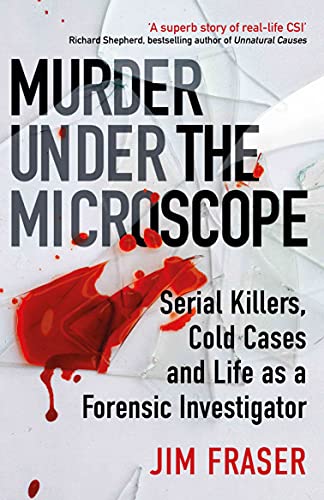
Murder Under the Microscope: Serial Killers, Cold Cases and Life as a Forensic Investigator - Softcover
Inhaltsangabe
'Jim Fraser has been at the forefront of forensic science in the UK for decades... A superb story of real-life CSI.' Dr Richard Shepherd, bestselling author of Unnatural Causes 'Powerful... Fascinating' Independent Most murders are not difficult to solve. People are usually killed by someone they know, there is usually abundant evidence and the police methods used to investigate this type of crime are highly effective. But what about the more difficult cases, where the investigation involves an unusual death, an unusual killer, or is complex or politically charged? In these cases, bringing the accused before the courts can take many years, even then, the outcome may be contentious or unresolved. In this compelling and chilling memoir, Jim Fraser draws on his personal experience as a forensic scientist and cold case reviewer to give a unique insight into some of the most notable cases that he has investigated during his forty-year career, including the deaths of Rachel Nickell, Damilola Taylor and Gareth Williams, the GCHQ code breaker. Inviting the reader into the forensic scientist's micro-world, Murder Under the Microscope reveals not only how each of these cases unfolded as a human, investigative and scientific puzzle, but also why some were solved and why others remain unsolved or controversial even to this day.
Die Inhaltsangabe kann sich auf eine andere Ausgabe dieses Titels beziehen.
Über die Autorin bzw. den Autor
Jim Fraser is a Research Professor in Forensic Science at the University of Strathclyde and a Commissioner of the Scottish Criminal Cases Review Commission. He has over forty years' experience in forensic science and has worked on many high-profile cases as an expert witness and case reviewer. He has advised many public agencies including police organisations in the UK and abroad, the Home Office, the Scottish Parliament and the UK Parliament.
Auszug. © Genehmigter Nachdruck. Alle Rechte vorbehalten.
Preface
‘Working on an interesting case?’ I asked my colleague sitting
opposite me.
She looked up from her microscope. ‘Not really,’ she replied.
‘There’s blood on the knife matching the victim and cuts in
the victim’s shirt that the knife could have made. The suspect
denies it but his fingerprints are on the knife. It’s the usual
murder stuff.’ She smiled and went back to what she was doing.
I have worked as a forensic scientist for over forty years,
during which I have dealt with some of the most terrible
murders. The murder detection rate in the UK is about 85 per
cent and most murders are not difficult to solve. There are
three reasons for this. First, most people are killed by someone
they know; the killer will be found within a small group of
family, friends and acquaintances. Second, the crime is the
end point of an escalating series of events that usually leaves
behind abundant evidence. Finally, the police methods used
to investigate this type of murder are highly effective.
Most of the murders I have worked on were pushed from
memory to be replaced by others in my busy operational role.
I gave evidence in only a small proportion of cases and it was
rare for me to get to know the outcome of any trial. Apart from
my memories, my only record of these cases, if I have one, is a
line in a notebook or diary recording the date I attended the
crime scene or court. My involvement was, in the end, relatively
superficial, as was my knowledge of the case. The public
profile of these cases also diminished, leaving the individuals
directly involved to deal with their impact and loss. The cases
in this book are different, for many reasons; they involve serial
killers (very rare), child victims, miscarriages of justice, poor
investigations or police misconduct, or they remain unresolved
or contentious. All have attracted a great deal of attention from
the media. My level of involvement was also very different. I
was much more closely engaged, sometimes over a very long
period, and I had extensive and detailed information about the
investigation. I knew these cases intimately and had some sense
of their often tangled trajectories.
A common theme in all of these inquiries is that they are
multi-layered; small stories are enclosed in bigger stories that in
turn are enclosed in yet bigger stories, like a set of Matryoshka
dolls. In this book, I deal with three layers. The outermost layer
could be called ‘societal’. These are the biggest stories; public
stories of expectations and beliefs, right and wrong, good and
evil, justice and injustice. I do not spend much time on this
layer, but all of the cases have some element of it.
The middle layer is what we might call ‘institutional’;
the systems that deal with murder investigation – for our
purposes primarily the criminal justice system (CJS).* The CJS
* There are many important elements to the criminal justice system –
social work, prisons, parole boards – but I confine myself to those I have
had some involvement with; primarily the police and the courts.
generally presents us with an image of procedural rectitude,
but these cases reveal a different reality under this polished
veneer. Although the CJS produces a binary output of guilt
or innocence,* this does not come from a mechanical or
algorithmic calculus, but from something more organic and
gelatinous. Component parts collide and merge in a loosely
linked, constantly moving network, like distributed ganglia in
some vast primitive organism. The CJS is all periphery and no
centre, a system that is not a system,1 a system that no single
individual fully understands. Organisations cooperate or
clash, muddle along or fail. My viewpoint of the CJS is narrow,
framed by science and technology, a peripheral domain that
is sometimes valorised, sometimes condemned. Science and
technology in this context does not stand alone; it relies on
human action, knowledge, imagination and fairness. It can
also be attenuated by human inaction, ignorance, failure
or prejudice.
The innermost layer of this book is the individual perspective;
my individual perspective from my direct involvement in
these cases. I have spent much of my working life looking
down microscopes: low-power microscopes, high-power
microscopes, polarising microscopes, comparison microscopes
and microscopes connected to other scientific instruments
that analyse colour or chemical structure. Looking at everyday
things under a low-power microscope reveals an extraordinary
micro-world. The surface of clothing yields an exotic array
of particles: fibers from the clothing itself and the items it
* Strictly speaking, not guilty. And of course in Scotland there is the
unique verdict of not proven.
has been in contact with, such as other clothing, furniture,
bedding; hairs from you, your family and acquaintances; fibers
and hairs from seats in your car; hairs from animals; minute
quantities of skin or dust; sparkling fragments of minerals and
crystals from domestic products, such as sugar or salt; glass
fragments, particles of foodstuffs, plants and insects.
But low magnification only takes you so far. Like scanning
the horizon with binoculars, it shows the trees and other
features but does not identify them individually. Increase
magnification a level and some of the debris can be more
clearly seen. It becomes possible to distinguish different types
of fibers and hairs, although it is hard to keep things in focus;
they tremble and disappear when you try to pick them up
with forceps. They are also more difficult to find. It’s rather
like trying to locate a star in the night sky with binoculars. At
higher magnifications, the Petri dish containing the debris
takes on the proportions of an airport long-stay car park, with
vast areas to search. Sometimes you look straight at the thing
you are hunting for but don’t realise it because it completely
fills the field in front of your eyes, like a giant cinema screen.
You can’t see the trees for the wood. In this world of higher
magnification, it is easy to get lost. And if you don’t know what
you are looking for, you can’t operate. You can’t search for
fibers when you don’t know what colour they are.
The cases in this book are under the microscope. For most
murders, those that are quickly resolved, low magnification
suffices. But when the police investigate the more difficult
homicides or unexplained deaths, they enter the equivalent of
the forensic scientist’s micro-world. The more closely they look,
the more they find, and the more detail they see. It becomes
harder to stay focused and what they discover becomes more
complicated and contradictory. Sometimes they don’t know
what they are looking for; but not looking is not an option.
These cases can become so saturated with information, so
fogged with detail that sometimes no sense can be made of
them. There is so much inchoate data that logic and reason
are overwhelmed.
These are cases that have puzzled me for many years, and I
have written about them in an effort to understand them and see
what they tell us about the business of homicide investigation.
The book moves constantly between the institutional and
individual perspectives. We shift from one lens to a second and
occasionally a third. Having worked on these cases, I thought
I knew their stories. I was wrong
„Über diesen Titel“ kann sich auf eine andere Ausgabe dieses Titels beziehen.
Suchergebnisse für Murder Under the Microscope: Serial Killers, Cold Cases...

Foto des Verkäufers
Murder Under the Microscope: Serial Killers, Cold Cases and Life as a Forensic Investigator
Anbieter: WeBuyBooks, Rossendale, LANCS, Vereinigtes Königreich
Verkäuferbewertung 5 von 5 Sternen

paperback. Zustand: Good. Most items will be dispatched the same or the next working day. A copy that has been read but remains in clean condition. All of the pages are intact and the cover is intact and the spine may show signs of wear. The book may have minor markings which are not specifically mentioned. Artikel-Nr. rev6972650486
Gebraucht kaufen
EUR 1,32
EUR 6,54 Versand
Versand von Vereinigtes Königreich nach USA
Versand von Vereinigtes Königreich nach USA
Anzahl: 1 verfügbar
Beispielbild für diese ISBN
Murder Under the Microscope: Serial Killers, Cold Cases and Life as a Forensic Investigator
Anbieter: AwesomeBooks, Wallingford, Vereinigtes Königreich
Verkäuferbewertung 5 von 5 Sternen
paperback. Zustand: Very Good. Murder Under the Microscope: Serial Killers, Cold Cases and Life as a Forensic Investigator This book is in very good condition and will be shipped within 24 hours of ordering. The cover may have some limited signs of wear but the pages are clean, intact and the spine remains undamaged. This book has clearly been well maintained and looked after thus far. Money back guarantee if you are not satisfied. See all our books here, order more than 1 book and get discounted shipping. Artikel-Nr. 7719-9781786495952
Gebraucht kaufen
EUR 3,50
EUR 4,80 Versand
Versand von Vereinigtes Königreich nach USA
Versand von Vereinigtes Königreich nach USA
Anzahl: 2 verfügbar
Beispielbild für diese ISBN
Murder Under the Microscope: Serial Killers, Cold Cases and Life as a Forensic Investigator
Anbieter: WorldofBooks, Goring-By-Sea, WS, Vereinigtes Königreich
Verkäuferbewertung 5 von 5 Sternen
Paperback. Zustand: Good. The book has been read but remains in clean condition. All pages are intact and the cover is intact. Some minor wear to the spine. Artikel-Nr. GOR013406808
Gebraucht kaufen
EUR 3,08
EUR 6,53 Versand
Versand von Vereinigtes Königreich nach USA
Versand von Vereinigtes Königreich nach USA
Anzahl: 1 verfügbar
Beispielbild für diese ISBN
Murder Under the Microscope: Serial Killers, Cold Cases and Life as a Forensic Investigator
Anbieter: WorldofBooks, Goring-By-Sea, WS, Vereinigtes Königreich
Verkäuferbewertung 5 von 5 Sternen
Paperback. Zustand: Fine. Artikel-Nr. GOR011943414
Gebraucht kaufen
EUR 3,08
EUR 6,53 Versand
Versand von Vereinigtes Königreich nach USA
Versand von Vereinigtes Königreich nach USA
Anzahl: 2 verfügbar
Beispielbild für diese ISBN
Murder Under the Microscope: Serial Killers, Cold Cases and Life as a Forensic Investigator
Verlag:
Atlantic Books, United Kingdom, London, 2021
ISBN 10: 1786495953
ISBN 13: 9781786495952
Gebraucht
Paperback
Anbieter: WorldofBooks, Goring-By-Sea, WS, Vereinigtes Königreich
Verkäuferbewertung 5 von 5 Sternen
Paperback. Zustand: Very Good. 'Jim Fraser has been at the forefront of forensic science in the UK for decades. A superb story of real-life CSI.' Dr Richard Shepherd, bestselling author of Unnatural Causes'Powerful. Fascinating' Independent Most murders are not difficult to solve. People are usually killed by someone they know, there is usually abundant evidence and the police methods used to investigate this type of crime are highly effective. But what about the more difficult cases, where the investigation involves an unusual death, an unusual killer, or is complex or politically charged? In these cases, bringing the accused before the courts can take many years, even then, the outcome may be contentious or unresolved. In this compelling and chilling memoir, Jim Fraser draws on his personal experience as a forensic scientist and cold case reviewer to give a unique insight into some of the most notable cases that he has investigated during his forty-year career, including the deaths of Rachel Nickell, Damilola Taylor and Gareth Williams, the GCHQ code breaker.Inviting the reader into the forensic scientist's micro-world, Murder Under the Microscope reveals not only how each of these cases unfolded as a human, investigative and scientific puzzle, but also why some were solved and why others remain unsolved or controversial even to this day. The book has been read, but is in excellent condition. Pages are intact and not marred by notes or highlighting. The spine remains undamaged. Artikel-Nr. GOR011714286
Gebraucht kaufen
EUR 3,08
EUR 6,53 Versand
Versand von Vereinigtes Königreich nach USA
Versand von Vereinigtes Königreich nach USA
Anzahl: 10 verfügbar
Beispielbild für diese ISBN
Murder under the Microscope : A Personal History of Homicide
Verlag:
Atlantic Books, Limited, 2021
ISBN 10: 1786495953
ISBN 13: 9781786495952
Gebraucht
Softcover
Anbieter: Better World Books Ltd, Dunfermline, Vereinigtes Königreich
Verkäuferbewertung 5 von 5 Sternen
Zustand: Very Good. Former library copy. Pages intact with possible writing/highlighting. Binding strong with minor wear. Dust jackets/supplements may not be included. Includes library markings. Stock photo provided. Product includes identifying sticker. Better World Books: Buy Books. Do Good. Artikel-Nr. 42404510-20
Gebraucht kaufen
EUR 5,67
EUR 5,83 Versand
Versand von Vereinigtes Königreich nach USA
Versand von Vereinigtes Königreich nach USA
Anzahl: 2 verfügbar
Beispielbild für diese ISBN
Murder Under the Microscope: Serial Killers, Cold Cases and Life as a Forensic Investigator
Anbieter: Bahamut Media, Reading, Vereinigtes Königreich
Verkäuferbewertung 4 von 5 Sternen

paperback. Zustand: Very Good. This book is in very good condition and will be shipped within 24 hours of ordering. The cover may have some limited signs of wear but the pages are clean, intact and the spine remains undamaged. This book has clearly been well maintained and looked after thus far. Money back guarantee if you are not satisfied. See all our books here, order more than 1 book and get discounted shipping. Artikel-Nr. 6545-9781786495952
Gebraucht kaufen
EUR 3,86
EUR 8,14 Versand
Versand von Vereinigtes Königreich nach USA
Versand von Vereinigtes Königreich nach USA
Anzahl: 2 verfügbar
Beispielbild für diese ISBN
Murder Under the Microscope
Anbieter: PBShop.store UK, Fairford, GLOS, Vereinigtes Königreich
Verkäuferbewertung 5 von 5 Sternen
PAP. Zustand: New. New Book. Shipped from UK. Established seller since 2000. Artikel-Nr. FV-9781786495952
Neu kaufen
EUR 15,23
EUR 4,85 Versand
Versand von Vereinigtes Königreich nach USA
Versand von Vereinigtes Königreich nach USA
Anzahl: 15 verfügbar
Beispielbild für diese ISBN
Murder Under the Microscope: A Personal History of Homicide Paperback ? November 1, 2021
Anbieter: Majestic Books, Hounslow, Vereinigtes Königreich
Verkäuferbewertung 4 von 5 Sternen
Zustand: New. Artikel-Nr. 379207346
Neu kaufen
EUR 18,10
EUR 7,58 Versand
Versand von Vereinigtes Königreich nach USA
Versand von Vereinigtes Königreich nach USA
Anzahl: 3 verfügbar
Beispielbild für diese ISBN
Murder Under the Microscope: Serial Killers, Cold Cases and Life as a Forensic Investigator
Anbieter: Revaluation Books, Exeter, Vereinigtes Königreich
Verkäuferbewertung 5 von 5 Sternen
Paperback. Zustand: Brand New. 352 pages. 7.75x5.00x1.20 inches. In Stock. Artikel-Nr. __1786495953
Neu kaufen
EUR 14,91
EUR 11,66 Versand
Versand von Vereinigtes Königreich nach USA
Versand von Vereinigtes Königreich nach USA
Anzahl: 2 verfügbar