
Verwandte Artikel zu How the Establishment Lost Control
Inhaltsangabe
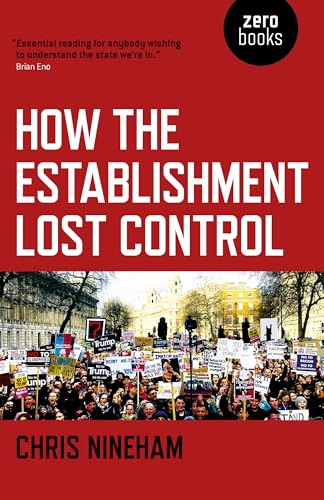
The post-war consensus is breaking up. The 2014 Scottish referendum, the election of Jeremy Corbyn as Labour leader and the turmoil of the EU referendum all testify to an insurgent mood amongst swathes of the population. This book will attempt to explain these dramatic developments and to show how they question received notions about politics, history and how change happens. Above all they challenge widespread assumptions about the resilience of elite hegemony, the influence of conventional structures of thought and the ability of the mass of the population to think autonomously in a ‘post-ideological age'.
Die Inhaltsangabe kann sich auf eine andere Ausgabe dieses Titels beziehen.
Über die Autorin bzw. den Autor
Chris Nineham is a socialist activist and writer based in the UK. He is one of the founder members of the Stop the War Coalition and is currently its vice chair, and has been involved in many of the campaigns discussed in his most recent book, How the Establishment Lost Control. He is author of The People versus Tony Blair and Capitalism and Class Consciousness: the ideas of Georg Lukacs. Nineham writes regularly for Stop the War and Counterfire.
Auszug. © Genehmigter Nachdruck. Alle Rechte vorbehalten.
How the Establishment Lost Control
The Left and the Return of Mass Politics
By Chris NinehamJohn Hunt Publishing Ltd.
Copyright © 2017 Chris Nineham
All rights reserved.
ISBN: 978-1-78535-631-5All rights reserved.
Contents
Acknowledgements, viii,
Introduction: Surprise, Surprise, 1,
1. We Never Bought the Dream, 12,
2. The Second Death of Liberal England, 25,
3. The Sound of Cracking, 44,
4. The Poverty of Propaganda, 60,
5. Where Are the Workers?, 74,
6. Socialists and System Failure, 88,
Endnotes, 101,
CHAPTER 1
We Never Bought the Dream
The working class is instinctively, spontaneously social democratic.
Vladimir Lenin
At the end of the 1980s events had come together to create a moment of triumphalism for the Western ruling classes. During the decade, in the USA, Britain and elsewhere, governments and employers had won a series of decisive battles against organised workers. Humiliation in these high profile conflicts sapped workers' enthusiasm for resistance and cleared the way for the dismantling of large parts of the welfare state. Private capital bought out nationalised industries at knockdown rates. Union busting, privatisation and restructuring ripped through society, restoring profit rates, if not productivity. Internationally, a debt crisis had landed a tranche of developing world economies in the laps of the Western banks. At the end of the decade economic failure and discontent led to the collapse of the Eastern European satellites of the USSR. The meltdown of the Soviet Union's state-run economy was clearly imminent.
It was possible to announce a historic victory for the forces of the free market – and the Western democratic model that was apparently its purest political incarnation. When, in a 1989 essay, American political scientist Francis Fukuyama announced the 'end of history', he wasn't saying that nothing more would happen in the world. He was claiming liberal democracy as the 'final form of human government'. 'At the end of history,' he wrote, 'it is not necessary that all societies become successful liberal societies, merely that they end their ideological pretensions of representing different and higher forms of human society'.
This triumphalism had a profound effect on intellectual life. The victory of an economic paradigm was judged to have buried alternatives and ushered in a world beyond ideology in which reason and the free market had synchronised. American commentator and historian Thomas Frank noted that, for some, the free market came to define what it meant to be human:
Only when people act within the marketplace, such thinkers told us, do they act rationally, chose rightly and make their own wishes known transparently. Only then could business give us what we wanted, cater to our freely expressed choices. Markets are where we are most fully human; markets are where we show that we have a soul. To protest against markets is to surrender one's very personhood, to put oneself outside the family of mankind.
Outriding
Britain was an early adopter. Margaret Thatcher, prime minister from 1979 to 1991, was one of the great champions of the free market economics that became known as neoliberalism. At its heart initially was a tight monetary policy to counter rising inflation, antipathy to the 'nanny state' and a deep hostility to working-class organisation. But it evolved into an assault on all the ways that the state had accommodated the demands of working people since World War Two and on the manufacturing base of British capitalism. Rhetorically, Thatcher went one better than Fukuyama, claiming in an interview with Woman's Own two years before the latter's end of history moment that 'there is no such thing as society', just 'individual men and women and their families'. The aim clearly was to discredit collective organisation and ideas, but the guiding thought was that they had been made redundant in a post-ideological world. The impersonal mechanisms of the market were delivering an ideal end-state for human civilisation.
Faced with retreat and rollback on what felt like every front, some of the left internalised this onslaught. In particular, a group of influential intellectuals around the journal Marxism Today popularised the idea of 'new times'. They gave ground to the free market lobby by arguing that capitalism had indeed entered a new phase in which consumerism dominated so effectively it was dissolving class identities. The right had seen the future and run with it, the left had to adapt or die. In the words of one such essay from 1988:
For more and more people it is outside work, outside the formal political structures, in the world of holidays, home interiors and superstores, that they have a sense of power and freedom to express themselves, to define their sense of self, to mould the good life. Thatcherism has not created that scenario, but the current present political culture has certainly capitalised on it. On the current climate the invitation is to 'buy out of politics', to see it only as to do with restrictive bureaucracy and petty nuisance. Life it seems, lies elsewhere.
In the memorable words of the most notable proponent of 'new times', Stuart Hall, 'capital' was marching 'simultaneously across the globe and through the Maginot Lines of our subjectivities'. The sense that the logic of commodity had invaded every aspect of our lives, influencing our behaviour and colonising the way we think and feel, remains influential on the left 30 years later. In his 2010 account of the neoliberals' coming to power, Jamie Peck's starting point is that:
The conventional wisdom can seem ubiquitous, inevitable, natural, and all-encompassing. To many, neoliberalism has become practically indistinguishable from the alleged "logic" of globalization – it seems to be everywhere, and it seems to be all that there is.
The tale of how ideological 'outriders' successfully promoted the neoliberal creed in the corridors of power has been well told recently. Conversion wasn't automatic even amongst the elites; as late as the mid-1980s Margaret Thatcher was still fighting a war against 'the wets', so-called 'One Nation' Tories concerned about the political and social costs of the new model. But the story of neoliberalism's roll-out in wider society is much more about imposition and confrontation than persuasion or incorporation. This story, combined with evidence about popular attitudes at the time, casts doubt on the idea of neoliberal capitalism's total ideological victory. It suggests that the paradigm, in fact, prevailed through a combination of a state strategy of class struggle, some good fortune for Thatcher and her supporters and shortcomings on the part of the opposition.
Labour and the damage done
The British ruling class adopted the new economics piecemeal and pragmatically as a result of the failure of the existing model. A broad social radicalisation at the end of World War Two had eventually forced a cross-party consensus that a mixed economy combining elements of state and private ownership was necessary for economic development. As Britain moved into the long boom, it was possible to meet some working-class aspirations through public spending on housing, health and welfare. But growth rates started to decline at the end of the 1960s, and slumped in the 1970s. For a time, governments met workers' continuing demands by printing additional money, not yet covered by the real economy. They ran into problems in the early...
„Über diesen Titel“ kann sich auf eine andere Ausgabe dieses Titels beziehen.
Suchergebnisse für How the Establishment Lost Control

Beispielbild für diese ISBN
How the Establishment Lost Control
Anbieter: AwesomeBooks, Wallingford, Vereinigtes Königreich
Verkäuferbewertung 5 von 5 Sternen

Paperback. Zustand: Very Good. How the Establishment Lost Control This book is in very good condition and will be shipped within 24 hours of ordering. The cover may have some limited signs of wear but the pages are clean, intact and the spine remains undamaged. This book has clearly been well maintained and looked after thus far. Money back guarantee if you are not satisfied. See all our books here, order more than 1 book and get discounted shipping. Artikel-Nr. 7719-9781785356315
Gebraucht kaufen
EUR 4,13
EUR 4,88 Versand
Versand von Vereinigtes Königreich nach USA
Versand von Vereinigtes Königreich nach USA
Anzahl: 2 verfügbar
Beispielbild für diese ISBN
How the Establishment Lost Control
Anbieter: WorldofBooks, Goring-By-Sea, WS, Vereinigtes Königreich
Verkäuferbewertung 5 von 5 Sternen
Paperback. Zustand: Very Good. The book has been read, but is in excellent condition. Pages are intact and not marred by notes or highlighting. The spine remains undamaged. Artikel-Nr. GOR009614611
Gebraucht kaufen
EUR 2,56
EUR 6,63 Versand
Versand von Vereinigtes Königreich nach USA
Versand von Vereinigtes Königreich nach USA
Anzahl: 1 verfügbar
Beispielbild für diese ISBN
How the Establishment Lost Control
Anbieter: WorldofBooks, Goring-By-Sea, WS, Vereinigtes Königreich
Verkäuferbewertung 5 von 5 Sternen
Paperback. Zustand: Fine. Artikel-Nr. GOR009088729
Gebraucht kaufen
EUR 2,56
EUR 6,63 Versand
Versand von Vereinigtes Königreich nach USA
Versand von Vereinigtes Königreich nach USA
Anzahl: 1 verfügbar
Beispielbild für diese ISBN
How the Establishment Lost Control
Anbieter: Bahamut Media, Reading, Vereinigtes Königreich
Verkäuferbewertung 4 von 5 Sternen

Paperback. Zustand: Very Good. This book is in very good condition and will be shipped within 24 hours of ordering. The cover may have some limited signs of wear but the pages are clean, intact and the spine remains undamaged. This book has clearly been well maintained and looked after thus far. Money back guarantee if you are not satisfied. See all our books here, order more than 1 book and get discounted shipping. Artikel-Nr. 6545-9781785356315
Gebraucht kaufen
EUR 6,32
EUR 8,26 Versand
Versand von Vereinigtes Königreich nach USA
Versand von Vereinigtes Königreich nach USA
Anzahl: 2 verfügbar
Beispielbild für diese ISBN
How the Establishment Lost Control
Anbieter: PBShop.store US, Wood Dale, IL, USA
Verkäuferbewertung 5 von 5 Sternen
PAP. Zustand: New. New Book. Shipped from UK. Established seller since 2000. Artikel-Nr. FW-9781785356315
Beispielbild für diese ISBN
How the Establishment Lost Control
Anbieter: PBShop.store UK, Fairford, GLOS, Vereinigtes Königreich
Verkäuferbewertung 5 von 5 Sternen
PAP. Zustand: New. New Book. Shipped from UK. Established seller since 2000. Artikel-Nr. FW-9781785356315
Neu kaufen
EUR 15,13
EUR 3,89 Versand
Versand von Vereinigtes Königreich nach USA
Versand von Vereinigtes Königreich nach USA
Anzahl: 15 verfügbar
Beispielbild für diese ISBN
How the Establishment Lost Control
Anbieter: Revaluation Books, Exeter, Vereinigtes Königreich
Verkäuferbewertung 5 von 5 Sternen
Paperback. Zustand: Brand New. 115 pages. 8.25x5.50x0.50 inches. In Stock. Artikel-Nr. __1785356313
Neu kaufen
EUR 11,20
EUR 11,84 Versand
Versand von Vereinigtes Königreich nach USA
Versand von Vereinigtes Königreich nach USA
Anzahl: 2 verfügbar
Beispielbild für diese ISBN
How the Establishment Lost Control
Anbieter: Ria Christie Collections, Uxbridge, Vereinigtes Königreich
Verkäuferbewertung 5 von 5 Sternen
Zustand: New. In English. Artikel-Nr. ria9781785356315_new
Neu kaufen
EUR 15,54
EUR 11,09 Versand
Versand von Vereinigtes Königreich nach USA
Versand von Vereinigtes Königreich nach USA
Anzahl: Mehr als 20 verfügbar
Beispielbild für diese ISBN
How the Establishment Lost Control
Anbieter: Kennys Bookstore, Olney, MD, USA
Verkäuferbewertung 5 von 5 Sternen
Zustand: New. 2017. Paperback. . . . . . Books ship from the US and Ireland. Artikel-Nr. V9781785356315
Neu kaufen
EUR 19,70
EUR 9,41 Versand
Versand innerhalb von USA
Versand innerhalb von USA
Anzahl: Mehr als 20 verfügbar