
Verwandte Artikel zu The Master Communicator's Handbook
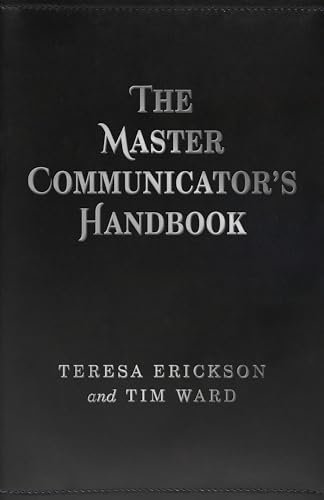
Inhaltsangabe
Clarity, Leadership, Impact. To have an impact, you need to communicate. This book is for people who want to change the world.
Die Inhaltsangabe kann sich auf eine andere Ausgabe dieses Titels beziehen.
Über die Autorin bzw. den Autor
Teresa Erickson is president and co-owner of Intermedia Communications Training, Inc. For the past twenty years, Teresa has designed and led communications workshops around the world. Born in Portugal, Teresa worked with the Voice of America for 17 years as a producer, editor, and host of VOA's flagship public affairs program, broadcast worldwide to 90 million listeners a week.
Tim Ward is the author of seven books, including the best-selling What the Buddha Never Taught and Savage Breast: One Man's Search for the Goddess. His travel stories have appeared in 13 anthologies, including Traveler's Tales Best Travel Writing 2006, 2010, 2011 and 2012. Tim is also the publisher of Changemakers Books (an imprint of John Hunt Publishing). He also co-owns Intermedia Communications Training with Teresa Erickson, his wife and business partner. They live in Bethesda, Maryland.
Auszug. © Genehmigter Nachdruck. Alle Rechte vorbehalten.
The Master Communicator's Handbook
By Teresa Erickson, Tim WardJohn Hunt Publishing Ltd.
Copyright © 2014 Teresa Erickson and Tim Ward
All rights reserved.
ISBN: 978-1-78535-153-2All rights reserved.
Contents
Introduction: Clarity, Leadership, Impact,
Part I: Communicating Ideas,
Chapter 1: Spreading Ideas: Memes and Messages,
Chapter 2: Crafting Strong Messages,
Chapter 3: Structure,
Part II: Communicating with Authority,
Chapter 4: Authoritative Body Language,
Chapter 5: Enhancing Your Voice,
Chapter 6: Choosing Powerful Words,
Part III: Answering Questions,
Chapter 7: Answering Questions Effectively,
Chapter 8: Dealing with Difficult Questions,
Part IV: Creating Connection,
Chapter 9: Micro-messages,
Chapter 10: Creating Rapport,
Part V: Changing Minds,
Chapter 11: The Visual Channel,
Chapter 12: Framing,
Chapter 13: Reframing,
Part VI: Leadership Communications,
Chapter 14: Cueing,
Chapter 15: Vision,
Chapter 16: Motivation: The DUH Triangle,
Chapter 17: Transformational Storytelling,
Chapter 18: Alignment: Expanding Your Influence,
References,
About the Authors,
CHAPTER 1
Spreading Ideas: Memes and Messages
In our 30 years as professional communicators, one of the most fascinating and useful concepts we have come across is the meme. A meme is a special kind of idea. It's an idea that spreads. Strictly defined, a meme is a "unit of culture transmitted from mind to mind." Some compare a meme to a "mind virus," which spreads like an infection, the virus replicating itself inside each new host. In the same way, powerful ideas can replicate and spread.
The word meme was coined by philosopher of science Richard Dawkins. In his 1976 book The Selfish Gene he mused about how ideas influence human evolution. Our genes pass on genetic information encoded chemically in our DNA molecules. Through survival of the fittest, the winning genes get passed on to the next generation, driving our physical evolution. Dawkins realized that ideas – memes – function in a similar manner. Our ideas pass on mental information ("units of culture") encoded electrically in our brains' neural networks. Through "survival of the fittest," the winning ideas get passed from mind to mind, driving our cultural evolution. Astonishingly, Dawkins had apparently discovered a second mechanism of human evolution. The difference between genes and memes is that innovative ideas spread much more quickly – at light speed compared to genetic evolution. Our genes could not possibly have evolved fast enough for humanity to make the jump from living in small nomadic bands to dwelling in thriving cities of many millions in just a few thousand years. In short, our memes have enabled us to dominate life on the planet.
Think of a meme as like the flame of a candle. Imagine a ceremony in a great hall in which each person holds an unlit candle. At the front, a match lights a single wick. That first flame gets passed back through the crowd, spreading from candle to candle, so that in just a few minutes, a thousand tiny flames illuminate the entire hall. That's how ideas spread.
What kinds of "unit of culture" are spread this way? It can be something as small and simple as an emoticon -:) – that ubiquitous little sideways smiley face that most of us started tagging on at the end of emails and texts. Or it can be a concept as profound as Climate Change, an idea that causes us to rethink the foundations of our global economy. The range of things that can be considered memes – units of culture that spread – is wide. It includes fashion fads, gossip, new technologies (such as smartphones and solar panels), scientific discoveries, political movements like the "Arab Spring." A song that gets stuck in your head is a meme. The music video of Gangnam Style has passed two billion hits on youtube.com as we write this chapter. Imagine if the message you want to communicate could reach such a huge global audience!
What's the difference between a meme and a message? A message is a political, commercial, social or moral idea that is being communicated. The root comes from the Latin missus, "to send." The emphasis is on the sender. You might be very inarticulate, but as long as you are expressing your idea, it can be considered a message. One might say, "He failed to communicate his message to anyone." With a meme, the emphasis is on the receiver. If there is no receiver, there is no meme.
Replicability is the mark of a meme, and this is crucial when it comes to effective communication. Usually when we communicate we think only about our immediate audience. Do they get the message? That's not enough. If your audience gets the message, but not well enough that they can articulate it clearly to others, the idea stops there. If you are seeking to create change – to build an organization, gather support for an issue, develop a new technology or enact any form of meaningful transformation – your ideas must spread from mind to mind to mind.
The evolutionary understanding of memes helps us better understand what really happens on a biological level when we communicate. The West's great thinkers – Plato, Thomas Aquinas, Descartes – all shared a faulty belief that the mind was some ineffable entity that existed in a separate realm that somehow connected to a physical body. We communicated mind to mind with ideas that existed eternally in an "ideal realm."
Instead, envision the mind as being part and parcel of a physical brain, an interrelated system in which the thoughts of the mind correlate with the electrical patterns produced by the cells of that brain. If we see human communication as taking place from brain to brain, the process of communication starts to seem quite difficult. How does the electrical storm in my head jump across space and share a new meme with the electrical storm in your head? While this theoretical question is currently the subject of much interesting neuroscience and psychological research, in practical terms we can derive three insights into what it takes to communicate an idea from one brain to another:
1. Attention
First, get your listener's attention. Now this might sound obvious, yet most of the time when we speak, we are not thinking about whether our listener is really paying attention. Without attention, the neural networks in your listener's brain won't respond to your words. It's like speaking into the phone before the other person has picked up the call. Our first principle is: No attention, no retention.
2. Fit-ness
A new meme must fit into the current set of memes in a listener's brain. On a cellular level, an idea is a collection of nerve cells firing in a specific pattern. A new idea creates a new pattern. The new pattern has a better chance of integrating into the person's mind if it meshes well with the existing patterns. It's like clicking a jigsaw puzzle piece into place. The edges of the new piece have to mesh around the edges of existing pieces or it won't fit – and it won't stick. This means if you are going to convey a new idea, you have to know the existing mental landscape of your listener and put your idea in terms that they can most easily assimilate.
The simplest example of this is what happens when someone speaks to you in an unfamiliar language. It's just babble in your ear. But all too...
„Über diesen Titel“ kann sich auf eine andere Ausgabe dieses Titels beziehen.
Suchergebnisse für The Master Communicator's Handbook

Beispielbild für diese ISBN
The Master Communicator's Handbook
Anbieter: ThriftBooks-Dallas, Dallas, TX, USA
Verkäuferbewertung 5 von 5 Sternen

Paperback. Zustand: Very Good. No Jacket. May have limited writing in cover pages. Pages are unmarked. ~ ThriftBooks: Read More, Spend Less. Artikel-Nr. G1785351532I4N00
Gebraucht kaufen
EUR 5,96
Versand gratis
Versand innerhalb von USA
Versand innerhalb von USA
Anzahl: 1 verfügbar
Beispielbild für diese ISBN
The Master Communicator's Handbook
Verlag:
Hunt Publishing Limited, John, 2015
ISBN 10: 1785351532
ISBN 13: 9781785351532
Gebraucht
Softcover
Anbieter: Better World Books, Mishawaka, IN, USA
Verkäuferbewertung 5 von 5 Sternen
Zustand: Very Good. Pages intact with possible writing/highlighting. Binding strong with minor wear. Dust jackets/supplements may not be included. Stock photo provided. Product includes identifying sticker. Better World Books: Buy Books. Do Good. Artikel-Nr. 52436014-6
Gebraucht kaufen
EUR 6,57
Versand gratis
Versand innerhalb von USA
Versand innerhalb von USA
Anzahl: 1 verfügbar
Beispielbild für diese ISBN
The Master Communicator's Handbook
Verlag:
Hunt Publishing Limited, John, 2015
ISBN 10: 1785351532
ISBN 13: 9781785351532
Gebraucht
Softcover
Anbieter: Better World Books, Mishawaka, IN, USA
Verkäuferbewertung 5 von 5 Sternen
Zustand: Good. Pages intact with minimal writing/highlighting. The binding may be loose and creased. Dust jackets/supplements are not included. Stock photo provided. Product includes identifying sticker. Better World Books: Buy Books. Do Good. Artikel-Nr. 18933324-6
Gebraucht kaufen
EUR 6,57
Versand gratis
Versand innerhalb von USA
Versand innerhalb von USA
Anzahl: 2 verfügbar
Beispielbild für diese ISBN
The Master Communicator's Handbook
Anbieter: Wonder Book, Frederick, MD, USA
Verkäuferbewertung 5 von 5 Sternen
Zustand: Good. Good condition. A copy that has been read but remains intact. May contain markings such as bookplates, stamps, limited notes and highlighting, or a few light stains. Artikel-Nr. K12Q-0151
Gebraucht kaufen
EUR 11,41
Versand gratis
Versand innerhalb von USA
Versand innerhalb von USA
Anzahl: 1 verfügbar
Beispielbild für diese ISBN
Master Communicator`s Handbook, The
Anbieter: PBShop.store US, Wood Dale, IL, USA
Verkäuferbewertung 5 von 5 Sternen
PAP. Zustand: New. New Book. Shipped from UK. Established seller since 2000. Artikel-Nr. FW-9781785351532
Beispielbild für diese ISBN
Master Communicator`s Handbook, The
Anbieter: PBShop.store UK, Fairford, GLOS, Vereinigtes Königreich
Verkäuferbewertung 5 von 5 Sternen
PAP. Zustand: New. New Book. Shipped from UK. Established seller since 2000. Artikel-Nr. FW-9781785351532
Neu kaufen
EUR 14,08
EUR 3,89 Versand
Versand von Vereinigtes Königreich nach USA
Versand von Vereinigtes Königreich nach USA
Anzahl: 15 verfügbar
Beispielbild für diese ISBN
Master Communicator`s Handbook, The
Anbieter: Revaluation Books, Exeter, Vereinigtes Königreich
Verkäuferbewertung 5 von 5 Sternen
Paperback. Zustand: Brand New. 172 pages. 8.25x5.25x0.50 inches. In Stock. Artikel-Nr. __1785351532
Neu kaufen
EUR 9,92
EUR 11,81 Versand
Versand von Vereinigtes Königreich nach USA
Versand von Vereinigtes Königreich nach USA
Anzahl: 2 verfügbar
Beispielbild für diese ISBN
The Master Communicator's Handbook
Anbieter: Ria Christie Collections, Uxbridge, Vereinigtes Königreich
Verkäuferbewertung 5 von 5 Sternen
Zustand: New. In English. Artikel-Nr. ria9781785351532_new
Neu kaufen
EUR 14,39
EUR 11,07 Versand
Versand von Vereinigtes Königreich nach USA
Versand von Vereinigtes Königreich nach USA
Anzahl: Mehr als 20 verfügbar
Beispielbild für diese ISBN
The Master Communicator s Handbook
Anbieter: Kennys Bookstore, Olney, MD, USA
Verkäuferbewertung 5 von 5 Sternen
Zustand: New. Clarity, Leadership, Impact. Num Pages: 184 pages. BIC Classification: KJP. Category: (G) General (US: Trade). Dimension: 218 x 140 x 18. Weight in Grams: 190. . 2015. Paperback. . . . . Books ship from the US and Ireland. Artikel-Nr. V9781785351532
Neu kaufen
EUR 17,87
EUR 9,37 Versand
Versand innerhalb von USA
Versand innerhalb von USA
Anzahl: Mehr als 20 verfügbar
Beispielbild für diese ISBN
The Master Communicator's Handbook [Paperback] Teresa Erickson & Tim Ward
Anbieter: Hay-on-Wye Booksellers, Hay-on-Wye, HEREF, Vereinigtes Königreich
Verkäuferbewertung 4 von 5 Sternen

Zustand: Poor. The bottom right corner of the book is bent and creased. Some light scratches and marks. The content remains fine to read/reference. Artikel-Nr. 062503-2
Gebraucht kaufen
EUR 4,19
EUR 29,54 Versand
Versand von Vereinigtes Königreich nach USA
Versand von Vereinigtes Königreich nach USA
Anzahl: 1 verfügbar