Statistics for Ecologists Using R and Excel: Data Collection, Exploration, Analysis and Presentation (Data in the Wild) - Hardcover
Buch 5 von 7: Data in the Wild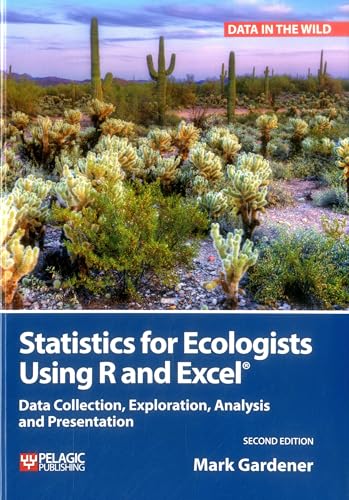
Inhaltsangabe
This is a book about the scientific process and how it is applied to data in ecology. We will learn how to plan for data collection, how to assemble data, how to analyse data and finally how to present the results. The book uses Microsoft Excel and the powerful Open Source R program.
Die Inhaltsangabe kann sich auf eine andere Ausgabe dieses Titels beziehen.
Über die Autorin bzw. den Autor
Mark Gardener (www.gardenersown.co.uk) is an ecologist, lecturer, and writer working in the UK. His primary area of research was in pollination ecology and he has worked in the UK and around the word (principally Australia and the United States). Since his doctorate he has worked in many areas of ecology, often as a teacher and supervisor. He believes that ecological data, especially community data, is the most complicated and ill-behaved and is consequently the most fun to work with. He was introduced to R by a like-minded pedant whilst working in Australia during his doctorate. Learning R was not only fun but opened up a new avenue, making the study of community ecology a whole lot easier. He is currently self-employed and runs courses in ecology, data analysis, and R for a variety of organizations. Mark lives in rural Devon with his wife Christine, a biochemist who consequently has little need of statistics.
Auszug. © Genehmigter Nachdruck. Alle Rechte vorbehalten.
Statistics for Ecologists Using R and Excel
Data Collection, Exploration, Analysis and Presentation
By Mark GardenerPelagic Publishing
Copyright © 2017 Mark Gardener
All rights reserved.
ISBN: 978-1-78427-140-4All rights reserved.
Contents
Preface, xi,
1. Planning, 1,
2. Data recording, 19,
3. Beginning data exploration – using software tools, 26,
4. Exploring data – looking at numbers, 54,
5. Exploring data – which test is right?, 100,
6. Exploring data – using graphs, 107,
7. Tests for differences, 182,
8. Tests for linking data – correlations, 206,
9. Tests for linking data – associations, 230,
10. Differences between more than two samples, 247,
11. Tests for linking several factors, 285,
12. Community ecology, 329,
13. Reporting results, 359,
14. Summary, 373,
Glossary, 375,
Appendices, 381,
Index, 394,
CHAPTER 1
Planning
The planning process is important, as it can save you a lot of time and effort later on.
1.1 The scientific method
Science is a way of looking at the natural world. In short, the process goes along the following lines:
• You have an idea about something.
• You come up with a hypothesis.
• You work out a way of testing this hypothesis/idea.
• You collect appropriate data in order to apply a test.
• You test the hypothesis and decide if the original idea is supported or rejected.
• If the hypothesis is rejected, then the original idea is modified to take the new findings into account.
• The process then repeats.
In this way, ideas are continually refined and your knowledge of the natural world is expanded. You can split the scientific process into four parts (more or less): planning, recording, analysing and reporting (summarized in Table 1.1).
1.1.1 Planning stage
This is the time to get the ideas. These may be based on previous research (by you or others), by observation or stem from previous data you have obtained. On the other hand, you might have been given a project by your professor, supervisor or teacher. If you are going to collect new data, then you will determine what data, how much data, when it will be collected, how it will be collected and how it will be analysed, all at this planning stage. Looking at previous research is a useful start as it can tell you how other researchers went about things. If you already have old data from some historic source then you still need to plan what you are going to do with it. You may have to delve into the data to some extent to see what you have – do you have the appropriate data to answer the questions you want answered? It may be that you have to modify your ideas/questions in light of what you have. A hypothesis is a fancy term for a research question. A hypothesis is framed in a certain scientific way so that it can be tested (see more about hypotheses in Section 1.4).
1.1.2 Recording stage
Finally, you get to collect data. The planning step will have determined (possibly with the help of a pilot study) how the data will be collected and what you are going to do with it. The recording stage nevertheless is important because you need to ensure that at the end you have an accurate record of what was done and what data were collected. Furthermore, the data need to be arranged in an appropriate manner that facilitates the analysis. It is often the case, especially with old data, that the researcher has to spend a lot of time rearranging numbers/data into a new configuration before anything can be done. Getting the data layout correct right at the start is therefore important (see more about data layout in Chapter 2).
1.1.3 Analysis stage
The means of undertaking your analysis should have been worked out at the planning stage. The analysis stage is where you apply the statistics and data handling methods that make sense of the numbers collected. Helping to understand data is vastly aided by the use of graphs. As part of the analysis, you will determine if your original hypothesis is supported or not (see more about kinds of analysis in Chapter 5).
1.1.4 Reporting stage
Of course there is some personal satisfaction in doing this work, but the bottom line is that you need to tell others what you did and what you found out. The means of reporting are varied and may be informal, as in a simple meeting between colleagues. Often the report is more formal, like a written report or paper or a presentation at a meeting. It is important that your findings are presented in such a way that your target audience understands what you did, what you found and what it means. In the context of conservation, for example, your research may determine that the current management is working well and so nothing much needs to be done apart from monitoring. On the other hand, you may determine that the situation is not good and that intervention is needed. Making the results of your work understandable is a key skill and the use of graphs to illustrate your results is usually the best way to achieve this. Your audience is much more likely to dwell on a graph than a page of figures and text. You'll see examples of how to report results throughout the text, with a summary in Chapter 13.
1.2 Types of experiment/project
As part of the planning process, you need to be aware of what you are trying to achieve. In general, there are three main types of research:
• Differences: you look to show that a is different to b and perhaps that c is different again. These kinds of situations are represented graphically using bar charts and box–whisker plots.
• Correlations: you are looking to find links between things. This might be that species a has increased in range over time or that the abundance of species a (or environmental factor a ) affects the abundance of species b. These kinds of situations are represented graphically using scatter plots.
• Associations: similar to the above except that the type of data is a bit different, e.g. species a is always found growing in the same place as species b. These kinds of situations are represented graphically using pie charts and bar charts.
Studies that concern whole communities of organisms usually require quite different approaches. The kinds of approach required for the study of community ecology are dealt with in detail in the companion volume to this work (Community Ecology, Analytical Methods Using R and Excel, Gardener 2014).
In this volume you'll see some basic approaches to community ecology, principally diversity and sample similarity (see Chapter 12). The other statistical approaches dealt with in this volume underpin many community studies.
Once you know what you are aiming at, you can decide what sort of data to collect; this affects the analytical approach, as you shall see later. You'll return to the topic of project types in Chapter 5.
1.3 Getting data – using a spreadsheet
A spreadsheet is an invaluable tool in science and data analysis. Learning to use one is a good skill to acquire. With a spreadsheet you are able to manipulate data and summarize it in different ways quite easily. You can also prepare data for further analysis in other computer programs in a spreadsheet. It is important...
„Über diesen Titel“ kann sich auf eine andere Ausgabe dieses Titels beziehen.
Weitere beliebte Ausgaben desselben Titels

Suchergebnisse für Statistics for Ecologists Using R and Excel: Data Collection...

Beispielbild für diese ISBN
Statistics for Ecologists Using R and Excel: Data Collection, Exploration, Analysis and Presentation
Anbieter: Revaluation Books, Exeter, Vereinigtes Königreich
Verkäuferbewertung 5 von 5 Sternen

Hardcover. Zustand: Brand New. 404 pages. 9.75x7.00x1.25 inches. In Stock. Artikel-Nr. x-1784271403
Neu kaufen
EUR 123,81
EUR 17,13 shipping
Versand von Vereinigtes Königreich nach USA
Versand von Vereinigtes Königreich nach USA
Anzahl: 2 verfügbar