
Verwandte Artikel zu The Fighter Pilot's Handbook: Magic, Death and...
Inhaltsangabe
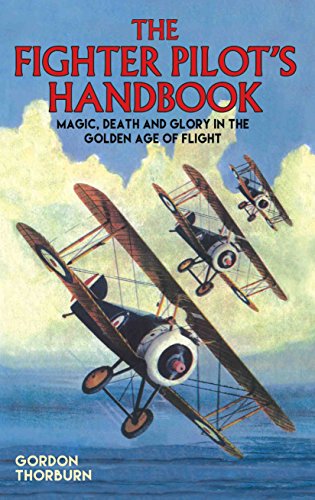
This study takes the reader on a journey from the first flying machines in the late 19th century, to the development of the specialized fighter aircraft armed with one or more machine guns. It takes in the development of the devices that allowed a machine gun to fire through the propeller arc, the coming of aerial photography and airborne wireless, parachutes, engine design, test flying and problems of flight, including the dreaded "spin" that killed so may pilots, and the invention of aerial tactics such as the Immelmann Turn. Here, too, are the pilots who became famous. Some, like Germany's "Red Baron," Britain's James McCudden, and Eddie Rickenbacker of the US, are still well-known. In 1914 it was all new, this business of flying at the enemy. It is a story of creativity, of machines, experiments, turning points, ebb and flow, and heroes. Starting from almost nothing, the fighting men established the principles that ultimately made aircraft the most important weapon of all.
Die Inhaltsangabe kann sich auf eine andere Ausgabe dieses Titels beziehen.
Über die Autorin bzw. den Autor
Gordon Thorburn is the author of No Need to Die: American Flyers in RAF Bomber Command.
Auszug. © Genehmigter Nachdruck. Alle Rechte vorbehalten.
The Fighter Pilot's Handbook
Magic, Death and Glory in the Golden Age of Flight
By Gordon ThorburnJohn Blake Publishing Ltd
Copyright © 2015 Gordon Thorburn
All rights reserved.
ISBN: 978-1-78418-819-1All rights reserved.
Contents
Title Page,
ACKNOWLEDGEMENTS,
PREFACE,
PART ONE Aeroplanes? In a War?,
PART TWO There's a First Time for Everything,
PART THREE Aces High,
ENVOI: from 'The Call of the Air' by Jeffery Day,
INDEX,
Copyright,
CHAPTER 1
Aeroplanes? In a War?
THOMAS MOY AND HIS AERIAL STEAMER
Towards conquering gravity by machine rather than gas bag, most of the practical work was done between 1891 and 1905. Before that, there were always people wanting to imitate birds, flapping wings in an effort to fly, and as long ago as 1799 came the first theoretical description of the kind of machine people would need, if they were ever to be able to fly usefully.
Sir George Cayley, 1773–1857, Yorkshire baronet, lord of the manor of Brompton-by-Sawdon in the North Riding near Scarborough, set out the basic principles at that time and in a more detailed paper published in 1809. He understood that we should have to replace flapping wings with fixed ones, and that flying surfaces would need to be curved to produce sufficient lift to overcome the drag, that is, the combined weight of the flying machine, plus its burden of aeronauts, plus its motive force, an engine. Steam engines, he said, would never do, but some new sort of engine would be required, so that forward motion could generate the aforementioned lift and the craft could journey purposefully from A to B.
Without a suitable engine, Sir George built several gliders that worked, one of which was supposedly piloted by his coachman in 1853 down Brompton Dale, but the quest continued for powered flight.
Sir George's opinion on steam power did not deter two other Englishmen, William Henson and John Stringfellow. They patented their airliner in 1842 – The Aerial Steam Carriage – and founded their airline, The Aerial Transit Company, 'to convey letters, goods and passengers from place to place through the air'. Through their appeals for investment in the company they hoped to raise the money to build the machine but, for some reason, investors did not rush forward. All that ever came of it was a short indoor flight of a scale model but, credit where it is due, the thing did fly, and it was steam-powered.
There was a lot of publicity engendered by Henson and Stringfellow, doubtless stirring interest in a young clerk in a London stationery firm, Thomas Moy (1823–1910). Like many other pioneers, Moy knew what the problem was. You only have to see a piece of paper blowing along the street to realise that a lightweight, flattish object can fly, but how do you control that and make that flight useful?
Moy started, again like many others, by watching birds. In the 1860s he made some model 'wings', attached them to a body, and towed the device like a little submarine under the still waters of a canal, to study how the currents flowed around the components. To his surprise, his experiment was ruined when his bird-boat surfaced; he had, without realising it, invented the hydrofoil.
He joined the newly formed Aeronautical Society of Great Britain (later the Royal Aeronautical Society), gave a paper on his conclusions regarding the seemingly effortless soaring flight of the albatross, and he designed a flying machine. Unlike Henson and Stringfellow, he built it.
Rather than wait for the engineers working on internal combustion to come up with a practical answer, Moy decided to ignore Sir George. The Aerial Steamer, with a lightweight engine developed by Richard Shill running on meths, made its debut at the Crystal Palace in July 1875 (only one year before the four-stroke petrol engine appeared). It had no pilot and was tethered, in the manner that aeromodellers call round-the-pole, and its wing, made of bamboo and linen, had a span of 14 feet. With its raised tailplane, today's readers might be reminded of the Starship Enterprise. Its inventor estimated that, to lift off, warp speed needed to be 35mph on its 2,000-yard circular track. Despite a really clever engine design, giving it over 500rpm, the Steamer only managed 12 mph, partly because its own motion caused the fumes from the three forward meths burners to blow out the other three.
Thomas Moy had built his machine out of his own limited funds and could not raise any more. He tried turning the Steamer into a kind of helicopter, which didn't work, but he did make a small aircraft, a model, that could take off under its own power provided by rubber bands. Such a take-off, without any kind of extra launching, was a significant feat for its time but, like steam, rubber would never do.
OTTO LILIENTHAL AND HIS HANG GLIDER
The next idea to give a real boost to flying-machine development came from Germany around 1891, curiously enough by a return to the birdman strategy. Otto Lilienthal and his brother Gustav made a pair of wings to fit on a man's arms, as so many had before, but with a major difference. Otto, agreeing with Sir George on curvature but not on fixedness, had realised that the wings had to be convex above, concave beneath. He made hundreds of flights in birdman mode and began to develop more sophisticated machines.
By 1895, he was sitting in an aircraft that would be easily recognisable to hang-glider pilots today. It had a tail with plane and fin (see patent diagram), and it would fly when launched from the top of a hill carrying a chap in a Tyrolean hat.
Lilienthal published several papers, usually to little effect. Some official attitudes could be summed up as 'Man will never fly', while others stated that man would only fly if he could work out how to do it with flat wings. Lilienthal sent his ideas to Hureau de Villeneuve, president of a French scientific commission investigating the possibilities of aeronautics, who wrote back from Paris:
I consider wings, pre-eminently, as moving organs for propelling at great speed, and when this speed has been reached the force necessary for supporting may be neglected. I have shown this by constructing mechanical birds with flat wings which fly very fast and keep themselves up very well when flying in the air. I try to make the wings true planes as far as I can, for the flatter they are the greater is the speed attained.
Lilienthal refused to join the flat-wing society and continued to publish his own ideas. In 1893 he wrote: 'Even to the present hour the majority of aviators expend much painful effort in attempting the hopeless task of trying to fly with flat wings.'
From the same paper, published in Zeitschrift für Luftschiffahrt (Journal of Aviation, literally 'airship travel' but meaning all types of aerial vessel) by Deutsche Verein zur Förderung der Luftschiffahrt (German Society for the Advancement of Aviation):
I have now reached the close of a series of experiments during which I had set myself a definite task. This was to construct an apparatus with curved carrying surfaces which should enable me to sail through the air, starting from high points and gliding as far as possible, that is to say, at the least obtainable inclination; and to do this with stability and safety even in winds of medium strength.
He succeeded in gliding but knew full well that this was only the beginning.
The mere discovery that with arched wings supporting forces are evolved which permit...
„Über diesen Titel“ kann sich auf eine andere Ausgabe dieses Titels beziehen.
Suchergebnisse für The Fighter Pilot's Handbook: Magic, Death and...

Beispielbild für diese ISBN
The Fighter Pilot's Handbook: Magic, Death and Glory in the Golden Age of Flight
Verlag:
Metro Books, London 05/11/2015, 2015
ISBN 10: 1784188190
ISBN 13: 9781784188191
Gebraucht
Hardcover
Anbieter: AwesomeBooks, Wallingford, Vereinigtes Königreich
Verkäuferbewertung 5 von 5 Sternen

Zustand: Very Good. This book is in very good condition and will be shipped within 24 hours of ordering. The cover may have some limited signs of wear but the pages are clean, intact and the spine remains undamaged. This book has clearly been well maintained and looked after thus far. Money back guarantee if you are not satisfied. See all our books here, order more than 1 book and get discounted shipping. . Artikel-Nr. 7719-9781784188191
Gebraucht kaufen
EUR 3,37
EUR 4,79 Versand
Versand von Vereinigtes Königreich nach USA
Versand von Vereinigtes Königreich nach USA
Anzahl: 1 verfügbar
Beispielbild für diese ISBN
The Fighter Pilot's Handbook: Magic, Death and Glory in the Golden Age of Flight
Anbieter: ThriftBooks-Atlanta, AUSTELL, GA, USA
Verkäuferbewertung 5 von 5 Sternen
Hardcover. Zustand: Very Good. No Jacket. May have limited writing in cover pages. Pages are unmarked. ~ ThriftBooks: Read More, Spend Less. Artikel-Nr. G1784188190I4N00
Gebraucht kaufen
EUR 8,55
Versand gratis
Versand innerhalb von USA
Versand innerhalb von USA
Anzahl: 1 verfügbar
Beispielbild für diese ISBN
The Fighter Pilot's Handbook: Magic, Death and Glory in the Golden Age of Flight
Anbieter: ThriftBooks-Phoenix, Phoenix, AZ, USA
Verkäuferbewertung 5 von 5 Sternen
Hardcover. Zustand: Very Good. No Jacket. May have limited writing in cover pages. Pages are unmarked. ~ ThriftBooks: Read More, Spend Less. Artikel-Nr. G1784188190I4N00
Gebraucht kaufen
EUR 8,55
Versand gratis
Versand innerhalb von USA
Versand innerhalb von USA
Anzahl: 1 verfügbar
Beispielbild für diese ISBN
The Fighter Pilot's Handbook: Magic, Death and Glory in the Golden Age of Flight
Anbieter: WorldofBooks, Goring-By-Sea, WS, Vereinigtes Königreich
Verkäuferbewertung 5 von 5 Sternen
Paperback. Zustand: Fine. Artikel-Nr. GOR011214201
Gebraucht kaufen
EUR 3,86
EUR 6,51 Versand
Versand von Vereinigtes Königreich nach USA
Versand von Vereinigtes Königreich nach USA
Anzahl: 2 verfügbar
Beispielbild für diese ISBN
The Fighter Pilot's Handbook: Magic, Death and Glory in the Golden Age of Flight
Anbieter: WorldofBooks, Goring-By-Sea, WS, Vereinigtes Königreich
Verkäuferbewertung 5 von 5 Sternen
Paperback. Zustand: Very Good. The book has been read, but is in excellent condition. Pages are intact and not marred by notes or highlighting. The spine remains undamaged. Artikel-Nr. GOR007573703
Gebraucht kaufen
EUR 3,86
EUR 6,51 Versand
Versand von Vereinigtes Königreich nach USA
Versand von Vereinigtes Königreich nach USA
Anzahl: 3 verfügbar
Beispielbild für diese ISBN
The Fighter Pilot's Handbook : Magic, Death and Glory in the Golden Age of Flight
Verlag:
Blake Publishing, Limited, John, 2016
ISBN 10: 1784188190
ISBN 13: 9781784188191
Gebraucht
Hardcover
Anbieter: Better World Books Ltd, Dunfermline, Vereinigtes Königreich
Verkäuferbewertung 5 von 5 Sternen
Zustand: Very Good. Former library copy. Pages intact with possible writing/highlighting. Binding strong with minor wear. Dust jackets/supplements may not be included. Includes library markings. Stock photo provided. Product includes identifying sticker. Better World Books: Buy Books. Do Good. Artikel-Nr. GRP97368617
Gebraucht kaufen
EUR 5,67
EUR 5,81 Versand
Versand von Vereinigtes Königreich nach USA
Versand von Vereinigtes Königreich nach USA
Anzahl: 2 verfügbar
Beispielbild für diese ISBN
The Fighter Pilot's Handbook: Magic, Death and Glory in the Golden Age of Flight
Verlag:
Metro Books, London 05/11/2015, 2015
ISBN 10: 1784188190
ISBN 13: 9781784188191
Gebraucht
Hardcover
Anbieter: Bahamut Media, Reading, Vereinigtes Königreich
Verkäuferbewertung 5 von 5 Sternen
Zustand: Very Good. Shipped within 24 hours from our UK warehouse. Clean, undamaged book with no damage to pages and minimal wear to the cover. Spine still tight, in very good condition. Remember if you are not happy, you are covered by our 100% money back guarantee. Artikel-Nr. 6545-9781784188191
Gebraucht kaufen
EUR 11,95
EUR 8,12 Versand
Versand von Vereinigtes Königreich nach USA
Versand von Vereinigtes Königreich nach USA
Anzahl: 1 verfügbar
Beispielbild für diese ISBN
The Fighter Pilot's Handbook: Magic, Death and Glory in the Golden Age of Flight
Anbieter: Revaluation Books, Exeter, Vereinigtes Königreich
Verkäuferbewertung 5 von 5 Sternen
Hardcover. Zustand: Brand New. 246 pages. 9.00x5.25x1.25 inches. In Stock. Artikel-Nr. zk1784188190
Neu kaufen
EUR 15,06
EUR 11,63 Versand
Versand von Vereinigtes Königreich nach USA
Versand von Vereinigtes Königreich nach USA
Anzahl: 1 verfügbar
Foto des Verkäufers
The Fighter Pilot's Handbook : Magic, Death and Glory in the Golden age of Flight
Verlag:
Metro Publishing, London, 2015
ISBN 10: 1784188190
ISBN 13: 9781784188191
Gebraucht
Hardcover
Erstausgabe
Anbieter: Adelaide Booksellers, Clarence Gardens, SA, Australien
Verkäuferbewertung 5 von 5 Sternen
Hardback. 1st Edition. Octavo Size [approx 15.5 x 22.8cm]. Near Fine copy in Near Fine dustjacket. DJ now protected in our purpose-made plastic sleeve. An excellent copy. Illustrated with Black and White Photographs. 246 pages. A fascinating study of early flying machines, the first air war and the men and machines that fought it. Robust, professional packaging and tracking provided for all parcels. Artikel-Nr. 321749
Gebraucht kaufen
EUR 15,86
EUR 19,77 Versand
Versand von Australien nach USA
Versand von Australien nach USA
Anzahl: 1 verfügbar