
Verwandte Artikel zu The Future of African Peace Operations: From the Janjaweed...
The Future of African Peace Operations: From the Janjaweed to Boko Haram (Africa Now) - Softcover
Buch 17 von 24: Africa Now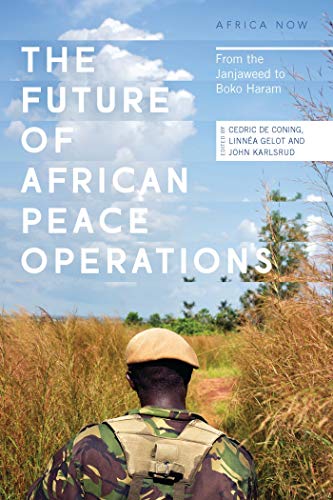
Inhaltsangabe
Provides vital insights into the future of peacekeeping operations in Africa, as well as practical solutions to security challenges facing the continent.
Die Inhaltsangabe kann sich auf eine andere Ausgabe dieses Titels beziehen.
Über die Autorin bzw. den Autor
Cedric de Coning is a senior researcher with the Peace Operations and Peacebuilding Research Group at the Norwegian Institute of International Affairs and a senior adviser on peacekeeping and peacebuilding for ACCORD.
Linnéa Gelot is a senior researcher at the Nordic Africa Institute in Uppsala, Sweden, a senior lecturer in peace and development studies at the School of Global Studies and an affiliated fellow of the Norwegian Institute of International Affairs.
John Karlsrud is senior research fellow and manager of the Training for Peace programme at the Norwegian Institute of International Affairs, working on peacekeeping, peacebuilding and humanitarian issues.
Auszug. © Genehmigter Nachdruck. Alle Rechte vorbehalten.
The future of African Peace Operations
From the Janjaweed to Boko Haram
By Cedric de Coning, Linnéa Gelot, John KarlsrudZed Books Ltd
Copyright © 2016 Cedric de Coning, Linnéa Gelot and John Karlsrud
All rights reserved.
ISBN: 978-1-78360-708-2All rights reserved.
Contents
Acknowledgements,
Abbreviations and acronyms,
1 Towards an African model of peace operations CEDRIC DE CONING, LINNÉA GELOT AND JOHN KARLSRUD,
2 Confronting hybrid threats in Africa: improving multidimensional responses KWESI ANING AND MUSTAPHA ABDALLAH,
3 Stabilization missions and mandates in African peace operations: implications for the ASF? SOLOMON A. DERSSO,
4 The relationship between the AU and the RECs/RMs in relation to peace and security in Africa: subsidiarity and inevitable common destiny MICHELLE NDIAYE,
5 The strategic relationship between the African Union and its partners LINDA DARKWA,
6 Mission support for African peace operations WALTER LOTZE,
7 United in challenges? The African Standby Force and the African Capacity for Immediate Response to Crises JIDE MARTYNS OKEKE,
8 What roles for the civilian and police dimensions in African peace operations? YVONNE AKPASOM,
9 Adapting the African Standby Force to a just-in-time readiness model: improved alignment with the emerging African model of peace operations CEDRIC DE CONING,
10 African peace operations: trends and future scenarios, conclusions and recommendations CEDRIC DE CONING, LINNÉA GELOT AND JOHN KARLSRUD,
About the contributors,
Index,
CHAPTER 1
Towards an African model of peace operations
Cedric de Coning, Linnéa Gelot and John Karlsrud
Introduction
Highly complex and dynamic conflict systems are placing significant demands on African peace and security institutions. In response, new practices and cooperative models are emerging in an attempt to try to shape a more peaceful and stable continent. This book takes stock of how African peace operations have evolved over the past decade – from protecting internally displaced persons in Darfur from the Janjaweed militias to supporting coordinated operations by countries in the Lake Chad Basin region in their fight against Boko Haram insurgents. In the process we call for institutionalizing a new African peace operation model to better reflect the kind of short-duration, high-intensity, multi-actor stabilization operations that have become the norm.
African regional actors have during the last decade shown their indispensability as partners and as leading actors in international efforts to enhance peace and security in Africa (Brosig 2013; Engel and Porto 2014; Gelot 2012; Weiss and Welz 2014). The UN Security Council (UNSC) relies on proactive regional interventionism to sustain the reach and access of UN agencies to violence-affected populations in Africa as well as to prepare the ground for a transition to comprehensive UN-led peace operations. To this effect, the UNSC commends the growing role of the African Union (AU) in peace and security in its region and stresses the need for a stronger and more cohesive partnership between the UN and the AU in conflict prevention and resolution, rapid response to emerging crises, protection of children and peace building (UNSC 2014; Boutellis and Williams 2013). While the UNSC in the 2005–10 period stressed the role of regional organizations, especially the AU, in responding to mass atrocities (UNSC 2006), the UNSC and the 'P3' – the United Kingdom, the United States and France – have since 2010 more actively aligned around the objective of closer cooperation with African regional actors to enable rapid reaction to counter contemporary regional and global security threats, among them criminal and terrorist networks, piracy, human trafficking and radicalized, armed non-state actors (UNSC 2014, 2015).
From experiences to date, a pattern of complex hybridity emerges. On the one hand, the UNSC relies on the AU and the Regional Economic Communities/Regional Mechanisms (RECs/RMs) to act as first responders to emerging crises, and employ a generous interpretation of Chapter VIII of the UN Charter. An enduring trend in this regard is the UN's inability to generate troops and police in sufficient numbers and to deploy them rapidly enough to meet the demands made on it. Structural constraints, for example bureaucratic rationales and security and safety rules, as well as normative constraints, including the UN's core principles regarding impartiality, consent of all parties to the conflict, and non-use of force except in self-defence and in the defence of the mandate, have also resulted in a cautious posture. On the other hand, African regional actors rely on the UNSC's legitimacy for their actions and on financial and other types of assistance from international partners as well as African states and institutions, without which the African peace operations to date could not have occurred (Gelot 2012; Badmus 2015). African institutions are also developing and institutionalizing their peace and security mechanisms concurrently with peace operations being deployed, tested and assessed, given the complex conflict scenarios on the continent (De Coning 2014). Additionally, African institutions have ever closer and more complex relations with a multitude of actors – creating new relations of opportunity and dependency. Bilateral relations with conventional as well as new partners such as China and Russia, relations with diverse funding bodies, private sector partnerships, civil society participation, etc., are all necessary albeit accompanied by problematic challenges such as inter-institutional rivalry, incoherence and unaccountability (Tardy and Wyss 2014).
The emerging ASF is illustrative of a key component of the APSA that is simultaneously being refined, constructed and evaluated. This volume grapples with the realization that the doctrine of the ASF is out of sync with the challenges faced by African peace operations on the ground. The foundations for the ASF were laid over a decade ago. The existing doctrine has been developed around traditional principles of multidimensional UN peace operations. It will now have to adapt so that the ASF can deploy in high-intensity 'non-permissive' situations that the UN peace operation model was not originally designed for. Working assumptions and principles are in the process of being reconsidered, while the revised deadline for full operational capability (FOC) has remained the same, set for December 2015.
As reflected in this volume in the chapters by Solomon Dersso and Jide Okeke (Chapters 3 and 7), the key question is how best to develop the Rapid Deployment Capability (RDC) concept, i.e. a process-based debate, and not how to, strictly speaking, operationalize the ASF on time. From recent discussion in the UNSC it is clear that the Western powers as well as emerging powers see a strategic value in supporting the development of an African rapid response capability (African Union 2015a). It is widely recognized that Africa will need an RDC to mitigate the worst effects of erupting conflicts and to bridge the time it takes the APSA and other international actors to discuss strategic objectives and to plan and deploy more comprehensive missions (Badmus 2015).
Against the background of the gap between current conflict scenarios and the ASF concept, Dersso and Okeke discuss one such proposal and its ambiguous standing within the APSA today, the 'African Capacity for Immediate Response to Crises' (ACIRC)....
„Über diesen Titel“ kann sich auf eine andere Ausgabe dieses Titels beziehen.
Suchergebnisse für The Future of African Peace Operations: From the Janjaweed...

Beispielbild für diese ISBN
The Future of African Peace Operations : From the Janjaweed to Boko Haram
Anbieter: Better World Books, Mishawaka, IN, USA
Verkäuferbewertung 5 von 5 Sternen

Zustand: Very Good. Pages intact with possible writing/highlighting. Binding strong with minor wear. Dust jackets/supplements may not be included. Stock photo provided. Product includes identifying sticker. Better World Books: Buy Books. Do Good. Artikel-Nr. 18513281-6
Gebraucht kaufen
EUR 30,03
Versand gratis
Versand innerhalb von USA
Versand innerhalb von USA
Anzahl: 1 verfügbar
Beispielbild für diese ISBN
The Future of African Peace Operations
Anbieter: PBShop.store US, Wood Dale, IL, USA
Verkäuferbewertung 5 von 5 Sternen
PAP. Zustand: New. New Book. Shipped from UK. Established seller since 2000. Artikel-Nr. L2-9781783607082
Neu kaufen
EUR 43,94
Versand gratis
Versand innerhalb von USA
Versand innerhalb von USA
Anzahl: Mehr als 20 verfügbar
Beispielbild für diese ISBN
The Future of African Peace Operations
Anbieter: PBShop.store UK, Fairford, GLOS, Vereinigtes Königreich
Verkäuferbewertung 5 von 5 Sternen
PAP. Zustand: New. New Book. Shipped from UK. Established seller since 2000. Artikel-Nr. L2-9781783607082
Neu kaufen
EUR 41,65
EUR 4,85 Versand
Versand von Vereinigtes Königreich nach USA
Versand von Vereinigtes Königreich nach USA
Anzahl: Mehr als 20 verfügbar
Beispielbild für diese ISBN
The Future of African Peace Operations: From the Janjaweed to Boko Haram (Africa Now)
Anbieter: Ria Christie Collections, Uxbridge, Vereinigtes Königreich
Verkäuferbewertung 5 von 5 Sternen
Zustand: New. In English. Artikel-Nr. ria9781783607082_new
Neu kaufen
EUR 45,54
EUR 10,93 Versand
Versand von Vereinigtes Königreich nach USA
Versand von Vereinigtes Königreich nach USA
Anzahl: Mehr als 20 verfügbar
Beispielbild für diese ISBN
The Future of African Peace Operations: From the Janjaweed to Boko Haram
Anbieter: Kennys Bookstore, Olney, MD, USA
Verkäuferbewertung 5 von 5 Sternen
Zustand: New. This timely new collection provides vital insights into the future of peacekeeping operations in Africa, as well as practical solutions to the immense security challenges facing regional actors on the continent. Editor(s): Coning, Cedric de; Gelot, Linnea; Karlsrud, John. Series: Africa Now. Num Pages: 256 pages. BIC Classification: 1H; GTJ; JPSL; JWLP. Category: (G) General (US: Trade). . . 2016. Paperback. . . . . Books ship from the US and Ireland. Artikel-Nr. V9781783607082
Neu kaufen
EUR 57,78
EUR 9,26 Versand
Versand innerhalb von USA
Versand innerhalb von USA
Anzahl: Mehr als 20 verfügbar
Beispielbild für diese ISBN
The Future of African Peace Operations: From the Janjaweed to Boko Haram
Anbieter: Revaluation Books, Exeter, Vereinigtes Königreich
Verkäuferbewertung 5 von 5 Sternen
Paperback. Zustand: Brand New. 153 pages. 9.25x6.00x0.50 inches. In Stock. Artikel-Nr. x-1783607084
Neu kaufen
EUR 65,06
EUR 11,67 Versand
Versand von Vereinigtes Königreich nach USA
Versand von Vereinigtes Königreich nach USA
Anzahl: 2 verfügbar