
Verwandte Artikel zu Green Growth: Ideology, Political Economy and the Alternativ...
Inhaltsangabe
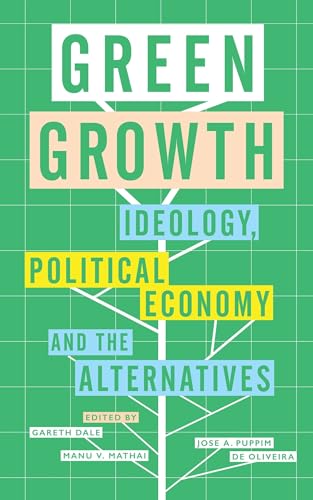
Bringing together leading scholars of environmental policy and political economy, the book assess the impact and viability of green growth and outlines the alternatives
Die Inhaltsangabe kann sich auf eine andere Ausgabe dieses Titels beziehen.
Über die Autorin bzw. den Autor
Gareth Dale teaches politics at Brunel University. His publications include books on Karl Polanyi, the GDR and Eastern Europe, and international migration.
Auszug. © Genehmigter Nachdruck. Alle Rechte vorbehalten.
Green Growth
Ideology, Political Economy and the Alternatives
By Gareth Dale, Manu V. Mathai, Jose A. Puppim De OliveiraZed Books Ltd
Copyright © 2016 Gareth Dale, Manu V. Mathai and Jose A. Puppim de Oliveira
All rights reserved.
ISBN: 978-1-78360-487-6All rights reserved.
Contents
Acknowledgements,
Contributors,
Introduction Gareth Dale, Manu V. Mathai and Jose A. Puppim De Oliveira,
Part I: Contradictions of green growth,
1 Can green growth really work? A reality check that elaborates on the true (socio-)economics of climate change Ulrich Hoffmann,
2 What is the 'green' in 'green growth'? Larry Lohmann,
3 The how and for whom of green governmentality Adrian Parr,
4 Degrowth and the roots of neoclassical economics James Meadway,
Part II: Case studies,
5 Giving green teeth to the Tiger? A critique of 'green growth' in South Korea Bettina Bluemling and Sun-Jin Yun,
6 Lessons from the EU: why capitalism cannot be rescued from its own contradictions Birgit Mahnkopf,
7 The green growth trap in Brazil Ricardo Abramovay,
8 Green jobs to promote sustainable development: creating a value chain of solid waste recycling in Brazil Anne Posthuma and Paulo Sergio Muçouçah,
9 Trends of social metabolism and environmental conflict: a comparison between India and Latin America Joan Martinez-Alier, Federico Demaria, Leah Temper and Mariana Walter,
Part III: Emerging alternatives?,
10 Beyond 'development' and 'growth': the search for 212 alternatives in India towards a sustainable and equitable world Ashish Kothari,
11 Reconsidering growth in the greenhouse: the Sustainable Energy Utility (SEU) as a practical strategy for the twenty-first century Job Taminiau and John Byrne,
12 Alternatives to green growth? Possibilities and contradictions of self-managed food production Steffen Böhm, Maria Ceci Araujo Misoczky, David Watson and Sanjay Lanka,
Notes,
Index,
CHAPTER 1
Can green growth really work? A reality check that elaborates on the true (socio)economics of climate change
Ulrich Hoffmann
Introduction
In the run-up to the Rio+20 Conference in June 2012 and the UN Climate Summit on 23 September 2014, virtually everyone from multilateral agencies to politicians, to businessmen, and to NGOs has advocated a fundamental shift towards 'green and inclusive growth' as the new, qualitatively different growth paradigm, which would considerably improve the energy efficiency of the economy and lead to drastic changes in its energy and material mix (replacing exhaustible by renewable materials), with corresponding structural changes. 'Green growth' advocates argue that such paradigm change would unleash new wealth creation and employment opportunities; provided that there was sufficient investment and companies had better information and supportive incentives. In other words, the impression occurs that the 'green growth' concept is flawless; just the enabling conditions for it are lacking. 'Green growth', which should be rather seen as a process of structural change, may indeed create some new growth impulses with reduced environmental load, in particular at microeconomic level. But can it also mitigate climate change at the required scale and pace (i.e. significant, absolute and permanent decline of GHG emissions in a historically very short period of time) at macroeconomic and global level?
The reality check below casts a long shadow on the 'green growth' hopes. Our analysis argues that the arithmetic of economic and population growth, energy/resource/material efficiency limits related to the rebound effect and horizontal shifting of problems, governance and market constraints, as well as systemic limits call into question the hopes of decoupling GHG from economic growth. Rather, one should not deceive oneself into believing that such an evolutionary (and often reductionist) approach will be sufficient to cope with the socio-economic complexities related to climate change (and some other global environmental problems, such as loss of biodiversity). 'Green growth' may give much false hope and excuses to do nothing really fundamental that can bring about a U-turn on global GHG emissions. The approach is largely reduced to a technocratic and technology-fetishized one, because changing technologies is much easier than altering societies and their socio-economic drivers.
'Green growth' proponents need to scrutinize the historical macro-(not micro-) economic evidence, in particular the arithmetic of economic and population growth, the colossal reductions required in the GHG-emission intensity of economic growth as well as the significant influence of the rebound effect. Furthermore, they need to realize that the required transformation goes far beyond innovation and structural changes to include better distribution of income and wealth, power over markets, and a culture of sufficiency. Against this very background, an attempt is made below to elaborate on the true economics of climate change. Global warming also calls into question the global equality of opportunity for prosperity (i.e. ecological justice and development space) and is thus a huge developmental challenge for the South and a question of life and death for some developing countries.
Limits set by the arithmetic of economic and population growth
In the last few years, the fossil-fuel-related CO2-emission trajectory has followed a trend that is worse than the worst-case scenario used in the 4th assessment report of the Intergovernmental Panel on Climate Change (IPCC) of 2007. If current GHG-emission trends continue unabated, according to the 5th IPCC assessment report of 2014, we are likely on course for temperature increases of 4–6°C and even more, which would undoubtedly have apocalyptic implications. The 4th IPCC assessment report concluded that GHG reductions in the order of 85 per cent for developed countries and some 50 per cent for developing countries would be necessary by 2050 to keep global warming at a range of 2 to 2.4°C.
It is, however, highly questionable whether the required drastic GHG-emissions reductions are really achievable under the prevailing growth paradigm. By way of illustration, global carbon intensity of production fell from around 1kg/$ of economic activity to just 770g/$ (i.e. by 23 per cent) in the 28 years between 1980 and 2008 (a drop of about 0.7 per cent per annum). Even if recent trends of global population (at 0.7 per cent per annum) and income growth (at 1.4 per cent per year) were just extrapolated to 2050, carbon intensity would have to be reduced to 36gCO2/$ – a 21-fold improvement on the current global average to limit global warming to 2 degrees. Allowing developing countries to catch up with the present level of GDP per capita in developed nations would even require a much higher drop in carbon intensity of almost 130 times by 2050 (see Figure 1.1). More recent analysis of global carbon intensity dynamics by Pricewaterhouse-Coopers (PwC) as part of its annual Low Carbon Economy Index supports Jackson's projections. According to the PwC experts, carbon intensity of the global economy would have to be reduced by 6.2 per cent a year between now and 2050. Even a doubling of the current rate of decarbonization (some 1.2 per cent in 2013) would still lead to emissions consistent with 4–6°C of warming by the end of the century.
Not once since World War II has humankind achieved the rate of reduction of carbon intensity of GDP required for limiting...
„Über diesen Titel“ kann sich auf eine andere Ausgabe dieses Titels beziehen.
Suchergebnisse für Green Growth: Ideology, Political Economy and the Alternativ...

Beispielbild für diese ISBN
Green Growth: Ideology, Political Economy and the Alternatives
Anbieter: WorldofBooks, Goring-By-Sea, WS, Vereinigtes Königreich
Verkäuferbewertung 5 von 5 Sternen

Paperback. Zustand: Very Good. The book has been read, but is in excellent condition. Pages are intact and not marred by notes or highlighting. The spine remains undamaged. Artikel-Nr. GOR008493541
Gebraucht kaufen
EUR 11,59
EUR 6,60 Versand
Versand von Vereinigtes Königreich nach USA
Versand von Vereinigtes Königreich nach USA
Anzahl: 1 verfügbar
Beispielbild für diese ISBN
Green Growth: Ideology, Political Economy and the Alternatives
Anbieter: Black Gull Books (P.B.F.A.), St Leonard's on Sea, Vereinigtes Königreich
Verkäuferbewertung 5 von 5 Sternen
paperback. Zustand: As New. Artikel-Nr. 20216
Gebraucht kaufen
EUR 12,14
EUR 15,33 Versand
Versand von Vereinigtes Königreich nach USA
Versand von Vereinigtes Königreich nach USA
Anzahl: 1 verfügbar
Beispielbild für diese ISBN
Green Growth
Anbieter: Majestic Books, Hounslow, Vereinigtes Königreich
Verkäuferbewertung 4 von 5 Sternen

Zustand: New. pp. 256. Artikel-Nr. 373297859
Neu kaufen
EUR 45,48
EUR 7,66 Versand
Versand von Vereinigtes Königreich nach USA
Versand von Vereinigtes Königreich nach USA
Anzahl: 1 verfügbar
Beispielbild für diese ISBN
Green Growth : Ideology, Political Economy And The Alternatives
Anbieter: Romtrade Corp., STERLING HEIGHTS, MI, USA
Verkäuferbewertung 5 von 5 Sternen
Zustand: New. This is a Brand-new US Edition. This Item may be shipped from US or any other country as we have multiple locations worldwide. Artikel-Nr. ABBB-172240
Beispielbild für diese ISBN
Green Growth: Ideology, Political Economy and the Alternatives
Anbieter: Ria Christie Collections, Uxbridge, Vereinigtes Königreich
Verkäuferbewertung 5 von 5 Sternen
Zustand: New. In English. Artikel-Nr. ria9781783604876_new
Neu kaufen
EUR 46,03
EUR 13,31 Versand
Versand von Vereinigtes Königreich nach USA
Versand von Vereinigtes Königreich nach USA
Anzahl: Mehr als 20 verfügbar
Beispielbild für diese ISBN
Green Growth: Political Ideology, Political Economy and Policy Alternatives
Anbieter: Revaluation Books, Exeter, Vereinigtes Königreich
Verkäuferbewertung 5 von 5 Sternen
Paperback. Zustand: Brand New. 1st edition. 323 pages. 8.25x5.50x0.75 inches. In Stock. Artikel-Nr. x-1783604875
Neu kaufen
EUR 65,93
EUR 11,79 Versand
Versand von Vereinigtes Königreich nach USA
Versand von Vereinigtes Königreich nach USA
Anzahl: 2 verfügbar
Beispielbild für diese ISBN
Green Growth: Ideology, Political Economy and the Alternatives
Anbieter: Kennys Bookstore, Olney, MD, USA
Verkäuferbewertung 5 von 5 Sternen
Zustand: New. First book to fully interrogate whether 'green growth' can lead us to a more sustainable society in a finite world. Editor(s): Dale, Dr. Gareth. Num Pages: 256 pages. BIC Classification: GTF; RND. Category: (UP) Postgraduate, Research & Scholarly. . . 2016. 1st Edition. Paperback. . . . . Books ship from the US and Ireland. Artikel-Nr. V9781783604876
Neu kaufen
EUR 78,12
EUR 9,33 Versand
Versand innerhalb von USA
Versand innerhalb von USA
Anzahl: Mehr als 20 verfügbar
Beispielbild für diese ISBN
Green Growth
Anbieter: Mooney's bookstore, Den Helder, Niederlande
Verkäuferbewertung 4 von 5 Sternen
Zustand: As New. Artikel-Nr. F6C6BC4C27039A6
Gebraucht kaufen
EUR 79,57
EUR 14,95 Versand
Versand von Niederlande nach USA
Versand von Niederlande nach USA
Anzahl: 1 verfügbar