
Verwandte Artikel zu The 1% and the Rest of Us: A Political Economy of Dominant...
Inhaltsangabe
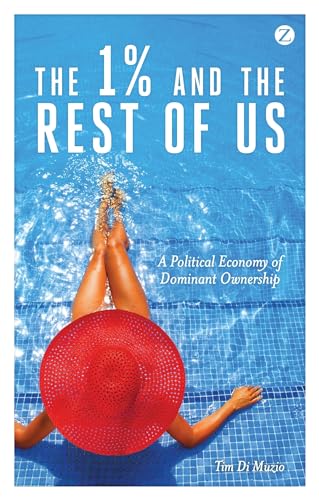
The first historically informed, theoretically rich and empirically detailed study of what Occupy has called the 1%.
Die Inhaltsangabe kann sich auf eine andere Ausgabe dieses Titels beziehen.
Über die Autorin bzw. den Autor
Tim Di Muzio is senior lecturer in international relations and political economy at the University of Wollongong in Australia. He currently edits the journal Review of Capital as Power.
Auszug. © Genehmigter Nachdruck. Alle Rechte vorbehalten.
The 1% and the Rest of Us
A Political Economy of Dominant Ownership
By Tim Di MuzioZed Books Ltd
Copyright © 2015 Tim Di Muzio
All rights reserved.
ISBN: 978-1-78360-142-4All rights reserved.
Contents
Tables and figures,
INTRODUCTION: TOWARDS A GLOBAL POLITICAL ECONOMY OF THE 1%,
1 THE UNUSUAL SUSPECTS: IDENTIFYING THE GLOBAL 1%,
2 CAPITAL AS POWER AND THE 1%,
3 WEALTH, MONEY AND POWER,
4 DIFFERENTIAL CONSUMPTION: THE RISE OF PLUTONOMY,
5 SOCIETY VERSUS THE SUPERMAN THEORY OF WEALTH,
6 THE PARTY OF THE 99%: RESISTANCE AND FUTURE PROSPECTS,
Notes,
Bibliography,
Index,
CHAPTER 1
THE UNUSUAL SUSPECTS: IDENTIFYING THE GLOBAL 1%
The distribution of wealth, therefore, depends on the laws and customs of society. (John Stuart Mill 2004: 86)
Domination means that the commands of a group or class are carried out with relatively little resistance, which is possible because that group or class has been able to establish the rules and customs through which everyday life is conducted. Domination, in other words, is the institutionalized outcome of great distributive power. (G. William Domhoff 2006: 199)
The accumulation of advantages at the very top parallels the vicious cycle of poverty at the very bottom. (C. Wright Mills 2000: 111)
The professor and the prince
In 2010, a University of Chicago law professor created a mini-firestorm on the internet when he posted a blog entry lamenting a potential increase in the taxation rate of high-income earners. The professor wrote that he and his wife made a total of US$250,000 a year but that they were not 'wealthy' and therefore could not afford any increase in their income taxes. The mini-firestorm ensued for a number of reasons, but many commentators tried to put things in perspective by highlighting the fact that the professor's household income put his family in the top 1%. In actuality, his family was in the top 0.04% of global income earners. Soon after the barrage of criticism, the professor deleted his blog and apologised for his insensitivity and the derision it caused towards his family. But despite these actions, and perhaps without knowing it, the professor demonstrated two very important points central to any global political economy of the 1%. The first is that, from a global perspective, making US$250,000 a year does indeed put you in the 0.04% of the world's richest citizens, although, and here is the paradox, nowhere near its wealthiest. In fact, if your income is US$31,100 or the equivalent in another currency, you are in the world's top 1% of income earners. This knowledge (or maybe lack thereof) did not stop another mini-firestorm from taking place about three years later. Saudi Prince Alwaleed bin Talal – who enriched himself through family connections, oil money and business acumen – filed a libel suit in a British court against Forbes for underreporting his wealth at a mere US$20 billion rather than (and this must matter a great deal to the prince) US$29.6 billion. One might think that a man who owns a 'marble-filled, 420-room Riyadh palace', a 'private Boeing 747 equipped with a throne' and a '120-acre resort on the edge of the Saudi capital with five homes, five artificial lakes and a mini-Grand Canyon' might overlook such trivial figures. But, like the good professor, he felt aggravated about his status in the social hierarchy. This is the crucial second point revealed by the professor's and the prince's mini-firestorms and the beginning of our study: how might we identify the 1% when wealth appears to be a relative or subjective judgement?
Income and wealth: a primer
Despite his household's giant income compared with that of the global population, the professor is not considered wealthy because he and his wife derive most of their income from paid employment (wages and salaries) rather than their ownership of income-generating assets (typically called capital). And in the global hierarchy of life chances, ownership of income-generating assets is what generates additional or greater income and then wealth. The fact that the 1% own more income streams than the one they might get from their own labour is largely what sets the 1% apart from everyone else. To be clear about this, consider the fact that someone making US$200,000 a year and someone making US$10 million a year, or US$3 billion, a year are all included in the top 1% of the global population by income. We can immediately note that there is a giant difference between making US$200,000 a year and making US$3 billion a year. But this takes us into the heart of the matter and one of the primary reasons for this study. From a global perspective, the professor is one of the richest people on the planet because his and his wife's household can command much more of the world's goods and services than his counterparts who make far, far less. If we stop to consider that most of humanity survives on US$2 a day or less, then it becomes clear that the professor's family is considerably better off. His children will also likely have much better life chances than those born in a poorer country or those who have less affluent parents. But from his subjective and culturally embedded point of view, his household is by no means wealthy in a comparative financial sense. And the truth of the matter, despite his inability to recognise his household's global position, is that he's exactly right. From the perspective of the real 1%, he is not wealthy but surprisingly working class – however well remunerated for his work. And this is where we should pause and make a clear analytical distinction between income and wealth.
According to the Oxford English Dictionary, the etymology of 'income' can be traced to the Old English word 'incuman', which in the fourteenth century simply meant to enter or arrive or the beginning of something. By the seventeenth century, however, 'income' took on a more financial meaning: 'that which comes in as the periodical produce of one's work, business, lands, or investments (considered in reference to its amount, and commonly expressed in terms of money); annual or periodical receipts accruing to a person or corporation; revenue'. In accounting terms today, 'income' can have a number of meanings, but we can generally think of it as a flow or stream of earnings quantified and measured in European numerals (1, 2, 3, etc.) and divisible by time. This numerical system was adopted in Europe from the Hindu-Arabic system in the late fifteenth century. The term 'income tax' originated as a war tax in Great Britain in 1799. The tax became permanent after 1842. Readers would do well to remember that the source of the income tax in Britain has its roots in financing the organised violence of an emergent capitalist and slave-trading empire. Last, the term 'national income' does not appear in the English language until 1878. Adam Smith's Wealth of Nations makes no mention of national income but he does speak about the 'general stock' of a country or society. We will discuss Smith's work at greater length in Chapter 3.
The term 'wealth' is about a century older than 'income' and derives from Middle English. In the thirteenth century, wealth could mean the existential condition of being happy and prosperous, a spiritual well-being or a blessing and/or an abundance of possessions or 'worldly goods'. In a world of what we would today call very little 'economic growth', it is small wonder that wealth was equated with the physical things one possessed. According to the Oxford...
„Über diesen Titel“ kann sich auf eine andere Ausgabe dieses Titels beziehen.
Suchergebnisse für The 1% and the Rest of Us: A Political Economy of Dominant...

Beispielbild für diese ISBN
The 1% and the Rest of Us: A Political Economy of Dominant Ownership
Anbieter: World of Books (was SecondSale), Montgomery, IL, USA
Verkäuferbewertung 5 von 5 Sternen

Zustand: Good. Item in good condition and has highlighting/writing on text. Used texts may not contain supplemental items such as CDs, info-trac etc. Artikel-Nr. 00032364135
Gebraucht kaufen
EUR 6,41
Versand gratis
Versand innerhalb von USA
Versand innerhalb von USA
Anzahl: 1 verfügbar
Beispielbild für diese ISBN
The 1% and the Rest of Us : A Political Economy of Dominant Ownership
Anbieter: Better World Books, Mishawaka, IN, USA
Verkäuferbewertung 5 von 5 Sternen
Zustand: Fine. Used book that is in almost brand-new condition. May contain a remainder mark. Better World Books: Buy Books. Do Good. Artikel-Nr. 52506689-6
Gebraucht kaufen
EUR 6,42
Versand gratis
Versand innerhalb von USA
Versand innerhalb von USA
Anzahl: 1 verfügbar
Beispielbild für diese ISBN
The 1% and the Rest of Us : A Political Economy of Dominant Ownership
Anbieter: Better World Books, Mishawaka, IN, USA
Verkäuferbewertung 5 von 5 Sternen
Zustand: Good. Pages intact with minimal writing/highlighting. The binding may be loose and creased. Dust jackets/supplements are not included. Stock photo provided. Product includes identifying sticker. Better World Books: Buy Books. Do Good. Artikel-Nr. 53634196-6
Gebraucht kaufen
EUR 6,42
Versand gratis
Versand innerhalb von USA
Versand innerhalb von USA
Anzahl: 1 verfügbar
Beispielbild für diese ISBN
The 1% and the Rest of Us: A Political Economy of Dominant Ownership
Anbieter: WorldofBooks, Goring-By-Sea, WS, Vereinigtes Königreich
Verkäuferbewertung 5 von 5 Sternen
Paperback. Zustand: Very Good. The book has been read, but is in excellent condition. Pages are intact and not marred by notes or highlighting. The spine remains undamaged. Artikel-Nr. GOR007556936
Gebraucht kaufen
EUR 5,53
EUR 6,53 Versand
Versand von Vereinigtes Königreich nach USA
Versand von Vereinigtes Königreich nach USA
Anzahl: 1 verfügbar
Beispielbild für diese ISBN
The 1% and the Rest of Us : A Political Economy of Dominant Ownership
Anbieter: Better World Books Ltd, Dunfermline, Vereinigtes Königreich
Verkäuferbewertung 5 von 5 Sternen
Zustand: Good. Pages intact with minimal writing/highlighting. The binding may be loose and creased. Dust jackets/supplements are not included. Stock photo provided. Product includes identifying sticker. Better World Books: Buy Books. Do Good. Artikel-Nr. 53634196-6
Gebraucht kaufen
EUR 9,06
EUR 5,83 Versand
Versand von Vereinigtes Königreich nach USA
Versand von Vereinigtes Königreich nach USA
Anzahl: 1 verfügbar
Beispielbild für diese ISBN
The 1% and the Rest of Us : A Political Economy of Dominant Ownership
Anbieter: Better World Books Ltd, Dunfermline, Vereinigtes Königreich
Verkäuferbewertung 5 von 5 Sternen
Zustand: Very Good. Former library copy. Pages intact with possible writing/highlighting. Binding strong with minor wear. Dust jackets/supplements may not be included. Includes library markings. Stock photo provided. Product includes identifying sticker. Better World Books: Buy Books. Do Good. Artikel-Nr. GRP86359514
Gebraucht kaufen
EUR 9,06
EUR 5,83 Versand
Versand von Vereinigtes Königreich nach USA
Versand von Vereinigtes Königreich nach USA
Anzahl: 3 verfügbar
Beispielbild für diese ISBN
The 1% and the Rest of Us: A Political Economy of Dominant Ownership
Anbieter: Anybook.com, Lincoln, Vereinigtes Königreich
Verkäuferbewertung 5 von 5 Sternen
Zustand: Good. This is an ex-library book and may have the usual library/used-book markings inside.This book has soft covers. Clean from markings. In good all round condition. Please note the Image in this listing is a stock photo and may not match the covers of the actual item,400grams, ISBN:9781783601424. Artikel-Nr. 7070059
Gebraucht kaufen
EUR 10,34
EUR 15,86 Versand
Versand von Vereinigtes Königreich nach USA
Versand von Vereinigtes Königreich nach USA
Anzahl: 1 verfügbar
Beispielbild für diese ISBN
The 1% and the Rest of Us
Anbieter: PBShop.store US, Wood Dale, IL, USA
Verkäuferbewertung 5 von 5 Sternen
PAP. Zustand: New. New Book. Shipped from UK. Established seller since 2000. Artikel-Nr. HU-9781783601424
Beispielbild für diese ISBN
The 1% and the Rest of Us: A Political Economy of Dominant Ownership
Anbieter: High Street Books, New Mills, Vereinigtes Königreich
Verkäuferbewertung 5 von 5 Sternen
Paperback. Zustand: Very Good. Light wear to the covers. Shipped from the UK in recyclable card packaging. Artikel-Nr. cb084-824-0133
Gebraucht kaufen
EUR 10,22
EUR 23,32 Versand
Versand von Vereinigtes Königreich nach USA
Versand von Vereinigtes Königreich nach USA
Anzahl: 1 verfügbar
Beispielbild für diese ISBN
The 1% and the Rest of Us: A Political Economy of Dominant Ownership
Anbieter: Kennys Bookstore, Olney, MD, USA
Verkäuferbewertung 5 von 5 Sternen
Zustand: New. The first historically informed, theoretically rich and empirically detailed study of what Occupy has called the 1%. Num Pages: 224 pages. BIC Classification: JPW; KCP. Category: (UP) Postgraduate, Research & Scholarly. Dimension: 217 x 345 x 23. Weight in Grams: 330. . 2015. Paperback. . . . . Books ship from the US and Ireland. Artikel-Nr. V9781783601424
Neu kaufen
EUR 32,95
EUR 9,16 Versand
Versand innerhalb von USA
Versand innerhalb von USA
Anzahl: Mehr als 20 verfügbar