
Verwandte Artikel zu The Refusal of Work: The Theory and Practice of Resistance...
Inhaltsangabe
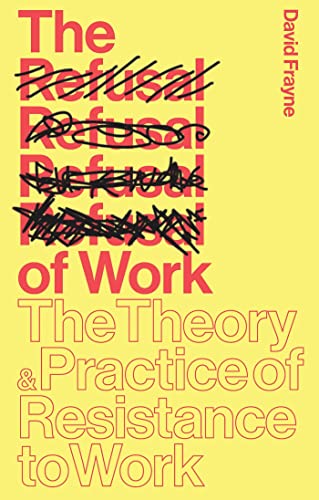
The Refusal of Work argues that the time has come to challenge the political and cultural centrality of paid work.
Die Inhaltsangabe kann sich auf eine andere Ausgabe dieses Titels beziehen.
Über die Autorin bzw. den Autor
David Frayne is a sociology teacher and social researcher, based at Cardiff University. His research interests are wide-ranging, but his main areas are social activism, consumer culture, the sociology of happiness, and radical perspectives on work. David is the author of several articles and has also written a chapter on critiques of work for the SAGE Handbook of the Sociology of Work and Employment. Twitter: @theworkdogma
Auszug. © Genehmigter Nachdruck. Alle Rechte vorbehalten.
The Refusal of Work
The Theory and Practice of Resistance to Work
By David FrayneZed Books Ltd
Copyright © 2015 David Frayne
All rights reserved.
ISBN: 978-1-78360-117-2All rights reserved.
Contents
ACKNOWLEDGEMENTS,
INTRODUCTION The work dogma,
ONE A provocation,
TWO Working pains,
THREE The colonising power of work,
FOUR The stronghold of work,
FIVE The breaking point,
SIX Alternative pleasures,
SEVEN Half a person,
EIGHT From escapism to autonomy,
NOTES,
BIBLIOGRAPHY,
INDEX,
CHAPTER 1
A provocation
Modern methods of production have given us the possibility of ease and security for all; we have chosen, instead, to have overwork for some and starvation for others. Hitherto we have continued to be as energetic as we were before there were machines; in this we have been foolish, but there is no reason to go on being foolish for ever.
Bertrand Russell – 'In Praise of Idleness' (2004c: 15)
In his 1972 book Working, Studs Terkel collected transcripts from over a hundred interviews with working Americans, providing an intricate snapshot of American life from an astonishing range of perspectives (Terkel, 2004). In this enormous book, we hear from welders, waiters, cab drivers, housewives, actors and telephone operators, as each discuss their hopes, fears and everyday experiences at work. Much of Terkel's book is about the little coping strategies that people use to get through the working day, from pranks and teasing to fantasising and other strategies of mental detachment. A gas-meter reader passes the time by ogling a housewife who sunbathes in her bikini. A waitress makes the day go quicker by gliding between tables, pretending to be a ballerina. A production line worker says 'fuck it', and takes a rest without permission. Standing back to reflect on the interviews in Working, Terkel wrote:
This book, being about work, is, by its very nature, a book about violence – to the spirit as well as the body. It is about ulcers as well as accidents, about shouting matches as well as fistfights, about nervous breakdowns as well as kicking the dog around. It is, above all (or beneath all), about daily humiliations. (Terkel, 2004: xi)
Many of the accounts featured in Terkel's book give substance to his conclusion that work is violence, yet some of the book's accounts also offer glimpses of work's pleasures. In one memorable case, a piano tuner portrayed his work as an artistic exercise, describing how he would enter an almost hypnotic state of concentration and aesthetic delight as he brought harmony to the pianos. His account brings to mind the notion of the 'flow state': a psychological condition of complete and blissful absorption in the task at hand, entered when a work task synchronises with a person's skill level and interests (Csikszentmihalyi, 1990). In the flow, one loses track of time and space, focusing only on the craft. It is the opposite experience to that of the bored worker who watches the ticking clock, unable to shake his physical surroundings from his mind.
The delight of Terkel's piano tuner is a form of pleasure unfamiliar to many people. In modern capitalist societies, access to satisfying and engaging work is profoundly unequal. For those who work in jobs with dubious social utility, subjected to the latest innovations in workplace organisation and control, work often represents a struggle against boredom, meaninglessness and exhaustion. A range of personal tactics help us to survive the working day: we remind ourselves that we are more interesting than the jobs we do, we stage imaginary rebellions against bosses and clients, or we hide away in shells of cynicism. Sometimes we construct elaborate escapes and compensations out of hours in an effort to forget (or 'rebalance', as the life coaches call it). In later chapters I will introduce people who describe work as an external, coercive pressure in their lives. They talk about how they felt 'compressed', 'controlled' and 'forced' in their work. They said that work made them feel 'watched from behind', 'penned in like battery hens', or 'dominated by a big beast'. The perceived meaninglessness of the work they performed (or that they might, in the future, be forced to perform) represented a significant source of distress. Matthew – only in his mid twenties – said that the thought of working in retail or an office job made him panic about death. His anxieties reminded me of something Terkel once said in a television interview: 'the jobs are not big enough for people's spirits'.
Work is not without resistance, of course. Activists and labour scholars continue to address the pressing need for fairer pay, better- quality jobs, and more democratic relationships in the workplace. These important issues delineate the traditional terrain of trade unions and the politics of the Left. They are all extremely pressing issues and the fight is far from won, but it is crucial that we also think beyond workers' rights to confront a broader and more fundamental set of questions. What is so great about work that sees society constantly trying to create more of it? Why, at the pinnacle of society's productive development, is there still thought to be a need for everybody to work for most of the time? What is work for, and what else could we be doing in the future, were we no longer cornered into spending most of our time working? As we will see, such questions are part of a well-established history of critical thinking on the meaning, purpose and future of work. If such questions are rarely posed outside of this academic clique, however, it is perhaps because they ask us to scrutinise realities that are usually accepted as natural and inevitable. It may feel like there is little incentive to reflect critically on work from a position where most of us, irrespective of our attitudes towards work, are pretty much obliged to perform it anyway. To take a critical stance on work may even seem distasteful or elitist in the context of a society where jobs are so highly sought after. In regions wracked by poverty and high rates of unemployment, what people are feeling is a need for more work, not less, but it should be noted that the thinkers introduced here are in no way ignorant or in denial of this fact. It would be senseless to dispute the fact that most of us experience a powerful need to work. What we can dispute, however, is the celebrated prominence of work in the cultural, ethical and political life of advanced industrial societies. What is baffling, from the perspective of work's critics, is the notion that the activity of work should continue to be valued more than other pastimes, practices and forms of social contribution.
The work-centred society
We live in a work-centred society, and this is true in a number of senses. First of all, work represents society's main mechanism for the distribution of income. Work is therefore the central avenue through which people access material necessities such as food, clothing and shelter, as well as the commercial entertainments and escapes offered by modern consumerism. The centrality of work is also grasped when we consider the sheer amount of time spent working – in which I also include the time spent preparing for, training for, searching for, worrying about, and travelling to and from work – as well as the fact that for most people, work represents the main centre of social life outside the family. In affluent societies, work is one of the most conventional and...
„Über diesen Titel“ kann sich auf eine andere Ausgabe dieses Titels beziehen.
Suchergebnisse für The Refusal of Work: The Theory and Practice of Resistance...

Beispielbild für diese ISBN
The Refusal of Work : Rethinking Post-Work Theory and Practice
Anbieter: Better World Books Ltd, Dunfermline, Vereinigtes Königreich
Verkäuferbewertung 5 von 5 Sternen

Zustand: Good. Former library copy. Pages intact with minimal writing/highlighting. The binding may be loose and creased. Dust jackets/supplements are not included. Includes library markings. Stock photo provided. Product includes identifying sticker. Better World Books: Buy Books. Do Good. Artikel-Nr. 52378786-20
Gebraucht kaufen
EUR 14,65
EUR 5,83 Versand
Versand von Vereinigtes Königreich nach USA
Versand von Vereinigtes Königreich nach USA
Anzahl: 1 verfügbar
Beispielbild für diese ISBN
The Refusal of Work: The Theory and Practice of Resistance to Work
Anbieter: Sell Books, Elland, YORKS, Vereinigtes Königreich
Verkäuferbewertung 5 von 5 Sternen
paperback. Zustand: Acceptable. Please see the condition note after this for details, if this is missing please consider Acceptable to mean poor quality that could include major staining, water damage, writing, missing dustjacket, etc etc. Our books are dispatched from a Yorkshire former cotton mill. We list via barcode/ISBN so please note that the images are stock images and may not be the exact copy you receive, furthermore the details about edition and year might not be accurate as many publishers reuse the same ISBN for multiple editions and as we simply scan a barcode or enter an ISBN we do not check the validity of the edition data when listing. If you're looking for an exact edition please don't order (at least not without checking with us first, although we don't always have time to check). We aim to dispatch prompty, the service used will depend on order value and book size. We can ship to most countries, see our shipping policies. Payment is via Abe only. Artikel-Nr. mon0000015875
Gebraucht kaufen
EUR 21,05
EUR 14,16 Versand
Versand von Vereinigtes Königreich nach USA
Versand von Vereinigtes Königreich nach USA
Anzahl: 1 verfügbar
Beispielbild für diese ISBN
Refusal of Work: The Theory and Practice of Resistance to Work
Anbieter: Magers and Quinn Booksellers, Minneapolis, MN, USA
Verkäuferbewertung 5 von 5 Sternen
paperback. Zustand: Very Good. May have light to moderate shelf wear and/or a remainder mark. Complete. Clean pages. Artikel-Nr. 1557574
Gebraucht kaufen
EUR 35,06
EUR 3,49 Versand
Versand innerhalb von USA
Versand innerhalb von USA
Anzahl: 1 verfügbar
Beispielbild für diese ISBN
The Refusal of Work: The Theory and Practice of Resistance to Work
Anbieter: Anybook.com, Lincoln, Vereinigtes Königreich
Verkäuferbewertung 5 von 5 Sternen
Zustand: Good. This is an ex-library book and may have the usual library/used-book markings inside.This book has soft covers. In good all round condition. Library sticker on front cover. Please note the Image in this listing is a stock photo and may not match the covers of the actual item,450grams, ISBN:9781783601172. Artikel-Nr. 2282402
Gebraucht kaufen
EUR 40,25
EUR 15,85 Versand
Versand von Vereinigtes Königreich nach USA
Versand von Vereinigtes Königreich nach USA
Anzahl: 1 verfügbar
Beispielbild für diese ISBN
The Refusal of Work: The Theory and Practice of Resistance to Work
Anbieter: Anybook.com, Lincoln, Vereinigtes Königreich
Verkäuferbewertung 5 von 5 Sternen
Zustand: Good. This is an ex-library book and may have the usual library/used-book markings inside.This book has soft covers. In good all round condition. Library sticker on front cover. Please note the Image in this listing is a stock photo and may not match the covers of the actual item,450grams, ISBN:9781783601172. Artikel-Nr. 2282404
Gebraucht kaufen
EUR 40,25
EUR 15,85 Versand
Versand von Vereinigtes Königreich nach USA
Versand von Vereinigtes Königreich nach USA
Anzahl: 1 verfügbar
Beispielbild für diese ISBN
The Refusal of Work: The Theory and Practice of Resistance to Work
Anbieter: Anybook.com, Lincoln, Vereinigtes Königreich
Verkäuferbewertung 5 von 5 Sternen
Zustand: Good. This is an ex-library book and may have the usual library/used-book markings inside.This book has soft covers. In good all round condition. Library sticker on front cover. Please note the Image in this listing is a stock photo and may not match the covers of the actual item,450grams, ISBN:9781783601172. Artikel-Nr. 2282403
Gebraucht kaufen
EUR 40,25
EUR 15,85 Versand
Versand von Vereinigtes Königreich nach USA
Versand von Vereinigtes Königreich nach USA
Anzahl: 1 verfügbar