
Verwandte Artikel zu New Rules for Global Justice: Structural Redistribution...
Inhaltsangabe
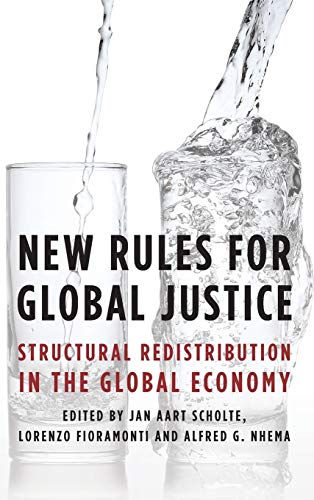
Today's globalised world means offshore finance, airport boutiques and high-speed Internet for some people, against dollar-a-day wages, used t-shirts, and illiteracy for others. How do these highly skewed global distributions happen, and what can be done to counter them?
New Rules for Global Justice engages with widespread public disquiet around global inequality. It explores (mal)distributions in relation to country, class, gender and race, with international examples drawn from Australia to Zimbabwe. The book is action-oriented and empowering, presenting concrete proposals for 'new rules' in regard to climate change, corruption, finance, food, investment, the Internet, migration and more.
Die Inhaltsangabe kann sich auf eine andere Ausgabe dieses Titels beziehen.
Über die Autorinnen und Autoren
Jan Aart Scholte is Faculty Professor in Peace and Development in the School of Global Studies at the University of Gothenburg.
Lorenzo Fioramonti is associate professor, Jean Monnet Chair in Regional Integration and Governance Studies, and director of the Centre for the Study of Governance Innovation at the University of Pretoria.
Alfred G. Nhema is a Senior Lecturer in the Department of Political and Administrative Studies at the University of Zimbabwe.
Auszug. © Genehmigter Nachdruck. Alle Rechte vorbehalten.
New Rules for Global Justice
Structural Redistribution in the Global Economy
By Jan Aart Scholte, Lorenzo Fioramonti, Alfred G. NhemaRowman & Littlefield International Ltd.
Copyright © 2016 Jan Aart Scholte, Lorenzo Fioramonti and Alfred G. Nhema
All rights reserved.
ISBN: 978-1-78348-774-5All rights reserved.
Contents
Acknowledgements, vii,
List of Abbreviations, ix,
1 Why Global Redistribution Is Needed Jan Aart Scholt, 1,
2 Structural Redistribution through Global Social Democracy Valentina Fedotova, 17,
3 Rethinking Global Investment Yash Tandon, 31,
4 Engaging the Diasporas: An Alternative Paradigm from the Caribbean Beverley Mullings and Alissa Trotz, 43,
5 Corruption of Anti-Corruption: Deconstructing Neo-liberal Good Governance Pinar Bedirhanoglu, 57,
6 An Alternative Global Money: Special Drawing Rights or Bitcoin? Taoxiong Liu with Mendang Huang, 71,
7 Financing Global Public Goods: The Case for a Currency Transaction Levy Nina Hall and Inge Kau, 85,
8 Copyfight: Global Redistribution in the Digital Age Blayne Haggar, 93,
9 From Land Grabs to Food Sovereignty Heloise Webe, 109,
10 Global Redistribution through Climate Justice Dorothy Grace Guerrero, 125,
11 Governance Innovation: Enabling Collective Action for Structural Redistribution Lorenzo Fioramonti and Alfred G. Nhema, 139,
Bibliography, 151,
Index, 171,
List of Contributors, 181,
CHAPTER 1
Why Global Redistribution Is Needed
Jan Aart Scholte
Readers who open this book are presumably troubled (maybe also outraged) by global economic inequality. Today's globalized world means offshore finance, airport boutiques, and high-speed Internet for some people, as against dollar-a-day wages, used t-shirts, and illiteracy for others. Latest research suggests that the richest 1 per cent of world population own 48.2 per cent of all assets, while the bottom half own less than 1 per cent of economic wealth (Credit Suisse 2014, 11). As this book goes to press, hundreds are drowning in the Mediterranean in desperate attempts to migrate across global inequalities. How do these highly skewed distributions happen, and what can be done to counter them? That is the concern of this volume.
The book engages with widespread public disquiet. Bank bailouts, Occupy protests, Greek plebiscites, and more have all put a spotlight on global inequality. In this situation, a 700-page analysis of economic inequality that would otherwise gather academic dust becomes a runaway bestseller (Piketty 2014). Antiglobalization icon Naomi Klein likewise returns to the headlines with a critique of capitalism and climate change (Klein 2014). Others bemoan that social justice has got lost amidst obsessions with growth (Fioramonti 2013). A debate is on.
This volume's special contribution to this debate is twofold. First, the chapters collectively offer a veritably global exploration of global economic inequality; authors bring age, gender, race, and regional diversity from Australia, Canada, the Caribbean, China, Germany, New Zealand, Russia, South Africa, Sweden, Thailand, Turkey, and Zimbabwe. Second, the book is action-oriented and empowering, presenting concrete proposals that could reduce the global inequalities which most people deplore.
New Rules for Global Justice develops these proposals through three steps of diagnosis, prescription, and process. Diagnosis asks how current circumstances of global political economy generate highly skewed distributions of world resources. Prescription asks how alternative principles and rules of global governance could yield progressive redistributions of world resources. Process asks what opportunities and obstacles for implementation face these proposals for change. In short: how did we get here; where do we want to go instead; and how do we get there?
The following chapters relate these three core questions to specific suggestions in respect of various areas of activity. Chapters 2–4 address long-standing issues of the so-called 'real' economy, such as foreign direct investment and migration. Chapters 5–7 shift the focus of redistributive strategies to globalized money and finance. Chapters 8–10 put the spotlight on newly emergent issues of redistribution connected with the Internet and global ecology. The aim in each chapter is to offer novel workable ideas for resource redistribution in today's global political economy.
Ahead of the elaboration of detailed proposals, this introductory chapter discusses the general problem of huge resource gaps in the contemporary global world. This opening overview has five steps. The first section below presents the project that has generated this book, thereby putting the analysis in a context. The second section describes the nature and extent of material inequalities in today's global economy, thereby summarizing the problem under investigation. The third section identifies broad circumstances that give rise to these resource gaps, noting in particular the role of rules and policies. The fourth section reviews general types of prescriptions for global redistribution that are developed through specific proposals in later chapters of the book. The fifth section surveys process, assessing key possibilities and challenges in the politics of global redistribution.
STRUCTURAL REDISTRIBUTION FOR GLOBAL DEMOCRACY
All knowledge emerges from a context, so it helps to say something at the outset about the development of this volume. The book is part of a broad programme on Building Global Democracy (BGD). Since 2008, this initiative has pursued action-oriented research on the nature of democracy in today's more global world (BGD 2015b; Scholte forthcoming). BGD has explored how to achieve people's power (demos kratos) in relation to the global-scale issues that figure so strongly in contemporary society. For example, how can affected publics have due say and control on problems around global ecology, global trade, global health, global media, global conflict, and so on?
BGD has approached the question of global democracy in a holistic fashion from five interrelated angles: conceptual, pedagogical, institutional, economic, and cultural. Thus, a first project examined concepts of global democracy: that is, what the very idea of 'global democracy' could mean. A second project considered learning for global democracy: that is, how affected people could gain the information and knowledge required to be empowered actors in global politics. A third project investigated institutional processes: in particular, how marginalized (and usually silenced) groups could gain access to and impact on global policymaking. A fourth project (the one behind this book) explored economics of global democracy: that is, the material conditions for effective people's power in global politics. A fifth project enquired how global democracy could respect, answer to, and benefit from cultural diversity across the world. BGD has therefore handled global democracy as a multifaceted issue that is at once philosophical, educational, procedural, material, and anthropological.
Structural Redistribution for Global Democracy (SRGD) is the fourth and economically focused BGD project. The starting premise of this investigation is that meaningful public participation and control in global politics requires that all affected people have sufficient resources to make their voices heard and their influence felt. In other words, achieving global democracy requires more than clear concepts, educated...
„Über diesen Titel“ kann sich auf eine andere Ausgabe dieses Titels beziehen.
Suchergebnisse für New Rules for Global Justice: Structural Redistribution...

Beispielbild für diese ISBN
New Rules for Global Justice: Structural Redistribution in the Global Economy
Anbieter: Ria Christie Collections, Uxbridge, Vereinigtes Königreich
Verkäuferbewertung 5 von 5 Sternen

Zustand: New. In English. Artikel-Nr. ria9781783487745_new
Neu kaufen
EUR 153,67
EUR 13,20 Versand
Versand von Vereinigtes Königreich nach USA
Versand von Vereinigtes Königreich nach USA
Anzahl: Mehr als 20 verfügbar
Beispielbild für diese ISBN
New Rules for Global Justice: Structural Redistribution in the Global Economy
Verlag:
Rowman & Littlefield Publishers (UK), 2016
ISBN 10: 1783487747
ISBN 13: 9781783487745
Neu
Hardcover
Anbieter: Kennys Bookstore, Olney, MD, USA
Verkäuferbewertung 5 von 5 Sternen
Zustand: New. The book is action-oriented and empowering, presenting concrete proposals that could reduce the most deplorable global inequalities. It asks: how did we get here?; where do we want to go instead?; and how do we get there? Editor(s): Scholte, Jan Aart; Fioramonti, Lorenzo; Nhema, Alfred G. Num Pages: 198 pages, 1 tables, 2 graphs. BIC Classification: JFFA; JFFS; KCP. Category: (P) Professional & Vocational. Dimension: 239 x 161 x 19. Weight in Grams: 472. . 2016. Illustrated. hardcover. . . . . Books ship from the US and Ireland. Artikel-Nr. V9781783487745
Neu kaufen
EUR 217,05
EUR 9,09 Versand
Versand innerhalb von USA
Versand innerhalb von USA
Anzahl: Mehr als 20 verfügbar
Beispielbild für diese ISBN
New Rules for Global Justice: Structural Redistribution in the Global Economy
Anbieter: Revaluation Books, Exeter, Vereinigtes Königreich
Verkäuferbewertung 5 von 5 Sternen
Hardcover. Zustand: Brand New. 185 pages. 9.50x6.50x0.75 inches. In Stock. Artikel-Nr. x-1783487747
Neu kaufen
EUR 230,79
EUR 11,69 Versand
Versand von Vereinigtes Königreich nach USA
Versand von Vereinigtes Königreich nach USA
Anzahl: 2 verfügbar