
Verwandte Artikel zu Climate Justice and Geoengineering: Ethics and Policy...
Inhaltsangabe
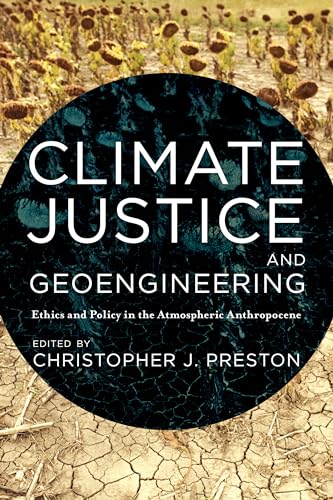
It is already clear that climate engineering raises numerous troubling ethical issues. The pertinent question yet to be addressed is how the ethical issues raised by climate engineering compare to those raised by alternative proposals for tackling climate change.
This volume is the first to put the ethical issues raised by climate engineering into a comprehensive, comparative context so that the key ethical challenges of these technologies can be better measured against those of alternative climate policies . Addressing the topic specifically through the lens of justice, contributors include both advocates of climate intervention research and its sceptics. The volume includes a helpful blend of the theoretical and the practical, with contributions from authors in philosophy, engineering, public policy, social science, geography, sustainable development studies, economics, and climate studies. This cross-disciplinary collection provides the start of an important and more contextualized "second generation" analysis of climate engineering and the difficult public policy decisions that lie ahead.
Die Inhaltsangabe kann sich auf eine andere Ausgabe dieses Titels beziehen.
Über die Autorin bzw. den Autor
Christopher J. Preston is an Associate Professor of Environmental Ethics at the University of Montana. He is the author of Saving Creation: Nature and Faith in the Life of Holmes Rolston, III (Trinity University Press, 2009) and Grounding Knowledge: Environmental Philosophy, Epistemology, and Place (University of Georgia Press, 2003), an edited collection of essays titled Nature Value, and Duty: Life on Earth with Holmes Rolston, III (Springer, 2007), and a special issue of the journal Ethics and the Environment on the "Epistemic Significance of Place."
Auszug. © Genehmigter Nachdruck. Alle Rechte vorbehalten.
Climate Justice and Geoengineering
Ethics and Policy in the Atmospheric Anthropocene
By Christopher J. PrestonRowman & Littlefield International, Ltd.
Copyright © 2016 Christopher J. Preston
All rights reserved.
ISBN: 978-1-78348-636-6All rights reserved.
Contents
Introduction: Climate Justice and Geoengineering Christopher J. Preston, vii,
PART I: GEOENGINEERING JUSTICE IN THEORY, 1,
1 Solar Radiation Management and Comparative Climate Justice Toby Svoboda, 3,
2 Why Geoengineering Is Not "Plan B" Augustin Fragnière and Stephen M. Gardiner, 15,
3 Justice, Recognition and Climate Change Marion Hourdequin, 33,
4 Do We Have a Residual Obligation to Engineer the Climate, as a Matter of Justice? Patrik Baard and Per Wikman-Svahn, 49,
5 Paying It Forward: Geoengineering and Compensation for the Further Future Allen Habib and Frank Jankunis, 63,
PART II: GEOENGINEERING JUSTICE IN PRACTICE, 77,
6 Solar Geoengineering and Obligations to the Global Poor Joshua Horton and David Keith, 79,
7 Why Aggressive Mitigation Must Be Part of Any Pathway to Climate Justice Christian Baatz and Konrad Ott, 93,
8 Bringing Geoengineering into the Mix of Climate Change Tools Jane Long, 109,
9 Food Systems and Climate Engineering: A Plate Full of Risks or Promises? Teea Kortetmaki and Markka Oksanen, 121,
PART III: GEOENGINEERING JUSTICE IN FRAMES, SCENARIOS AND MODELS, 137,
10 Framing Out Justice: The Post-politics of Climate Engineering Discourses Duncan McLaren, 139,
11 Solar Geoengineering: Technology-based Climate Intervention or Compromising Social Justice in Africa? Cush Ngonzo Luwesi, Dzigbodi Adzo Doke and David R. Morrow, 161,
12 Geoengineering and Climate Change Mitigation: Trade-offs and Synergies as Foreseen by Integrated Assessment Models Johannes Emmerling and Massimo Tavoni, 175,
13 Distributional Implications of Geoengineering Richard S. J. Tol, 189,
Index, 201,
Notes on Contributors, 205,
CHAPTER 1
Solar Radiation Management and Comparative Climate Justice
Toby Svoboda
Solar radiation management (SRM) — that is, any climate engineering technique that would reduce the fraction of incoming solar radiation absorbed by the planet — is a very interesting subject for distributive justice, or the type of justice that concerns how benefits and burdens should be apportioned among various parties. On the one hand, SRM techniques carry risks of substantial injustice to present and future parties, and ethicists interested in climate engineering have tended to focus on these possible injustices. On the other hand, SRM has the potential to manage current and impending injustices due to anthropogenic climate change, including risks of unjust harm to the global poor. This points to the possibility that, for all its potential ethical problems, a climate policy involving deployment of some SRM technique might perform better than other available options in securing distributively just (or minimizing distributively unjust) outcomes, at least in certain future contexts.
In line with Christopher Preston's argument in the introduction to this volume, I argue here that, although it is helpful to identify potential injustices associated with SRM, it is also crucial both to evaluate how SRM compares to other available options and to consider empirical conditions under which deployment might occur. In arguing for this view, I rely on a distinction between two types of questions: (1) whether SRM would produce just or unjust outcomes in some case and (2) whether it would be just to deploy SRM in that same case. The former question pertains to whether some distribution of benefits and burdens is morally good or bad, whereas the latter pertains to whether some action or policy is morally permissible, impermissible or obligatory. Although related, these two uses of justice do not come to the same thing. It may be that some climate policy involving SRM carries risks of substantial distributive injustice and yet is permissible or even obligatory. This is because, as I argue, considering what would be just to do should be comparative, taking into consideration both empirical conditions and the morally valuable and disvaluable features of alternative climate policies. To put this in a more intuitive manner, rightness and goodness can come apart — sometimes the right course of action produces bad outcomes. I will return to this distinction in greater detail below.
I consider a prima facie case that some climate policies involving SRM could come out well on such a comparative perspective, given that a commitment to dangerous climate change due to past emissions may limit the effectiveness of policies relying on mitigation and adaptation alone. Notwithstanding, the Paris agreement reached at COP 21, given the insufficient progress on cutting global emissions to this point, it is plausible to expect that, at some point in the future, all available climate policies will exhibit substantial inadequacies when it comes to securing just outcomes. In such cases, the morally disvaluable features of SRM might not be decisive in counting against the permissibility of deployment. In one sense of the term, we might think of this as a 'lesser of two evils' argument, for my claim is that SRM, despite serious problems, could be morally permissible in cases in which it compares favourably to all the alternatives. However, although not technically incorrect, using this language of 'lesser evils' potentially invites misunderstanding. Usually, 'lesser of two evils' arguments are broadly consequentialist in nature, claiming that some policy is to be favoured despite serious costs or harms, and this because its ratio of benefits to costs or harms is better than the ratios of the alternatives. My argument is quite different, because it does not involve merely weighing up the aggregate costs and benefits of various climate policies. Instead, my focus is on the distributions of such costs (or burdens) and benefits, and I argue that some policy involving SRM can be a just thing to do if its distribution of burdens and benefits is better than that of any alternative policy. In order to avoid the false impression that my argument hinges on aggregate costs and benefits, I will forego using the 'lesser of two evils' language.
DISTRIBUTIVE JUSTICE AND CLIMATE CHANGE
Anthropogenic climate change raises important questions of distributive justice, because climate change will involve substantial benefits and burdens, as will any policy meant to deal with it. Importantly, these benefits and burdens will be differentially distributed on each policy, with some parties enjoying a greater share of benefits or suffering a greater share of burdens. Moreover, specific distributions will vary depending on what responses are adopted. Potential climate-related burdens are driven by many factors: an increased frequency of extreme weather events, sea-level rise, the spread of disease to new regions and so on. Potential benefits of various climate policies include curbing these burdens and perhaps avoiding them altogether. This could be achieved through mitigation of greenhouse gas emissions, adaptation to changing climatic conditions, climate engineering through either carbon dioxide removal (CDR) or SRM techniques or some combination of these responses.
Anthropogenic climate change and climate policy are matters of justice because, unlike natural phenomena, they are driven by human activity, such as the emission of greenhouse gases and the...
„Über diesen Titel“ kann sich auf eine andere Ausgabe dieses Titels beziehen.
Suchergebnisse für Climate Justice and Geoengineering: Ethics and Policy...

Beispielbild für diese ISBN
Climate Justice and Geoengineering: Ethics and Policy in the Atmospheric Anthropocene
Anbieter: Ria Christie Collections, Uxbridge, Vereinigtes Königreich
Verkäuferbewertung 5 von 5 Sternen

Zustand: New. In English. Artikel-Nr. ria9781783486366_new
Neu kaufen
EUR 183,15
EUR 13,22 Versand
Versand von Vereinigtes Königreich nach USA
Versand von Vereinigtes Königreich nach USA
Anzahl: Mehr als 20 verfügbar
Beispielbild für diese ISBN
Climate Justice and Geoengineering
Verlag:
Rowman & Littlefield International, 2016
ISBN 10: 1783486368
ISBN 13: 9781783486366
Neu
Hardcover
Anbieter: Kennys Bookstore, Olney, MD, USA
Verkäuferbewertung 5 von 5 Sternen
Zustand: New. A collection of original and innovative essays that compare the justice issues raised by climate engineering to the justice issues raised by competing approaches to solving the climate problem. Editor(s): Preston, Christopher J. Num Pages: 234 pages, 9 black & white illustrations, 5 tables. BIC Classification: HPQ; JPQB; RNA; RNPG. Category: (P) Professional & Vocational. Dimension: 237 x 162 x 20. Weight in Grams: 476. . 2016. Hardback. . . . . Books ship from the US and Ireland. Artikel-Nr. V9781783486366
Neu kaufen
EUR 237,55
EUR 9,27 Versand
Versand innerhalb von USA
Versand innerhalb von USA
Anzahl: Mehr als 20 verfügbar
Beispielbild für diese ISBN
Climate Justice and Geoengineering: Ethics and Policy in the Atmospheric Anthropocene
Anbieter: Revaluation Books, Exeter, Vereinigtes Königreich
Verkäuferbewertung 5 von 5 Sternen
Hardcover. Zustand: Brand New. 209 pages. 9.50x6.25x0.50 inches. In Stock. Artikel-Nr. x-1783486368
Neu kaufen
EUR 272,65
EUR 11,71 Versand
Versand von Vereinigtes Königreich nach USA
Versand von Vereinigtes Königreich nach USA
Anzahl: 2 verfügbar