
Verwandte Artikel zu The Strong and the Free Economy
Inhaltsangabe
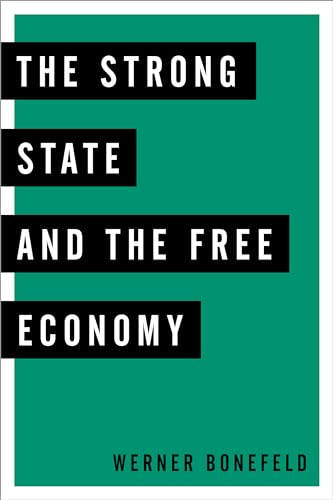
An investigation into the theoretical foundations of ordoliberal thought and its historical and theoretical contexts.
Die Inhaltsangabe kann sich auf eine andere Ausgabe dieses Titels beziehen.
Über die Autorin bzw. den Autor
Werner Bonefeld is Professor of Politics at the University of York, UK.
Auszug. © Genehmigter Nachdruck. Alle Rechte vorbehalten.
The Strong State and the Free Economy
By Werner BonefeldRowman & Littlefield International, Ltd
Copyright © 2017 Werner Bonefeld
All rights reserved.
ISBN: 978-1-78348-628-1All rights reserved.
Contents
Acknowledgements,
1 The Strong State and the Free Economy: German Ordoliberalism, Political Theology and European Democracy,
2 The Free Economy as Political Practice,
3 Democracy and Freedom: On Authoritarian Liberalism,
4 Economic Constitution and Social Order: On the Freedom of Complete Competition,
5 Social policy: From the Class Society to the Enterprise Society,
6 Europe and the Idea of Subsidiarity: On the Elements of Ordoliberalism,
7 European Monetary Union: Economic Constitution and Ordnungspolitik,
8 Authoritarian Liberalism and the Euro: On the Political Theology of the Executive State,
Bibliography,
Index,
CHAPTER 1
The Strong State and the Free Economy: German Ordoliberalism, Political Theology and European Democracy
The program of liberalism ... summed up in a single word, should read: property, that is, private ownership of the means of production. ... All the other demands of liberalism derive from this fundamental demand.
von Mises 1985, 19
The term laissez-faire is a highly ambiguous and misleading description of the principles on which a liberal policy is based.
Hayek 1944, 60
Of Rules and Order.
German ordoliberalism (The Economist 9 May 2015)
ORDOLIBERALISM AND EUROPEAN DEMOCRACY
Ordoliberalism has been identified as the villainous presence at the heart of Europe (Dardot and Laval 2013). It is said to be behind the austerity politics that the EU has actively promoted recently (Blyth 2013; see also Mirowski 2013). According to Nedergaard and Snaith (2015) and Biebricher (2014) the influence of ordoliberalism extends beyond the politics of austerity. It also shaped the institutions of economic governance in the Eurozone. Indeed, it is said to be the theoretical foundation of European monetary union and ideological force behind the entirely misguided response to the euro crisis, which ruined the economies of the weaker member states and led to conditions of abject misery, particularly in the Southern member states (see Stiglitz 2016). For these critics ordoliberalism stands for an imperious 'German ideology' (Ojala and Harjuniemi 2016) that transformed the Eurozone into an 'ordoliberal iron cage' (Ryner 2015).
Other critics characterise the European Union as a contemporary manifestation of a tradition of authoritarian liberalism that goes back to Carl Schmitt's political theology and expresses the political project of the founding ordoliberal thinkers. In this argument the Europe that has come to pass is an exception to law-based policy making by democratic government. Jonathan White (2015, 314) thus speaks about an 'emergency Europe' that replaces law-based policy making with 'emergency politics' or with 'managerial decisionism' (Everson and Jörges 2013; Jörges and Weimer 2014) by the European Council, which is the meeting of the heads of government. Jürgen Habermas is the most prominent critic of what he calls the emergence of a European 'executive federalism'. He charges that ordoliberalism has 'more confidence in economic constitution than democracy' and that executive federalism amounts to a 'faceless exercise of rule behind closed doors by the European Council' (Habermas 2012, 102, 129). He rejects Eurozone governance as a 'post-democratic exercise of political authority' (Habermas 2012, viii). Wolfgang Streek (2015, 361) summarises this argument about European policy making well. In his judgement the European Council now 'closely follows the liberal – authoritarian template devised by Schmitt and others in the final years of the Weimar Republic'. What Streek refers to as 'the others' are the founding ordoliberal thinkers (see also Oberndorfer 2012, 2015; Wilkinson 2014, 2015).
The book expounds the principles of ordoliberal political economy and analyses the character of an ordoliberal Europe. The identification of ordoliberalism with austerity is not helpful and does not hold up. The ordoliberal argument is not about this economic policy and that economic technique. Rather, it is about the construction of what Müller-Armack (1976, 231–242) called a definite 'economic style' of moral sociability. It is an argument about the liberal state as a market constituting and preserving power. It is to civilise and moralise the economic conduct and restrain competition to rules. Ordoliberalism recognises the political state as the concentrated power of economic liberty. The book argues that the European Union is founded on and integrates the role of the federated member states as 'market police' (Rüstow 1942). This term is central to the ordoliberal conception of political economy and places the argument about 'emergency Europe' into the context of a history of authoritarian liberal thought, from Benjamin Constant to Carl Schmitt.
ON ORDOLIBERALISM
The founding ordoliberal thinkers are Walter Eucken (1891–1950), Franz Böhm (1895–1977), Alexander Rüstow (1885–1963), Wilhelm Röpke (1899–1966) and Alfred MüllerArmack (1901–1978). Against the background of the turmoil of the Weimar Republic, they asked what needed to be done to (re-)assert and sustain a free labour economy. Like traditional liberalism they accepted that laissez-faire is the economic concept of freedom. Yet, in distinction to the popular understanding of traditional liberalism, they argued that the economy does not comprise an independent reality. Rather, in the ordoliberal argument, market regulation by the invisible hand amounts fundamentally to a political practice of government. In ordoliberalism the state is the primary and predominant institution of the free economy.
The founding ordoliberal thinkers reprimanded laissez-faire liberalism for its neglect of the state, which led to its abandonment to social democracy and the lobby of powerful economic interests, including the trade unions. 'What', asks Rüstow (1954, 221), 'really distinguishes our neoliberalism from the long vanquished paleo-liberalism of ... laissez faire? The distinction is this: we do not expel the state from the economy only for a much weakened state to come back through the backdoors of interventionism, economic subsidies, and protectionism. Right from the start, we assign to the strong and independent state the foundational task of market-police to secure economic freedom and complete competition'. The ordoliberals recognise that free economy is a social construct, an 'artificial order' (Müller-Armack 1947a, 86), that has to be actively constructed and maintained by means of state. Ordoliberalism asks about the conditions of liberty and what needs to be done to achieve and maintain them, and what can one hope for?
In the ordoliberal argument the freedom to compete defines the essence of Man (Eucken 1989, 34). They argue for a system of complete competition and identify unrestrained greed, protection from (labour) market pressures and the democratic welfare state as a threat to human freedom. The ordoliberals reject any talk about the state as a weak night-watchman state. The weak state does not govern for complete competition. Rather, it is overwhelmed by the powerful rent-seeking private interests (see Rüstow 1963, 258). The ordoliberal state is a strong state. It does not allow itself to become the prey of the competing social interests, nor...
„Über diesen Titel“ kann sich auf eine andere Ausgabe dieses Titels beziehen.
Suchergebnisse für The Strong and the Free Economy

Beispielbild für diese ISBN
The Strong and the Free Economy
Anbieter: Ria Christie Collections, Uxbridge, Vereinigtes Königreich
Verkäuferbewertung 5 von 5 Sternen

Zustand: New. In English. Artikel-Nr. ria9781783486281_new
Neu kaufen
EUR 74,43
EUR 10,99 Versand
Versand von Vereinigtes Königreich nach USA
Versand von Vereinigtes Königreich nach USA
Anzahl: Mehr als 20 verfügbar
Beispielbild für diese ISBN
The Strong State and the Free Economy
Anbieter: Revaluation Books, Exeter, Vereinigtes Königreich
Verkäuferbewertung 5 von 5 Sternen
Paperback. Zustand: Brand New. 199 pages. 8.75x6.00x0.75 inches. In Stock. Artikel-Nr. x-1783486287
Neu kaufen
EUR 93,34
EUR 11,73 Versand
Versand von Vereinigtes Königreich nach USA
Versand von Vereinigtes Königreich nach USA
Anzahl: 2 verfügbar
Beispielbild für diese ISBN
The Strong State and the Free Economy
Verlag:
Rowman & Littlefield International, 2017
ISBN 10: 1783486287
ISBN 13: 9781783486281
Neu
Softcover
Anbieter: Kennys Bookstore, Olney, MD, USA
Verkäuferbewertung 5 von 5 Sternen
Zustand: New. An investigation into the theoretical foundations of ordoliberal thought and its historical and theoretical contexts. Num Pages: 240 pages. BIC Classification: 1DFG; JPFK; KCA. Category: (P) Professional & Vocational. Dimension: 229 x 152. . . 2017. Paperback. . . . . Books ship from the US and Ireland. Artikel-Nr. V9781783486281
Neu kaufen
EUR 126,57
EUR 9,33 Versand
Versand innerhalb von USA
Versand innerhalb von USA
Anzahl: Mehr als 20 verfügbar