
Verwandte Artikel zu The Arab-Israeli Conflict in the Arab Press: The First...
Inhaltsangabe
This monograph provides a much-needed history of the Arab print media as well as an in-depth study of translated Arab media sources, remedying a remarkable gap in Western intellectual culture. Setting the scene, the manuscript begins with a brief historical narrative of Arab newspapers from the 1940s to the mid-1970s, when a free press virtually disappeared. William Haddad then explores the historiography of the Arab print media, compiling a valuable collection of available scholarship on the subject. The book simultaneously considers the contemporary ongoing problem of censorship in Middle East journalism. With this valuable context, Haddad then sets about examining the Arab print media’s view of the Arab-Israeli conflict in its first three decades. By giving voice to the Arab political journalists who wrote editorials and opinion pieces, the bulk of the book explores the variety of opinions held in the Arab print media regarding the Arab-Israeli conflict.
Die Inhaltsangabe kann sich auf eine andere Ausgabe dieses Titels beziehen.
Über die Autorin bzw. den Autor
William W. Haddad is professor of history emeritus at California State University Fullerton.
Auszug. © Genehmigter Nachdruck. Alle Rechte vorbehalten.
The Arab-Israeli Conflict in the Arab Press: The First Three Decades
By William W. HaddadIntellect Ltd.
Copyright © 2018 Intellect Ltd.
All rights reserved.
ISBN: 978-1-78320-910-1All rights reserved.
Contents
Acknowledgments, ix,
Foreword: The Arab-Israeli Crisis in the Arab Press: An Untapped Resource Mary Marki, xi,
Chapter 1: Introduction to the Manuscript, 1,
Chapter 2: Editorial Opinion on May 1948, 19,
Chapter 3: From the Palestine War to the Assassination of King 'Abd Allah, 39,
Chapter 4: The Decline of Western Influence from the Death of 'Abd Allah to the 1956 Suez Crisis, 65,
Chapter 5: From Sinai to the End of a Free Press in the UAR, 1956–58, 91,
Chapter 6: The Period Dominated by 'Abd al-Nasir: 1958–70, 107,
Chapter 7: The Arabs Move to the Offensive: 1970–74, 161,
Chapter 8: Al-Salam or Al-Istislam? 1974–78, 189,
Chapter 9: Conclusion, 229,
Bibliography, 243,
Newspapers, 249,
Index, 251,
CHAPTER 1
Introduction to the Manuscript
Notes on Transliteration and Translation
In the transliteration of Arabic into Latin script, I use the US Library of Congress system.
This includes the 'to represent the Arabic ayn and the' to represent the hamza. I have used the Syrian J instead of the Egyptian G.
Arabic places that have a commonly accepted, enduring, and familiar spelling in English are used. Thus, Palestine instead of Filastin, Cairo in place of al-Qahirah, Beirut not Bayrut, and so forth. Arab editorialists who wrote for the French or English-language press, largely in Beirut, have their own method of transliterating their names, I have retained their spellings.
One other important characterization of the transliteration system has been the rejection of Western renderings of leaders' names. This has led me to spell, for example, Nasser as 'Abd al-Nasir and Abdullah as 'Abd Allah.
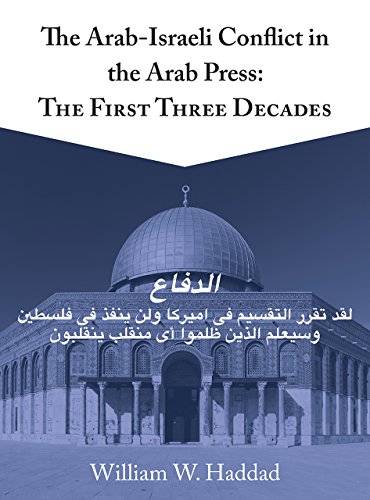
I have attempted to be as accurate as possible in my translations. However, sometimes direct translations from Arabic to English are difficult; for example the second line of the headline on the cover. Therefore I have in some instances translated liberally with the purpose of conveying the meaning if not the exact wording.
The Focus
This manuscript focuses on the Arab-Israeli conflict as seen through opinion pieces and editorials in the Arab print media between 1947 and 1978. It is rare for the defeated in a war to tell their story; this is an attempt to allow the voices of Arab writers to be heard so that we may grasp the perspective of the Arab side in the struggle for Palestine.
The time period was chosen purposefully, from the time of the adoption of the United Nations Partition Resolution until the end of a free press in the countries under examination. As explained in the forward, the papers examined come exclusively from Egypt, Jordan (or Transjordan), Lebanon, Syria, and Palestine.
It is important to emphasize that this study is limited because only one segment of Arab opinion, albeit important, was studied. A further limitation is the issue of literacy: absent subscription and circulation data we cannot be sure how widely disseminated the opinion pieces examined in this study extended. We know that literacy was very low in the Arab states in this study for at least two decades after the Second World War. Nonetheless, I believe the views expressed within newspapers reached the illiterate through oral transmission and informal networks. For example, in my ancestral village of Khirbah Qanafar as well as many other towns, there were literate men who read the newspapers to their communities. More importantly, the newspapers in this study were ordinarily published by political parties, governments, branches of the military and patrons in support of one tendency or another. A reader of a newspaper, for example, al-'Amal in Lebanon, which was the spokesman of the Phalangist Party, would receive the party line and presumably act on this knowledge to disseminate the party's platform. Thus, even though circulation might be small, there was a multiplier effect on public opinion.
Approximately 60 newspapers were examined over three decades. I started reading a newspaper beginning in 1947, and thereafter perused every available issue through the 1978 conclusion of the study. I view this monograph as an historical record of the Arab-Israeli conflict as seen by the losing side. Such an account has not previously been available to non-Arabic speakers.
The Historical Context
Just as the end of the Second World War saw the rising Zionist crescendo that would result in the United Nations Partition Plan for Palestine, Resolution 181 of November 1947 and the subsequent establishment of the State of Israel, so too did it mark the nominal end of the British and French occupation of the Levant. The newly independent states also saw the rise of an independent press. This golden period lasted for slightly more than a decade, until 1958, when the press passed from a relatively free era into a time when it was less independent. This was the year of the unification of Egypt and Syria into the United Arab Republic (UAR), initiating a process that would lead to state control of the press in those two countries. One of the first acts of the president of the UAR, Jamal 'Abd al-Nasir, was to ban all political parties in the Syrian province. As a result, the Syrian press lost much of its income from political subsidies. The Syrian press was also subject to competition from Egyptian papers that were flown to Damascus and sold at a cheaper rate. In this manner, many Syrian newspapers declined precipitously. I calculate that of nineteen Damascene dailies in print prior to unification, only four survived. Moreover, the editorial opinion found in those papers that survived was quite sterile. The demise of the Syrian press was formalized in December 1958 with a presidential order banning a large number of Syrian papers. 1958 was also the year of the first Lebanese civil war, during which the Lebanese press was much less interested in Palestine and Israel than with domestic concerns. The Lebanese government was also less inclined to allow its press to operate freely. Thus, 1958 marks the disappearance in Lebanon, even for a short period, of a free press. In Jordan, the political events of 1957 and 1958 destroyed the free press. Beginning as early as the abortive pro-Egyptian Abu Nuwwar coup in April 1957, the Hashimite Kingdom found itself tempted to stifle dissent in whatever form. The subsequent Egyptian campaign to prevent Jordan's joining Iraq and the West, culminating in the landing of British troops in Jordan three days after the July 14 Iraqi coup and the overthrow of the Hashimite monarchy, provided further inducement to muzzle the press. Between 1958 and 1978, freedom of the press in Jordan all but disappeared and editorials in that country reflected a sad sameness.
What was occurring in Syria and to a lesser extent in Lebanon and Jordan was being reenacted on the Egyptian stage. The revolution of 1952 had promised freedom to that country's press. However, the tradition of party subsidies to newspapers was incompatible with the Egyptian Revolutionary Command Council's (RCC) goal of banning political parties. The steps leading to the demise of the press were similar to those seen in Syria. The government abolished all political parties; the Egyptian press gradually became impoverished and in its death pangs, struck out against the RCC. The regime responded with more controls and...
„Über diesen Titel“ kann sich auf eine andere Ausgabe dieses Titels beziehen.
Suchergebnisse für The Arab-Israeli Conflict in the Arab Press: The First...

Beispielbild für diese ISBN
Arab-Israeli Conflict in the Arab Press
Anbieter: ISD LLC, Bristol, CT, USA
Verkäuferbewertung 5 von 5 Sternen

paperback. Zustand: New. Artikel-Nr. 1935761
Neu kaufen
EUR 34,49
EUR 4,45 Versand
Versand innerhalb von USA
Versand innerhalb von USA
Anzahl: 1 verfügbar
Beispielbild für diese ISBN
The Arab-Israeli Conflict in the Arab Press : The First Three Decades
Anbieter: Buchpark, Trebbin, Deutschland
Verkäuferbewertung 5 von 5 Sternen
Zustand: Hervorragend. Zustand: Hervorragend | Seiten: 280 | Sprache: Englisch | Produktart: Bücher | Keine Beschreibung verfügbar. Artikel-Nr. 31908781/1
Gebraucht kaufen
EUR 47,95
EUR 105,00 Versand
Versand von Deutschland nach USA
Versand von Deutschland nach USA
Anzahl: 1 verfügbar