
Verwandte Artikel zu Understanding Kubrick's 2001: A Space Odyssey :...
Inhaltsangabe
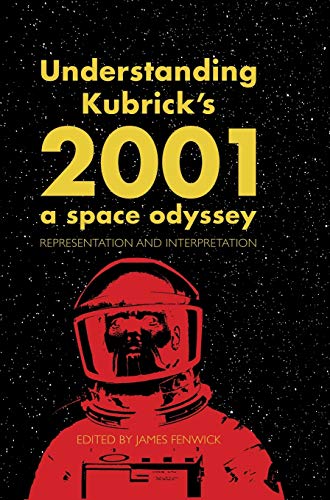
Scholars have been studying the films of Stanley Kubrick for decades. This book, however, breaks new ground by bringing together recent empirical approaches to Kubrick with earlier, formalist approaches to arrive at a broader understanding of the ways in which Kubrick's methods were developed to create the unique aesthetic creation that is 2001: A Space Odyssey. As the fiftieth anniversary of the film nears, the contributors explore its still striking design, vision, and philosophical structure, offering new insights and analyses that will give even dedicated Kubrick fans new ways of thinking about the director and his masterpiece.
Die Inhaltsangabe kann sich auf eine andere Ausgabe dieses Titels beziehen.
Über die Autorin bzw. den Autor
James Fenwick is a senior lecturer in media and communications at Sheffield Hallam University in England.
Auszug. © Genehmigter Nachdruck. Alle Rechte vorbehalten.
Understanding Kubrick's 2001: A Space Odyssey
Representation and Interpretation
By James FenwickIntellect Ltd
Copyright © 2018 Intellect Ltd.
All rights reserved.
ISBN: 978-1-78320-863-0All rights reserved.
Contents
List of Illustrations, ix,
Notes on Contributors, xi,
Acknowledgements, xv,
Notes on the Text, xvii,
Introduction: Forging new perspectives James Fenwick, 1,
Part One: Narrative and Adaptation, 13,
Chapter One: 'God, it'll be hard topping the H-bomb': Kubrick's search for a new obsession in the path from Dr. Strangelove to 2001: A Space Odyssey Simone Odino, 17,
Chapter Two: 2001: A Space Odyssey: A transcendental trans-locution Suparno Banerjee, 33,
Chapter Three: Four-colour Kubrick: Jack Kirby's 2001: A Space Odyssey as adaptation and extension Dru Jeffries, 45,
Part Two: Performance, 59,
Chapter Four: Performing the man-ape in 'The Dawn of Man': Daniel Richter and The American Mime Theatre James Fenwick, 63,
Chapter Five: Life functions terminated: Actors' performances and the aesthetics of distanced subjectivity in 2001: A Space Odyssey Vincent Jaunas, 79,
Part Three: Technology, 95,
Chapter Six: From technical to cinematographic objects in 2001: A Space Odyssey Antoine Balga-Prévost, 99,
Chapter Seven: Homo machinus: Kubrick's two HALs and the evolution of monstrous machines Cynthia J. Miller and A. Bowdoin Van Riper, 115,
Part Four: Masculinity and the Astronaut, 129,
Chapter Eight: Clarke and Kubrick's 2001: A queer odyssey Dominic Janes, 133,
Chapter Nine: 'But as to whether or not he has feelings is something I don't think anyone can truthfully answer': The image of the astronaut in 2001: A Space Odyssey and its lasting impact Nils Daniel Peiler, 151,
Part Five: Visual Spectacle, 163,
Chapter Ten: Negative/Positive: Metaphors of photography in 2001: A Space Odyssey Caterina Martino, 167,
Chapter Eleven: The sublime in 2001: A Space Odyssey Rachel Walisko, 181,
Part Six: Production, 197,
Chapter Twelve: 2001: A comprehensive chronology Filippo Ulivieri, 201,
Appendix One: Stanley Kubrick filmography, 225,
Appendix Two: 2001: A Space Odyssey film credits, 227,
Notes, 229,
Bibliography, 239,
Index, 261,
CHAPTER 1
'God, it'll be hard topping the H-bomb': Kubrick's search for a new obsession in the path from Dr. Strangelove to 2001: A Space Odyssey
Simone Odino
When Dr. Strangelove was released in the United States on 29 January 1964, Stanley Kubrick was already considered one of the most interesting directors in the film industry. Regarded by the press as author of controversial, unconventional films, his nightmare comedy had garnered considerable attention for its original approach on the topic of nuclear war. In the round of publicity interviews surrounding the release of the film, therefore, many of the questions revolved around his creative process and what his next project would be. On one of these occasions Kubrick answered,
I haven't found anything I can get so obsessed with. It takes me two years: that's too big a commitment for something that may suddenly go flat [...] there's no reason to do it my way unless you are, as I said, obsessed. You must be obsessed.
(McGrady 1964: 3c)
Kubrick was referring to his distinctive authorial style, which made him the prototype of the 'total filmmaker'. As he said, 'making a film starts with the germ of an idea and continues through script, rehearsing, shooting, cutting music projection, and tax-accountants' (Southern 1962: 343). The problem to find a so-called obsession was therefore related to the considerable effort needed to put a story on screen. The director often claimed it was never easy for him to find something that would prove to be interesting in the long run, and to better illustrate this crucial point he used to employ a romantic (and fatalistic) comparison: 'Finding a story which will make a film is a little like finding the right girl. It's very hard to say how you do it, or when you're going to do it. Some stories just come from a chance thing' (Bean 1963: 12).
Kubrick had first hinted at what his new love interest would be in an interview on 3 February 1964 that revealed how he was 'fascinated by outer space, which he thinks is inhabited, and he is reading and reading and reading about it' (Anon. 1964a: 80). Tackling a topic by researching it exhaustively was already the method of choice for the director; for Dr. Strangelove, he had immersed himself in years of research into the topic of nuclear warfare, a long-time obsession of his, reading in the process 'almost every available book on the nuclear situation' (Southern 1963: 29).
Kubrick's mention of outer space immediately led to speculation by the trade press, and the April 1964 issue of Show Magazine attached the director's name to an 'untitled story of extra-terrestrial life' (Anon. 1964b). Still, it would take until December 1964 for Kubrick to officially go on the record, in an interview with journalist and friend Alexander Walker:
His next film will have what he admitted (with obvious feat that he was saying too much) is a 'futuristic plot'. He is co-scripting it with Arthur C. Clarke, the scientist explorer [...]. His coal-black eye twinkled, then he said with almost presidential gravity: 'But God, it'll be hard topping the H-bomb'.
(Walker 1964)
The caution he used and the solemn tone of the last sentence suggest a sort of performance anxiety not usually associated with Kubrick's public persona. However, one should be aware that by December 1964 the director had spent the best part of the previous eight months in daily brainstorming sessions with Arthur C. Clarke, struggling to produce a completely original plot, an effort that he had not undertaken since Killer's Kiss. Kubrick's career up to that point had been characterized by a series of rejections from major studios and continual difficulties in having his projects green-lighted, as the director himself recalled years later:
Up until A Clockwork Orange, there wasn't a single producer who was prepared to produce my films. For example, MGM only took on 2001 at the last minute; no one wanted it. [...] The same thing for Dr. Strangelove, it was turned down by all the studios.
(Heymann 1987: 478)
It is against this complicated background that the director started his path towards 2001, whose starting point is traditionally identified in a chance encounter with Roger Caras on 17 February 1964, a lunch during which Kubrick revealed his intention to follow Dr. Strangelove with 'something about extraterrestrials' (McAleer 1992: 190–91), to which Caras suggested the director contact his friend Arthur C. Clarke.
I think that a small step back is needed, though, to better understand the artistic decisions taken in the conception and production of the movie that would, eventually, 'top the H-bomb'. The period between the post-production of Dr. Strangelove (late 1963) and the director's commitment with Clarke (the two signed a deal on 20 May 1964 (McAleer 1992: 195–97) has, to date, received scarce scholarly attention. Such neglect is surprising given that in the relatively short space between late 1963 and spring 1964, the director was apparently offered a movie project about overpopulation, was nearly co-opted onto a United Nations-funded TV-series, and optioned the rights of a science-fiction radio drama about an invasion...
„Über diesen Titel“ kann sich auf eine andere Ausgabe dieses Titels beziehen.
Suchergebnisse für Understanding Kubrick's 2001: A Space Odyssey :...

Beispielbild für diese ISBN
Understanding Kubrick's 2001: A Space Odyssey
Anbieter: PBShop.store UK, Fairford, GLOS, Vereinigtes Königreich
Verkäuferbewertung 5 von 5 Sternen

HRD. Zustand: New. New Book. Shipped from UK. Established seller since 2000. Artikel-Nr. CX-9781783208630
Neu kaufen
EUR 87,33
EUR 5,94 Versand
Versand von Vereinigtes Königreich nach USA
Versand von Vereinigtes Königreich nach USA
Anzahl: 15 verfügbar
Beispielbild für diese ISBN
Understanding Kubrick's 2001: A Space Odyssey
Anbieter: PBShop.store US, Wood Dale, IL, USA
Verkäuferbewertung 5 von 5 Sternen
HRD. Zustand: New. New Book. Shipped from UK. Established seller since 2000. Artikel-Nr. CX-9781783208630
Beispielbild für diese ISBN
Understanding Kubrick's 2001: A Space Odyssey: Representation and Interpretation
Anbieter: Ria Christie Collections, Uxbridge, Vereinigtes Königreich
Verkäuferbewertung 5 von 5 Sternen
Zustand: New. In English. Artikel-Nr. ria9781783208630_new
Neu kaufen
EUR 112,17
EUR 13,36 Versand
Versand von Vereinigtes Königreich nach USA
Versand von Vereinigtes Königreich nach USA
Anzahl: Mehr als 20 verfügbar