
Verwandte Artikel zu Dramaturging Personal Narratives: Who am I and Where...
Inhaltsangabe
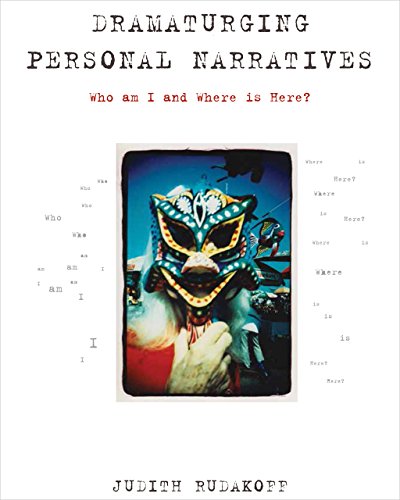
How do people identify, locate or express home? Many all over the world grapple with this question. This book explores the relationship between personal and cultural identity by investigating how people perceive and creatively express self, home and homeland through showcasing a variety of innovative artistic processes and resulting projects.
Die Inhaltsangabe kann sich auf eine andere Ausgabe dieses Titels beziehen.
Über die Autorin bzw. den Autor
Judith Rudakoff has worked as a dramaturg with emerging and established playwrights throughout Canada and internationally for three decades. A member of Literary Managers and Dramaturgs of the Americas, and the Playwrights Guild of Canada, she is professor of theater at York University in Toronto, Canada.
Auszug. © Genehmigter Nachdruck. Alle Rechte vorbehalten.
Dramaturging Personal Narratives
Who am I and Where is Here?
By Judith RudakoffIntellect Ltd
Copyright © 2015 Intellect Ltd
All rights reserved.
ISBN: 978-1-78320-419-9All rights reserved.
Contents
Acknowledgements, vii,
Introduction,
Dramaturging Personal Narratives: Who am I and Where is Here?, 1,
Section One: The Ashley Plays,
The Ashley Plays: The Basics, 25,
Chapter 1: Ashley Lives in Cape Town, South Africa I (2002), 29,
Chapter 2: Ashley Lives in Cape Town, South Africa II (2006), 45,
Chapter 3: Ashley Lives in Cape Town, South Africa III (2006), 67,
Chapter 4: Ashley Lives in Iqaluit, Canada (2006), 85,
Chapter 5: Ashley Lives in Namma Bhoomi, India (2008), 99,
Chapter 6: Ashley Lives in Whitehorse, Canada (2008), 135,
Section Two: The Virtual Ashley Plays,
The Virtual Ashley Plays: The Basics, 167,
Chapter 1: Ashley Lives in Canada, Iran, South Africa, and United Kingdom (2007), 171,
Chapter 2: Ashley Lives in Cuba, Canada, and USA (2007), 189,
Chapter 3: Ashley lives in Cameroon, Jamaica, India, Iran, Iraq, Israel, and South Africa (2008), 199,
Chapter 4: Common Ground Forum: "Talking ABOUT Ashley" and "Talking AS Ashley" (2007), 207,
Section Three: Photobiography,
Photobiography: The Basics, 227,
Chapter 1: Iqaluit, Nunavut, Canada and Khayelitsha Township, South Africa (2007), 231,
Chapter 2: Whitehorse, Canada (2010), 243,
Section Four: Roots/Routes Journeys to Home,
Roots/Routes Journeys to Home: The Basics, 249,
Chapter 1: Journey I: Geoffrey Hyland, South Africa (2008), 255,
Chapter 2: Journey II: Mfundo Tshazibane, South Africa (2007), 271,
Chapter 3: Journey III: Mercedes Bravo, Cuba (2008), 285,
Chapter 4: Journey IV: Jolene Arreak, Canada (2007), 297,
Appendix: 35 Sample Lomogram images, 313,
CHAPTER 1
Section One
The Ashley Plays: The Basics
In this section I will introduce the basic method for creating The Ashley Plays, and then document and analyze examples of cycles created between 2002 and 2008. Some of these cycles were performative, others non-performative, and still others a combination of the two formats. Some cycles were disseminated through live interaction and others through electronic transmission. The live Ashley cycles have been created with group-generated plays as well as one-person performances.
As explained in the Introduction, The Ashley Plays, a cycle of short original plays, provide a form for the telling of personal narratives. While the plays in each cycle are not linked by a linear narrative, a common theme or question informs each play. Most often, this theme relates to the exploration of home.
The Ashley Plays are meant to encourage expression of personal voice and individual narrative, so work can emerge in a wide variety of genres and styles.
For all types of Ashley cycles, there is no director. There is, instead, a dramaturg. In consultation with the dramaturg, the participants begin by choosing a specific date and time as the setting for their plays. They then research and generate an outline of events from global, national, regional, and local contexts as a resource for delineating the shared world of the plays in the cycle.
A profile of provocative characteristics is then collaboratively created to inspire the basic development of a character named Ashley, who will evolve and vary in each play. At least three of the characteristics from the profile must inform each Ashley, and no characteristics may be contradicted.
Each play must be about Ashley, who may be male, female, transgender, inanimate, or a genderless spirit. Ashley need not be an actual character in the play, but the plot must focus on Ashley.
Dramaturgical development of the cycle can vary according to the time available and plays can range from three minutes to fifteen minutes in length.
For live, performative cycles, the dramaturg selects an appropriate amount of sites for the number of plays in the cycle and assigns one site to each playwright or group. These sites must be incorporated into the narrative of each play. There should be no lighting or sound support at the sites except that which is ambient. Further, the integrity of each site must be maintained: a kitchen must be a kitchen; a stairwell must be a stairwell.
In the case of live performance, audiences are divided into smaller pods which move from site to site in a prescribed viewing order. This requires multiple performances of each play in the cycle, and a predetermined set of viewing sequences. These sequences must give performers time to re-set their site between showings, and avoid the collision of travelling audience pods. Cycles can also be performed and recorded, and then uploaded to a dedicated website. Non-performative cycles, comprised of narrative text, photographs or short videos, can be viewed live, as a type of installation in a gallery setting, or they too can be uploaded to a website. The design of online cycles offers a multitude of possibilities for spectators, from random access to prescribed viewing order.
Chapter 1
Ashley Lives in Cape Town, South Africa I
This presentation of The Ashley Plays was a live, devised play performance cycle which brought together nineteen students from different cultural, racial, and economic backgrounds during a five-week residency I undertook at University of Cape Town, South Africa, in April and May 2002. I worked with second and third year undergraduate students in the Theatre-Maker Stream of the BA (Theatre), and graduate students in MA (Playwriting) at University of Cape Town (UCT). The Ashley Plays were performed twice, at 11:00 a.m. and at 4:00 p.m., on Saturday May 1, 2002 at five locations on the Hiddingh Campus, a satellite campus of the University of Cape Town.
Cape Town is the southern-most metropolitan centre on the African continent, located at latitude 33.55° s and longitude 18.27° e. Theatre director and professor at UCT, Dr. Mark Fleishman, has described the city thusly:
Cape Town is a city of migrants, immigrants, colonists, slaves, tourists, investors, hunters and gatherers, always coming from somewhere else; always passing through; just on the verge of belonging; not destined to stay. Cape Town has many physical features that identify it. The meeting of two oceans for example. But it is the chain of mountains that is its single most dominant feature. The flat-topped Table Mountain at the centre with its famous tablecloth; the pointed Devil's Peak on which Van Hunks and the devil are rumoured to smoke up a storm when the wind shifts south-west; the Lion's Head with its reclining feline cap; and the Hottentot's Holland in the distance forming a barrier to the interior, the great expanse of the African continent beyond.
Participants in this cycle did not possess the same degree of linguistic fluency in English, Afrikaans, Xhosa, Zulu, or any other primary languages spoken in the region. While they held relatively few common perspectives on recent and current events in South Africa, there were points of intersection: even the most distinctly different people in the group opposed such obvious negatives as violent crime, AIDS/HIV transmission, and bureaucratic or governmental corruption. Academic levels also varied: some of the participants were part of a university programme that required them to demonstrate academic proficiency along with artistic progress in conservatory classes...
„Über diesen Titel“ kann sich auf eine andere Ausgabe dieses Titels beziehen.
Suchergebnisse für Dramaturging Personal Narratives: Who am I and Where...

Beispielbild für diese ISBN
Dramaturging Personal Narratives
Anbieter: PBShop.store UK, Fairford, GLOS, Vereinigtes Königreich
Verkäuferbewertung 5 von 5 Sternen

PAP. Zustand: New. New Book. Shipped from UK. Established seller since 2000. Artikel-Nr. CX-9781783204199
Neu kaufen
EUR 52,11
EUR 5,94 Versand
Versand von Vereinigtes Königreich nach USA
Versand von Vereinigtes Königreich nach USA
Anzahl: 15 verfügbar
Beispielbild für diese ISBN
Dramaturging Personal Narratives
Anbieter: PBShop.store US, Wood Dale, IL, USA
Verkäuferbewertung 5 von 5 Sternen
PAP. Zustand: New. New Book. Shipped from UK. Established seller since 2000. Artikel-Nr. CX-9781783204199
Beispielbild für diese ISBN
Dramaturging Personal Narratives: Who Am I and Where Is Here?
Anbieter: Ria Christie Collections, Uxbridge, Vereinigtes Königreich
Verkäuferbewertung 5 von 5 Sternen
Zustand: New. In English. Artikel-Nr. ria9781783204199_new
Neu kaufen
EUR 66,78
EUR 13,36 Versand
Versand von Vereinigtes Königreich nach USA
Versand von Vereinigtes Königreich nach USA
Anzahl: Mehr als 20 verfügbar